



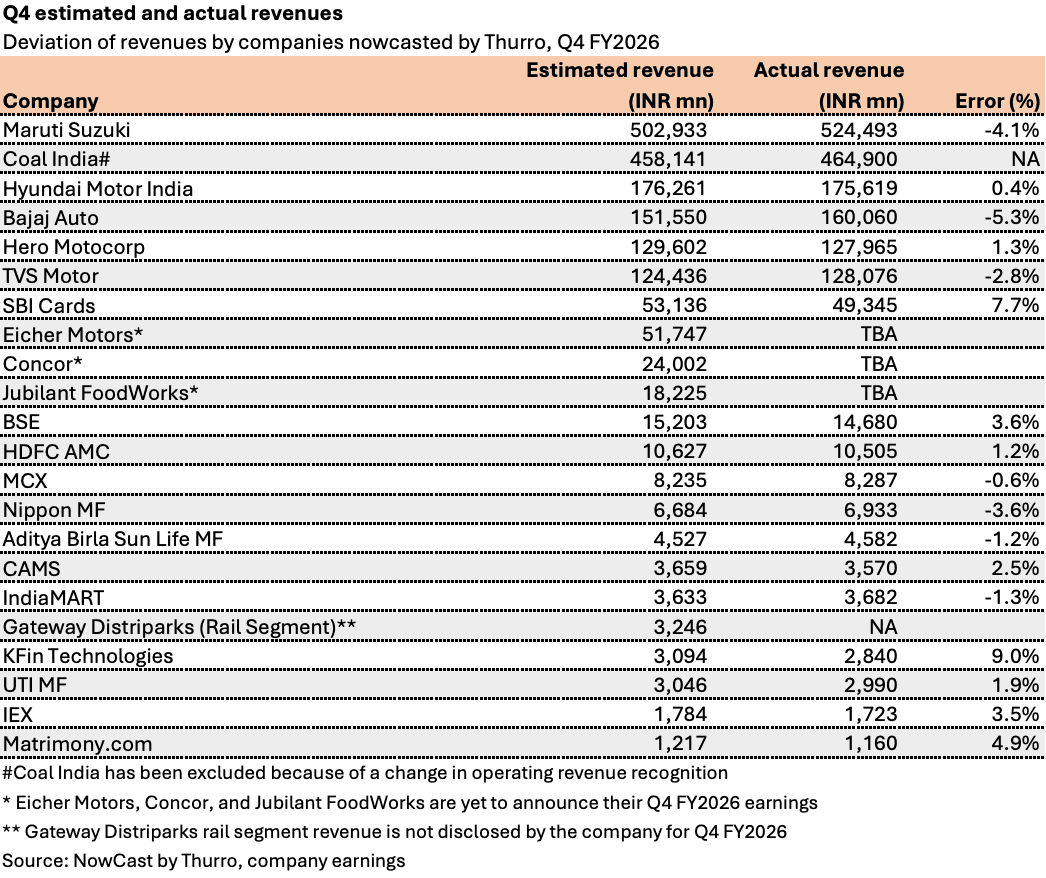
We are in the middle of the Q4 FY2026 earnings season. So far, looking at the earnings reported by 18 of the 22 companies tracked by Thurro’s NowCast, the framework has continued to deliver disciplined forecast accuracy, with the vast majority of forecasts remaining within the tolerance band. Concor, Eicher Motors, and Jubilant FoodWorksare yet to announce their Q4 FY2026 earnings.
The quarter, however, was meaningfully tougher than Q3 FY2026. Error dispersion widened, and the standard deviation of forecast errors rose from 2.5% in Q3 FY2026 to 3.9% in Q4 FY2026. Yet the average error remained tightly anchored at 1%, indicating that while a handful of companies saw larger deviations, the framework itself did not develop a systematic bias.
Forecasting systems often deteriorate not because of a broad collapse in methodology, but because a small number of sectors or companies experience temporary disruptions in operational data, pricing signals, or accounting treatment. Q4 FY2026 reflected precisely that dynamic.
The larger takeaway from the quarter was that the framework stayed directionally disciplined even as the operating environment became harder to predict.
Q4 FY2026: a challenging quarter
Across the 22 companies tracked during Q4 FY2026, most forecasts remained clustered within a relatively tight deviation band. The widening in dispersion, however, was concentrated in a small number of companies.
KFin Technologies recorded a deviation of 9.0%, while SBI Cards came in at 7.7%. Among automobile companies, Bajaj Auto and Maruti Suzuki saw deviations of -5.3% and -4.1%, respectively. Coal India also saw a larger-than-usual variation during the quarter.
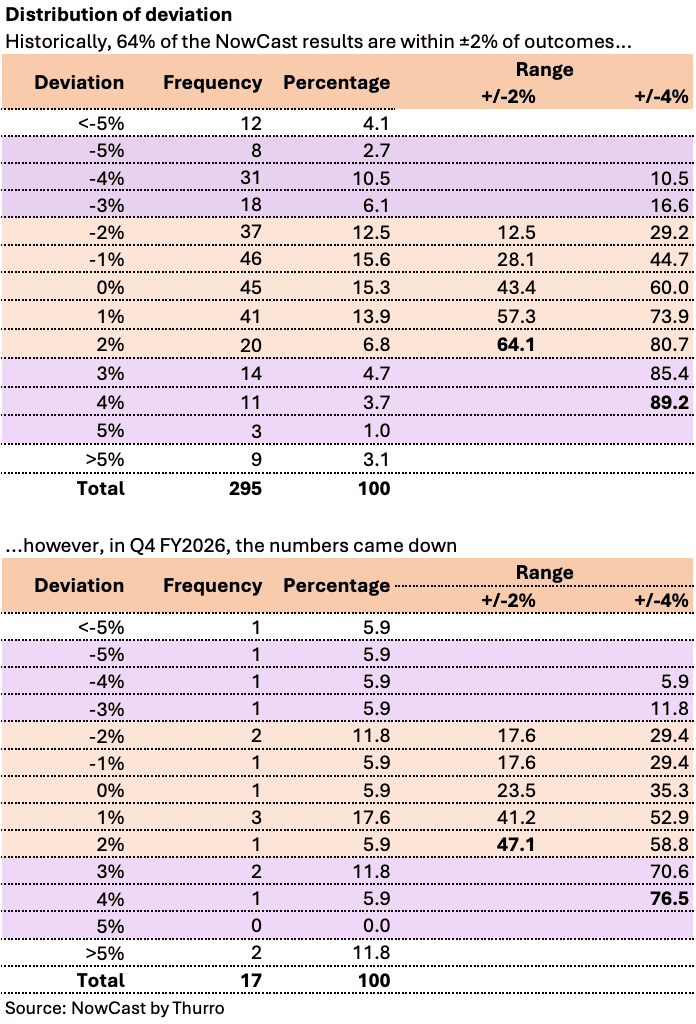
Yet even with these outliers, the broader distribution remained stable. Over the full history of the framework since Q3 FY2023, around 64% of forecasts have landed within a ±2% band, and 89.2% have remained within ±4%.
However, in Q4 FY2026, the share of forecasts within the tighter tolerance bands declined, with 47.1% of forecasts remaining within a ±2% band and 76.5% within a ±4% band.
More importantly, the average error across quarters has consistently remained close to zero, suggesting that the framework’s errors are noisy rather than directionally biased.
The underlying reasons for the wider Q4 FY2026 dispersion were highly specific and operational in nature. One such example was the automobile sector. NowCasting the revenues of automobile companies relies heavily on both volume and pricing data.
While volume data for the quarter was available on schedule, the government source used for automotive pricing data developed irregular disclosure timelines during the quarter. As a result, some forecasts were generated before the latest pricing information became available, directly affecting the accuracy of several automotive nowcasts during the quarter.
Waiting for the March-quarter pricing disclosures would have materially reduced the usefulness of the real-time NowCast itself. The quarter has also reinforced the importance of building resilience across alternate data pipelines. Thurro is now working towards integrating a wider range of private-sector pricing indicators so that when one operational data source becomes unreliable or unavailable, alternative pipelines can still support the framework.
The broader learning from the quarter was that resilient nowcasting systems require not just strong models, but also redundancy and adaptability across the underlying data architecture.
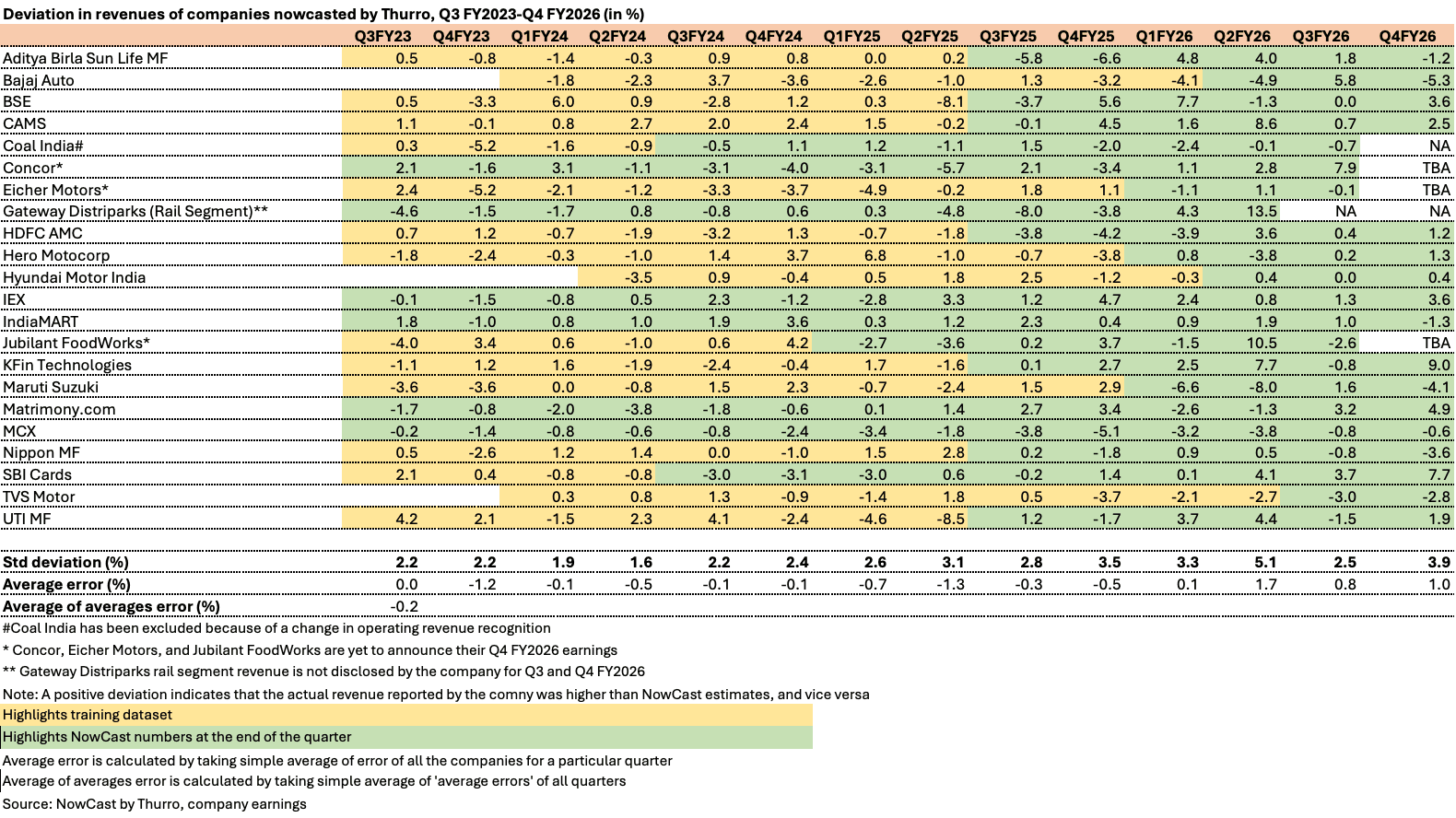
Another challenge emerged in the case of Coal India, which changed the recognition of operating revenue during the quarter. As a result, the reported numbers were not directly comparable with the historical relationships on which the model had been trained.
Accordingly, Coal India has been excluded from the quarter’s comparable forecast deviation. The model has since been updated to reflect the revised reporting structure.
While such accounting changes are relatively rare, they remain important structural events for real-time forecasting systems to identify and adapt to quickly.
The quarter also reinforced the importance of continuously expanding and refining model variables. In some cases, relevant alternate data indicators had not yet been fully incorporated into the modelling framework. In others, the required alternate indicators themselves were not yet available within the data architecture. These learnings are now being integrated into the next iteration of the models.
The important point is that these were identifiable and explainable deviations. The quarter did not see a generalized deterioration across all companies or sectors. Instead, a small number of company-specific and data-specific issues drove most of the increase in variation.
Data and models
NowCast by Thurro relies on hard data, sophisticated modelling, and advanced algorithms. The objective is not merely to reduce average forecasting error, but also to maintain stability and discipline across different sectors and operating environments.
Short-term business trajectories can shift rapidly because of regulatory changes, evolving competitive dynamics, pricing movements, seasonality, or broader macroeconomic conditions. Investors attempting to track these shifts in real time often rely on fragmented disclosures, management’s commentary, channel checks, and brokerage research. NowCast by Thurro is designed to bridge this information gap.
The framework draws upon publicly available operational datasets that function as leading indicators of revenue. These “core alternative datasets” are paired with additional variables such as pricing trends, inflation, macroeconomic indicators, and sector-specific operational metrics to generate company-level nowcasts.
The key insight is that there is no one-size-fits-all framework. Each company requires a bespoke model built around the specific operational structure of its business. Market infrastructure companies, for example, rely on very different data architectures compared to automobile manufacturers or logistics companies.
The consistency of the framework over time depends not only on modelling sophistication, but also on the stability, granularity, and continuity of the underlying alternate data itself.
Learnings from a tough quarter
Q4 FY2026 reinforced an important reality about nowcasting: forecasting accuracy is ultimately a function not just of modelling sophistication, but of the stability and continuity of the underlying operational data.
The quarter demonstrated how even temporary disruptions in pricing visibility or changes in financial reporting structures can widen forecast dispersion despite the broader framework remaining stable. Crucially, these deviations remained identifiable, explainable, and concentrated in a small number of companies.
More importantly, the quarter reinforced that production-grade nowcasting is not simply a matter of applying AI models to large datasets. Real-time forecasting requires continuous human oversight, source validation, operational interpretation, and judgment around structural breaks in the underlying data.
As the coverage universe expands across sectors and business models, maintaining data integrity, validating source continuity, and identifying operational anomalies become as important as the models themselves.
Taken together, the quarter reinforced that production-grade nowcasting systems evolve continuously through operational feedback, structural breaks, and the ongoing refinement of both data pipelines and modelling frameworks.
What’s next?
The Thurro NowCast universe continued to expand during the quarter. In Q4 FY2026, we added two companies to the Thurro NowCast universe: ICICI Prudential AMC and Canara Robeco AMC. These companies remain in the testing and validation stage and were, therefore, not included in the active nowcasting set for the quarter. The framework is expected to begin publishing forecasts for these companies in the coming quarters once the models achieve the required stability thresholds.
The onboarding process, however, remains deliberately selective. Companies are added only when the team is able to identify stable, granular, and continuous datasets for both prices and volumes over a sufficiently long historical period. While this appears straightforward in theory, the practical challenge is significantly harder. In many cases, one of the datasets is unavailable. In others, the data appears stable initially but later breaks because of reporting inconsistencies, methodology changes, or missing historical continuity.
This is why the framework remains concentrated in sectors where high-frequency operational datasets are relatively stronger and more reliable, including automobiles, asset management companies, exchanges, and market infrastructure businesses.
The ambition, however, remains unchanged: to continue expanding the universe of companies while maintaining forecasting discipline and methodological robustness. The objective is not simply to increase coverage, but to build a scalable real-time framework for understanding how listed companies are performing before earnings season fully reveals the answer.
The analysis reflects company commentary and disclosures rather than an independent assessment of geopolitical developments.
Cover photo credit: AI generated image
View disclaimer
Unlock the power of alternative data
Do not just follow the market — stay ahead of it. Thurro helps you transform raw filings and alternative datasets into actionable insights.
Explore Thurro AltData Book a demoRelated Articles
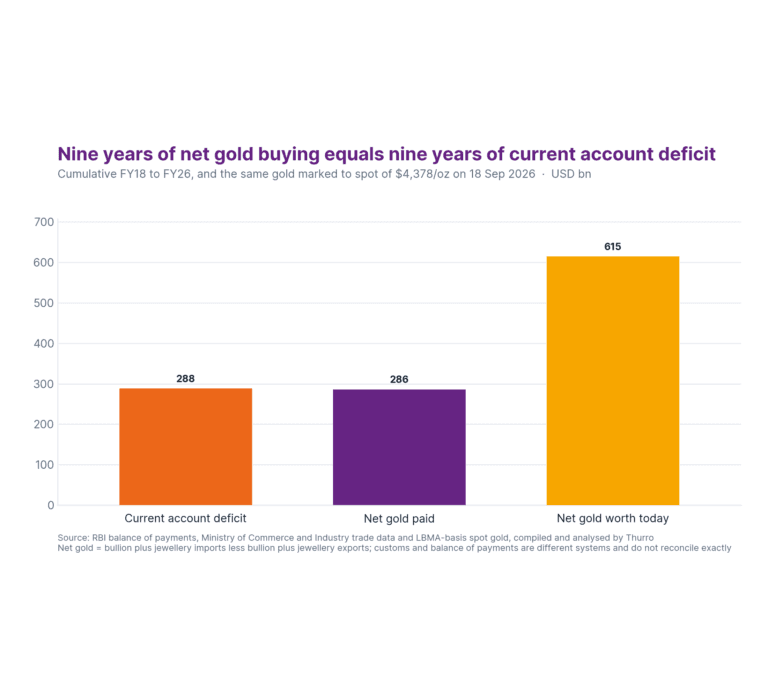
Nine years of net gold buying equals nine years of current account deficit — and it has doubled in value
India paid out $286bn for net gold between FY18 and FY26. Its cumulative current account deficit over the…
The UPI MDR pool is about ₹1,000 crore a month, and two-thirds of it sits where nobody can see it
Parliament has cleared the way for merchant charges on UPI. The merchant-category data says the revenue is real…
India’s commodity trade is running on price, not volume
India's trade value is still climbing — imports up about 18 percent and exports about 8 percent in…