



The first signs of stress did not appear in oil prices. They appeared in exchange filings.
Within weeks of the US attack on Iran and the subsequent closure of the Strait of Hormuz, Indian companies across chemicals, aviation, logistics, and engineering began disclosing force majeure events, shipment disruptions, raw material shortages, and margin pressure. Rating agencies responded before earnings deterioration had fully appeared.
The disruption exposed a widening divide across industry. Companies with index-linked contracts, regulatory pass-through support, diversified sourcing networks, or structurally high margins absorbed the shock relatively well. Firms dependent on imported feedstock, fixed contracts, or regulated pricing structures struggled to protect margins.
Thurro’s analysis of earnings calls, management commentary, investor presentations, credit rating actions, exchange disclosures, and SEBI Reg 30 filings across 25 Indian-listed companies between April 2025 and May 2026 suggests the conflict became less a sectoral shock and more a stress test of pricing power, logistics resilience, and operational adaptability. The companies referenced explicitly discussed operational, pricing, freight, fuel, currency, or supply-chain impacts linked to the disruption.
The dataset is illustrative rather than exhaustive. The analysis began by screening Q4 FY2026 earnings calls and disclosures for references to the Iran-Israel conflict and the Strait of Hormuz, before grouping companies across multiple lenses including pricing power, operational disruption, freight exposure, rating actions, and supply-chain resilience. Similar workflows can be used across the Thurro knowledge base to identify additional companies, sectors, and second-order effects linked to geopolitical or commodity shocks.
Energy and logistics at the epicentre
The closure of the Strait of Hormuz changed the nature of the disruption. The issue was no longer confined to tanker rerouting or temporary freight volatility. It became a broad energy, shipping, and supply-chain shock that spread across sectors.
Reliance Industries, in its post-Q4 FY2026 earnings conference call on 26 April, described the disruption as the largest oil supply interruption management had tracked, with Hormuz transit volumes collapsing sharply during the peak of the crisis. The company said it diversified crude sourcing and rearranged loading contracts to maintain refinery throughput despite significant Middle East exposure.
Meanwhile, Chennai Petroleum maintained refinery utilisation at 111% in Q4 FY2026 and 112% for the full year through alternate sourcing, spot purchases, and continued coordination with suppliers. During the company’s Q4 FY2026 earnings call on 28 April, CFO Rohit Agrawala said roughly 55–60% of crude supply continued under term contracts, while additional requirements were met through spot procurement despite the disruption.
Oil India emerged as one of the clearest beneficiaries of the disruption because of the diesel-heavy product mix at Numaligarh Refinery, where diesel accounts for roughly 65–70% of output. During Oil India’s Q3 FY2026 analyst meet on 11 February, management said diesel cracks had risen to nearly USD 24 per barrel during the quarter, helping the refinery report a gross refining margin of USD 16 per barrel while operating above 100% utilisation. Management also highlighted an additional USD 2–4 per barrel cost advantage from pipeline transportation and the ability to process cheaper crude blends.
The split within oil and gas illustrated the broader pattern across industry. The same macro shock produced very different outcomes depending on product mix, sourcing flexibility, and pricing structure.
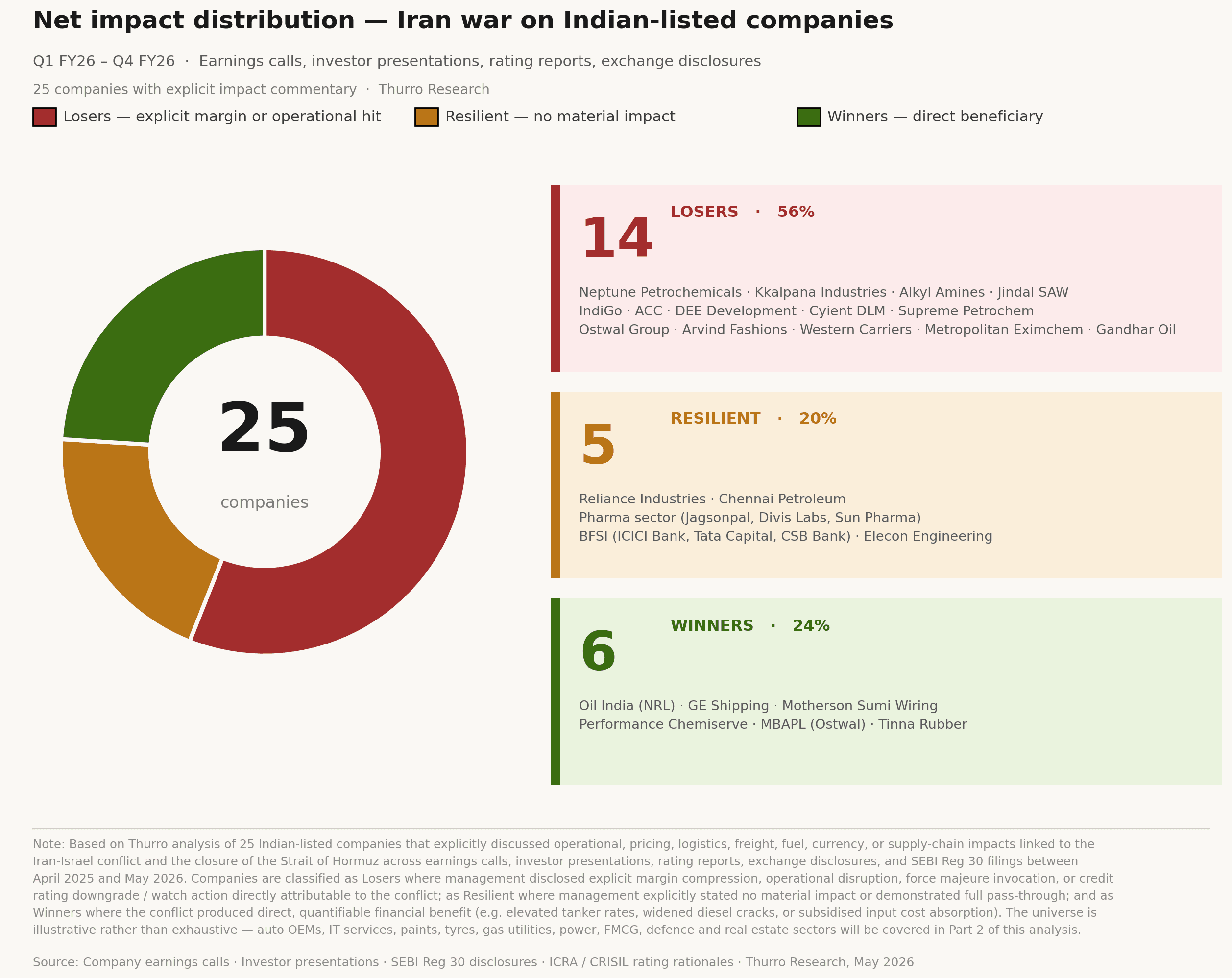
Impact of the Iran war on listed Indian companies
The strongest beneficiaries were companies exposed to freight rates, diesel margins, or flexible pricing structures.
Great Eastern Shipping benefited from the sharp rise in tanker rates during the disruption, particularly in crude and LPG shipping. Management commentary through FY2026 showed the company maintained close to 100% utilisation across its fleet while retaining significant spot-market exposure that allowed it to capture the rate spike.
During Great Eastern Shipping’s Q3 FY2026 earnings call in February, CFO G. Shivakumar said average Suezmax tanker rates rose to USD 58,691 per day during the first nine months of FY2026 from USD 44,517 a year earlier, while very large gas carrier rates increased to USD 55,284 per day, up 37% year-on-year. Management also said crude shipping had emerged as the strongest-performing segment during the year as freight markets tightened following rerouting and vessel dislocation.
The company continued expanding its fleet through the disruption. On 1 April 2026, Great Eastern Shipping acquired a 2014-built medium-range tanker with carrying capacity of 49,420 deadweight tons, following the earlier delivery of the Suezmax tanker Jag Laadki in October 2025. By Q4 FY2026, the company’s fleet had expanded to 40 vessels, including 26 tankers and 14 dry bulk carriers, while debt-to-equity remained low at 0.08x.
Motherson Sumi Wiring represented a different kind of resilience story. During the company’s Q1 FY2026 earnings call on 12 September 2025, management said earlier Red Sea disruptions had already pushed the company to redesign parts of its logistics network, including building a proprietary logistics technology stack and establishing on-ground coordination teams across geographies.
Management said those changes helped reduce third-party logistics costs to roughly 12% below historical averages despite continued shipping disruption. Alternate UAE–Jeddah–Europe routing also reduced transit time by roughly 50% compared with the Cape of Good Hope route.
Triple shock for aviation
InterGlobe Aviation, which operates IndiGo, illustrated how quickly the disruption transmitted across fuel, currency, and network operations simultaneously.
Within weeks of the escalation, both ICRA and CRISIL placed the airline’s ratings on watch with negative implications as higher fuel costs, rerouting, and currency depreciation began affecting profitability.
At the same time, aviation turbine fuel prices rose sharply. Rating reports cited by the company said aviation turbine fuel prices had risen more than 130% during the peak of the disruption, while Brent crude prices rose roughly 60–70%. Fuel accounts for roughly 35–40% of IndiGo’s operating costs.
Currency pressures compounded the impact. The rupee weakened from roughly 91 per US dollar in December 2025 to around 93.5–94/USD during the peak of the disruption, increasing the cost of aircraft rentals, maintenance, and other USD-linked expenses, which account for another 35–40% of operating expenditure.
Unlike refiners or shipping companies, airlines had limited pass-through flexibility. IndiGo introduced fuel surcharges on 1 April 2026 ranging from INR 275 to INR 950 on domestic routes and up to INR 10,000 on Europe routes, but rating agencies said fare increases only partially offset the rise in costs.
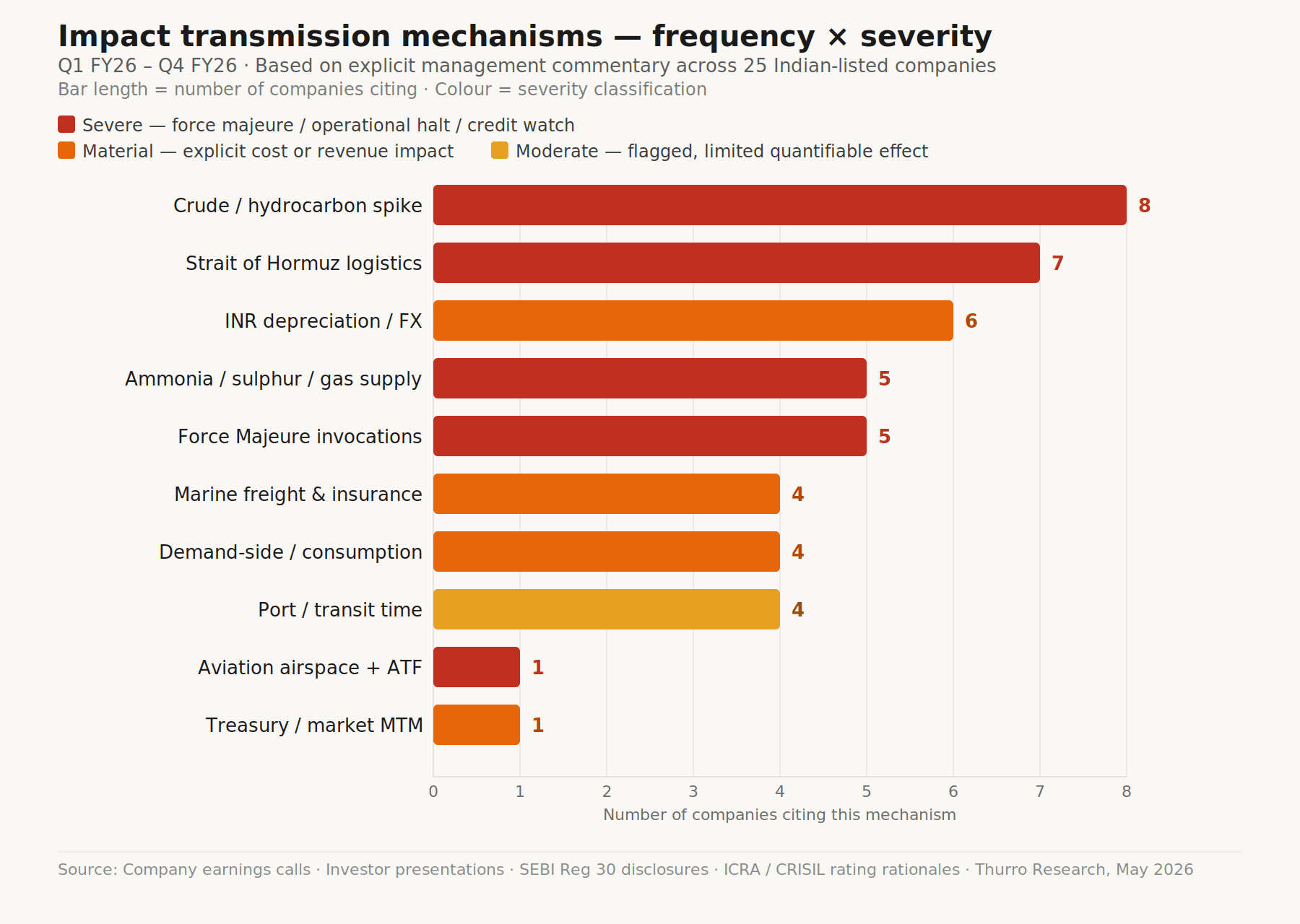
How the disruption spread across sectors
The aviation sector highlighted a broader pattern visible across industries: operational exposure alone did not determine outcomes.
The force majeure cluster
The sharpest operational disruptions emerged in chemicals and petrochemicals, where multiple companies disclosed force majeure events, production interruptions, or raw material shortages within weeks of the escalation.
Neptune Petrochemicals issued two disruption disclosures on 24 and 27 March, saying the conflict had adversely affected production cycles and reduced sales volumes. On 8 April, Kkalpana Industries invoked force majeure after disruptions in Middle East supply chains led to shortages of critical raw materials.
Alkyl Amines disclosed disruptions in ammonia-linked operations on 16 March before gradually restarting production by late April. During the company’s April 2026 commentary, Managing Director Kirat Patel said sanctions and restrictions linked to Iran-connected petrochemical flows had disrupted ammonia availability and redirected supply routes through China.
The sector’s vulnerability reflected India’s dependence on imported feedstock, ammonia, sulphur, and petrochemical inputs connected to Middle East supply chains. However, outcomes within chemicals still diverged depending on pricing flexibility and sourcing capability.
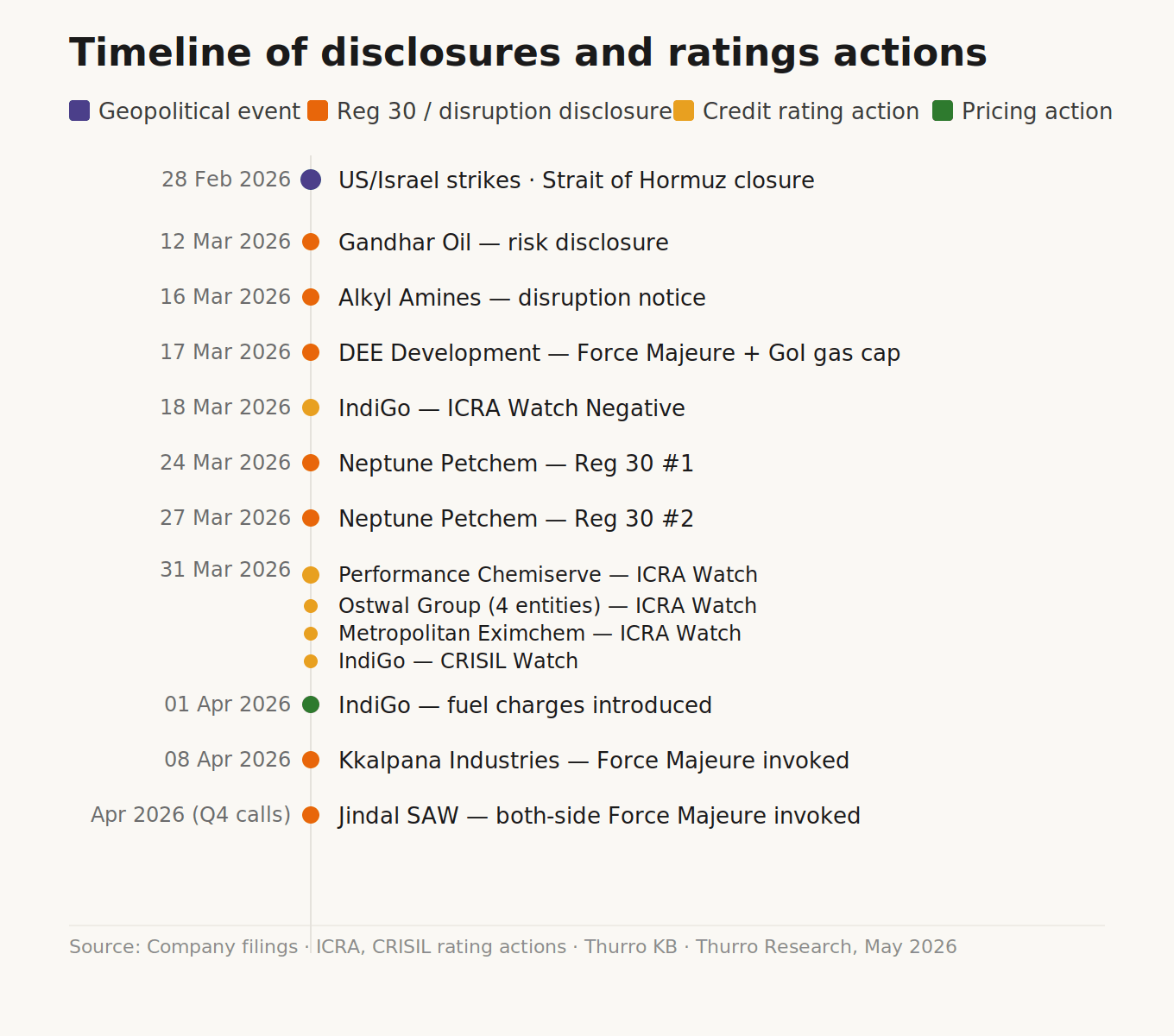
Force majeure notices and rating actions accelerated after escalation
Performance Chemiserve, part of the Deepak Group, said higher ammonia prices had a positive impact on profitability because most contracts allowed input-cost pass-through. The company also secured a new gas supply arrangement with Equinor beginning May 2026 to diversify sourcing.
Supreme Petrochem, meanwhile, said its mass ABS plant had restarted at roughly 65% of design capacity after Middle East shipments were disrupted in March 2026. Management said existing inventory buffers and alternate sourcing arrangements helped maintain domestic supply despite the disruption.
The distinction again came down to pricing flexibility, sourcing diversification, and inventory preparedness.
The pass-through hierarchy defined outcomes
Across sectors, the conflict exposed a broad hierarchy of pricing power and operational flexibility.
At one end were companies with rapid or automatic pass-through mechanisms. Refiners benefited from market-linked pricing and elevated diesel cracks, fertilizer companies received subsidy support alongside higher selling prices, and firms operating with index-linked contracts were able to recover higher input costs relatively quickly.
For example, MBAPL said ammonia prices had risen by roughly INR 45,000 per ton during the disruption, but higher subsidies and a 50% increase in maximum retail prices helped offset the impact on profitability. Performance Chemiserve similarly said most contracts allowed raw material cost pass-through, limiting margin pressure despite higher ammonia prices.
In the middle were companies with partial pass-through ability, where higher costs could eventually be recovered but only with delays. Consumer-facing businesses, manufacturers, and airlines introduced selective price increases or surcharges, but those adjustments lagged the rise in freight, fuel, or imported input costs.
At the weakest end were firms facing operational disruption without meaningful pricing leverage. Companies dependent on imported feedstock, annual contracts, or regulated pricing structures saw the sharpest pressure on margins and operations. Chemicals and petrochemical companies faced raw material shortages and force majeure events, while airlines absorbed simultaneous increases in fuel, rerouting, and currency-related costs.
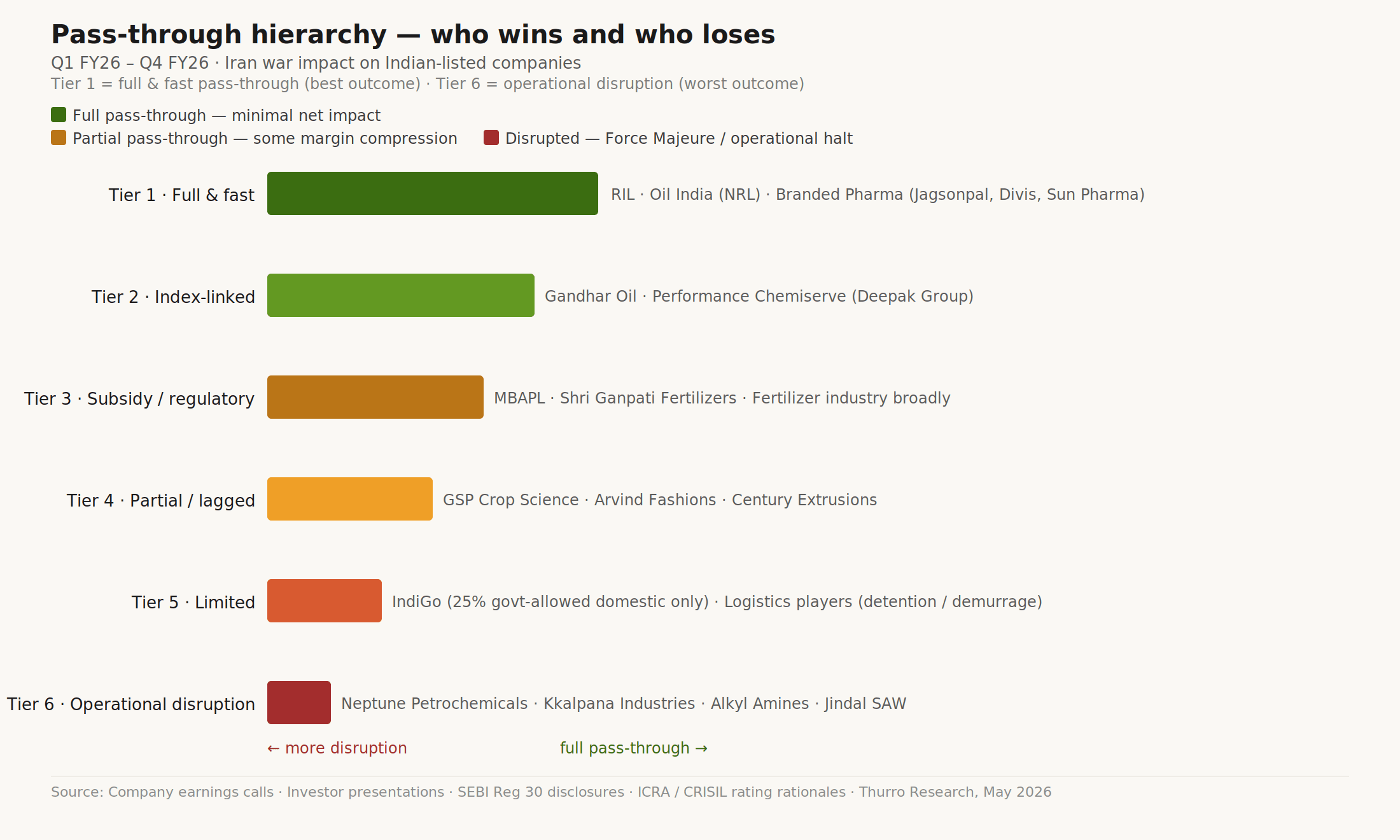
Pricing power shaped corporate outcomes
The implications extended beyond the immediate conflict.
The disruption showed that modern geopolitical shocks increasingly propagate through logistics systems, freight markets, energy routing, and imported-input dependencies rather than direct geographic exposure alone.
For Indian companies, resilience increasingly depends on diversification of supply chains, inventory flexibility, pricing structures, and the ability to reconfigure operations quickly during periods of disruption.
The conflict also showed that prior disruptions mattered. Companies that had adapted during earlier Red Sea disruptions entered the Strait of Hormuz shock with stronger operational preparedness and greater supply-chain flexibility.
In several cases, that operational learning became a competitive advantage.
Methodology
The analysis is based on management commentary, investor presentations, credit rating actions, exchange disclosures, and earnings calls across Indian-listed companies between April 2025 and May 2026. The report examines how companies described operational, pricing, logistics, and input-cost impacts linked to the Iran-Israel conflict and the closure of the Strait of Hormuz.
How this analysis was built
The analysis began with a simple screening exercise across Thurro’s database of Q4 FY2026 earnings calls, investor presentations, exchange disclosures, and rating reports to identify management commentary linked to the Iran-Israel conflict and the closure of the Strait of Hormuz.
From there, the commentary was reorganised across multiple lenses: sector exposure, operational disruption, pricing power, freight and logistics impact, fuel and commodity exposure, rating actions, and pass-through ability. That made it possible to compare how the same macro shock transmitted differently across industries and business models.
Similar workflows can be used to identify company- or sector-level exposure to geopolitical events, supply-chain disruptions, commodity shocks, or regulatory changes across Indian-listed companies.
The analysis reflects company commentary and disclosures rather than an independent assessment of geopolitical developments.
Cover photo credit: AI generated image
View disclaimer
Unlock the power of alternative data
Do not just follow the market — stay ahead of it. Thurro helps you transform raw filings and alternative datasets into actionable insights.
Explore Thurro AltData Book a demoRelated Articles
Nine years of net gold buying equals nine years of current account deficit — and it has doubled in value
India paid out $286bn for net gold between FY18 and FY26. Its cumulative current account deficit over the…
The UPI MDR pool is about ₹1,000 crore a month, and two-thirds of it sits where nobody can see it
Parliament has cleared the way for merchant charges on UPI. The merchant-category data says the revenue is real…
India’s commodity trade is running on price, not volume
India's trade value is still climbing — imports up about 18 percent and exports about 8 percent in…