



India’s import profile continues to be dominated by energy, and this shapes how external vulnerability of the economy is typically understood. Data from Thurro’s platform shows crude oil alone accounted for $138.8 billion, or 18.4% of total imports, in calendar year 2025, making it the single largest line item in India’s external balance, large enough to skew any comparison.
As a result, India’s import story is still told through oil. It is visible, it moves prices, shapes inflation, and drives macroeconomic adjustment. But the recent war in the Middle East has brought to the foreground a different kind of risk. Over the last month, these other commodities—fertilisers, coal, petrochemical intermediates, and increasingly, LPG—have also emerged as equally critical inputs, with the potential to constrain production and transmit stress across the economy, even if they are not as visible as crude oil.
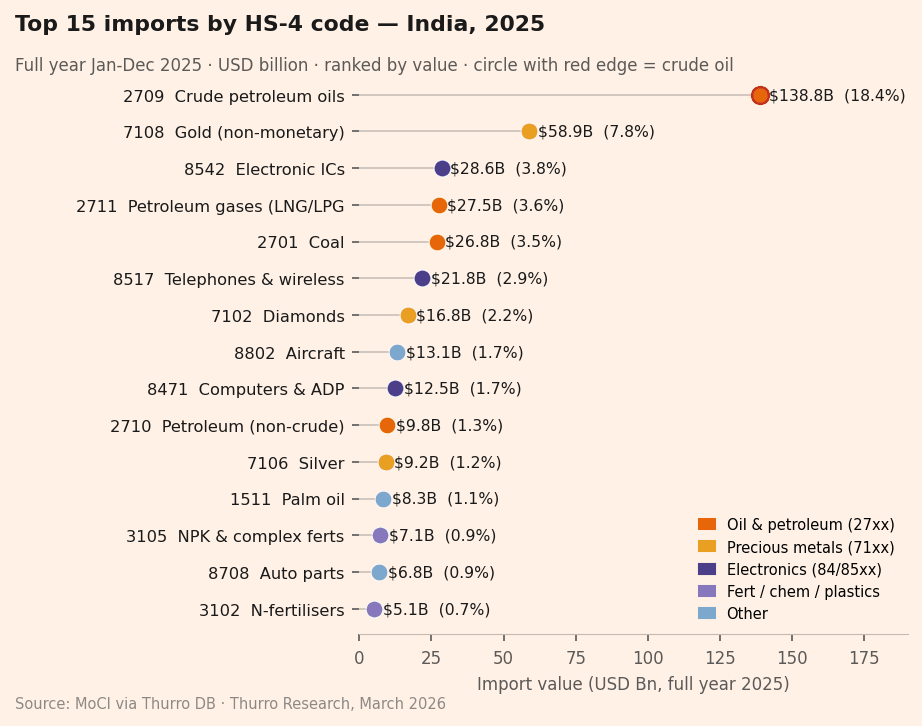
Energy products dominate India’s import basket by value
From price exposure to supply exposure
Oil price movements typically transmit through costs. Higher crude prices raise input costs across sectors, compress margins, and contribute to inflationary pressures. The adjustment, while sometimes sharp, generally unfolds over time through a combination of demand response, substitution at the margin, and policy intervention.
A number of other inputs—particularly fertilisers, coal, petrochemical intermediates, and LPG—exhibit a different form of exposure. Their relevance lies less in price volatility and more in availability and substitutability. Where these inputs are required for production processes and alternatives are limited, supply disruptions can have a more immediate operational impact.
At an aggregate level, the data appears to suggest some moderation in dependence. The share of oil, fertilisers, chemicals, and plastics in total imports declined from 46.3% in 2022 to 35.9% in 2025 (driven by relatively benign oil price environment).
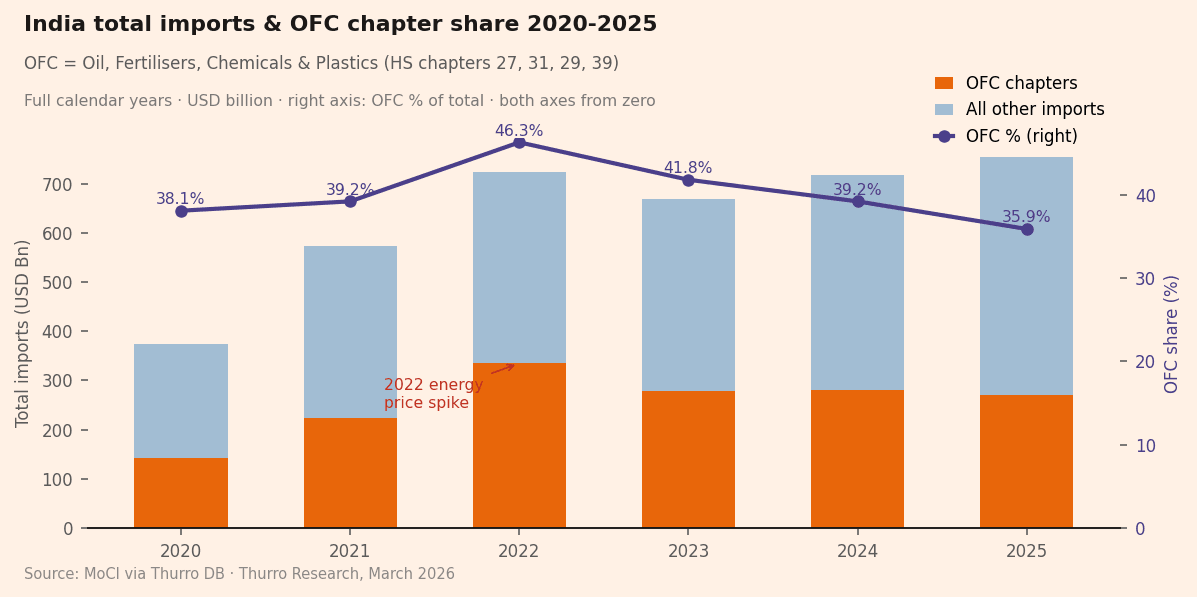
The decline in oil, fertilisers, and chemical share reflects commodity price normalisation rather than structural reduction in dependence
However, as the time series indicates, this change is consistent with the normalisation of global commodity prices following the 2022 spike, rather than a structural shift in underlying dependence. In other words, the apparent improvement reflects price effects more than changes in physical import reliance. This matters because price normalisation can reduce the apparent weight of certain imports without materially altering underlying dependence.
Where dependence becomes more binding
A clearer picture emerges when the analysis shifts from categories to specific inputs. Several materials—including fertilisers such as DAP, coking coal used in steelmaking, and a range of petrochemical intermediates—show high to near-total import dependence, as indicated in the input-level analysis.
In several cases, this dependence reflects negligible or zero domestic production capacity. For a set of critical inputs—including DAP fertiliser, coking coal, and select petrochemical intermediates such as ethylene vinyl acetate (EVA), used in solar module manufacturing, and methylene diphenyl diisocyanate (MDI), used in insulation, appliances, and cold storage—there is effectively no domestic fallback. This means that any disruption in imports directly translates into supply constraints rather than price adjustments.
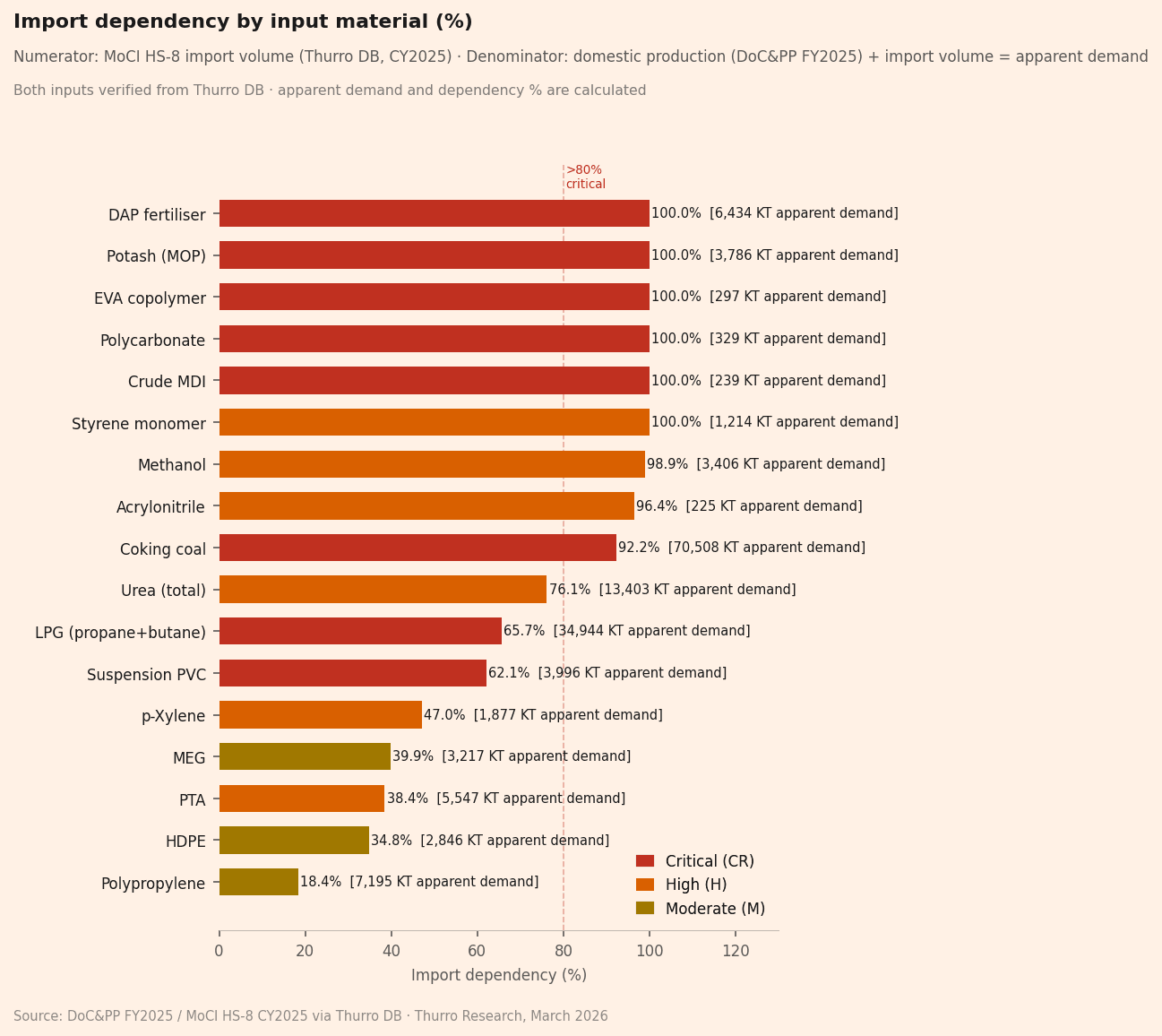
Multiple inputs exhibit high import dependence with limited domestic production capacity
These inputs are not always the largest contributors to the import bill, but they play a central role in enabling production across multiple sectors. Their importance is, therefore, functional and can have cascading effects across sectors.
This creates a situation where the system’s sensitivity is determined not only by how much is imported, but by how critical those imports are to ongoing activity. Where dependence is high and alternatives are limited, the margin for adjustment becomes narrower.
Transmission into downstream sectors
The impact of these dependencies becomes clearer when mapped to downstream sectors. The sub-sector linkage analysis shows that individual inputs feed into multiple industries simultaneously.
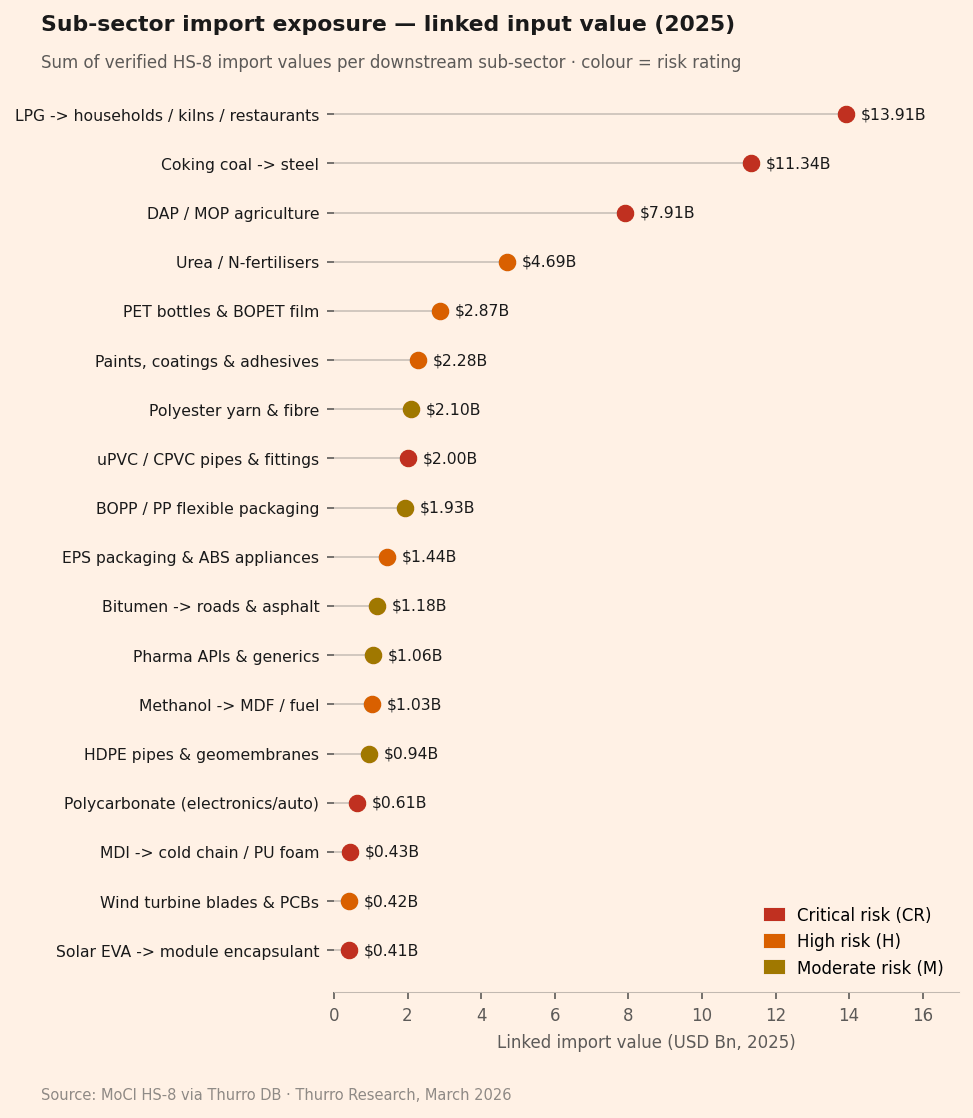
Critical inputs are embedded across multiple downstream sectors
For example, fertilisers are directly linked to agricultural output and crop cycles, where timing constraints limit flexibility. In addition, import dependence in fertilisers has fiscal implications, as price volatility can translate into higher subsidy requirements, particularly for inputs such as DAP.
Coking coal is a key input in steel production, with downstream implications for autos, construction, capital goods, and government infrastructure projects, particularly in water supply and pipeline networks. LPG, meanwhile, is used across a range of applications, including small-scale industrial processes, restaurants and food delivery businesses, and commercial consumption.
In ceramics, clusters such as Morbi—one of the world’s largest tile manufacturing hubs—are heavily dependent on LPG as a fuel input, making them particularly sensitive to supply disruptions. Recent reports indicate that supply constraints have already begun to affect operations in the cluster, with some units scaling down or suspending production.
In such cases, limited availability—particularly where substitutes are not readily accessible—can constrain activity within relatively short adjustment windows. The transmission is therefore not confined to a single sector but can extend across multiple parts of the economy.
Concentration and substitutability
Not all import dependencies carry the same level of risk. The degree of vulnerability depends not only on import dependence but also on supply concentration and substitutability.
The criticality matrix highlights inputs that combine relatively high import value with concentrated supply structures.
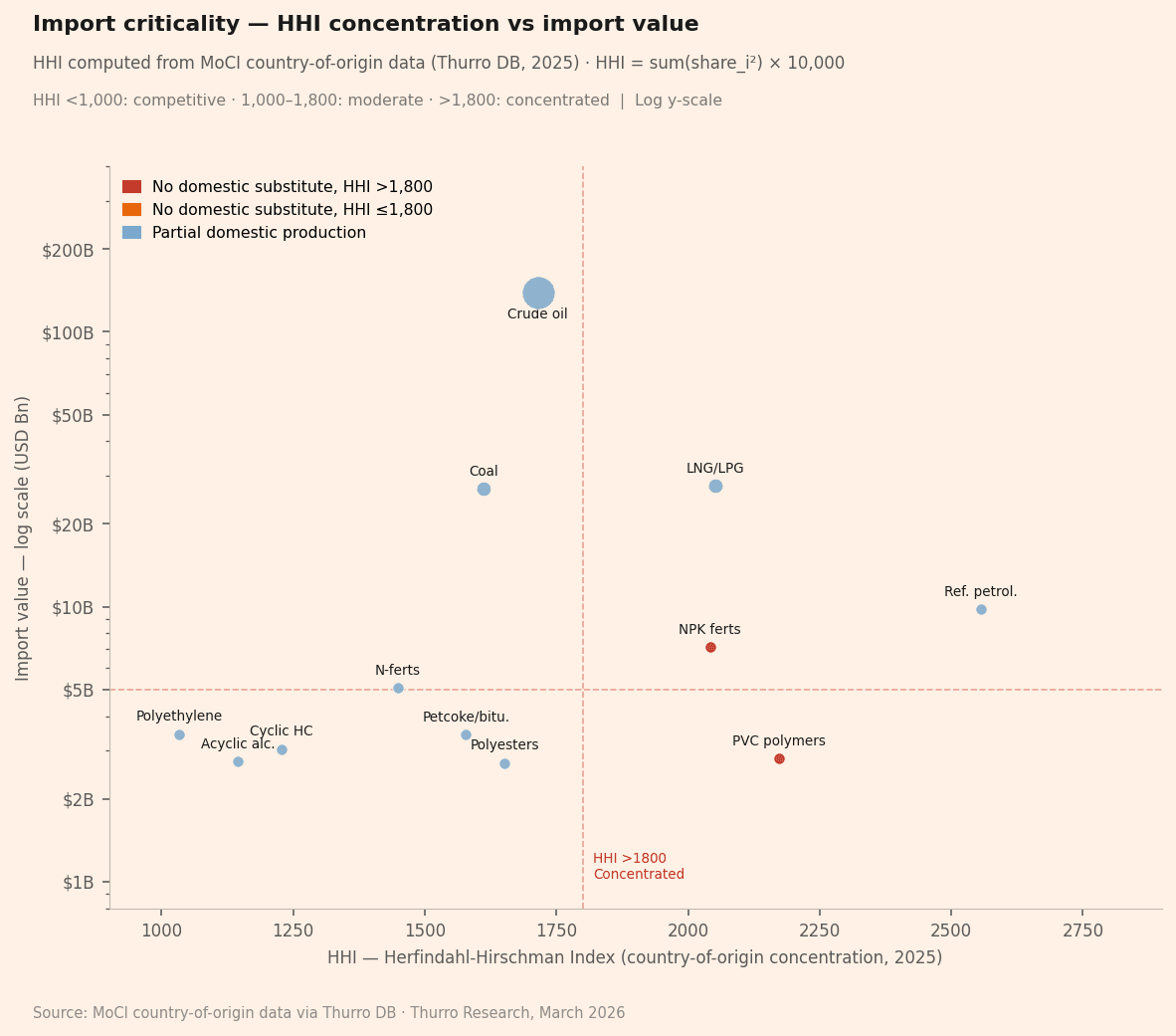
Inputs with high value and concentrated supply represent relatively higher vulnerability due to limited diversification options
In such cases, the ability to diversify sourcing or substitute inputs in the short term may be constrained. This increases sensitivity to disruptions, particularly where supply is concentrated across a limited number of countries or suppliers.
Reframing import risk
India’s import dependence remains significant, particularly in energy and industrial inputs. While headline indicators suggest some moderation, the underlying structure—especially at the level of critical inputs—shows limited change.
The distinction between price exposure and supply exposure is central to understanding this shift. While oil continues to shape inflation dynamics, a range of other inputs influence the continuity of production across sectors.
This suggests that import risk is not solely a function of aggregate value, but of how dependence is distributed across inputs with varying degrees of substitutability and concentration.
A more detailed version of this analysis, including underlying datasets and extended breakdowns, is available to clients on request. For access, please write to contact@thurro.com.
Cover photo credit: AI generated image
View disclaimer
Unlock the power of alternative data
Do not just follow the market — stay ahead of it. Thurro helps you transform raw filings and alternative datasets into actionable insights.
Explore Thurro AltData Book a demoRelated Articles
Nine years of net gold buying equals nine years of current account deficit — and it has doubled in value
India paid out $286bn for net gold between FY18 and FY26. Its cumulative current account deficit over the…
The UPI MDR pool is about ₹1,000 crore a month, and two-thirds of it sits where nobody can see it
Parliament has cleared the way for merchant charges on UPI. The merchant-category data says the revenue is real…
India’s commodity trade is running on price, not volume
India's trade value is still climbing — imports up about 18 percent and exports about 8 percent in…