

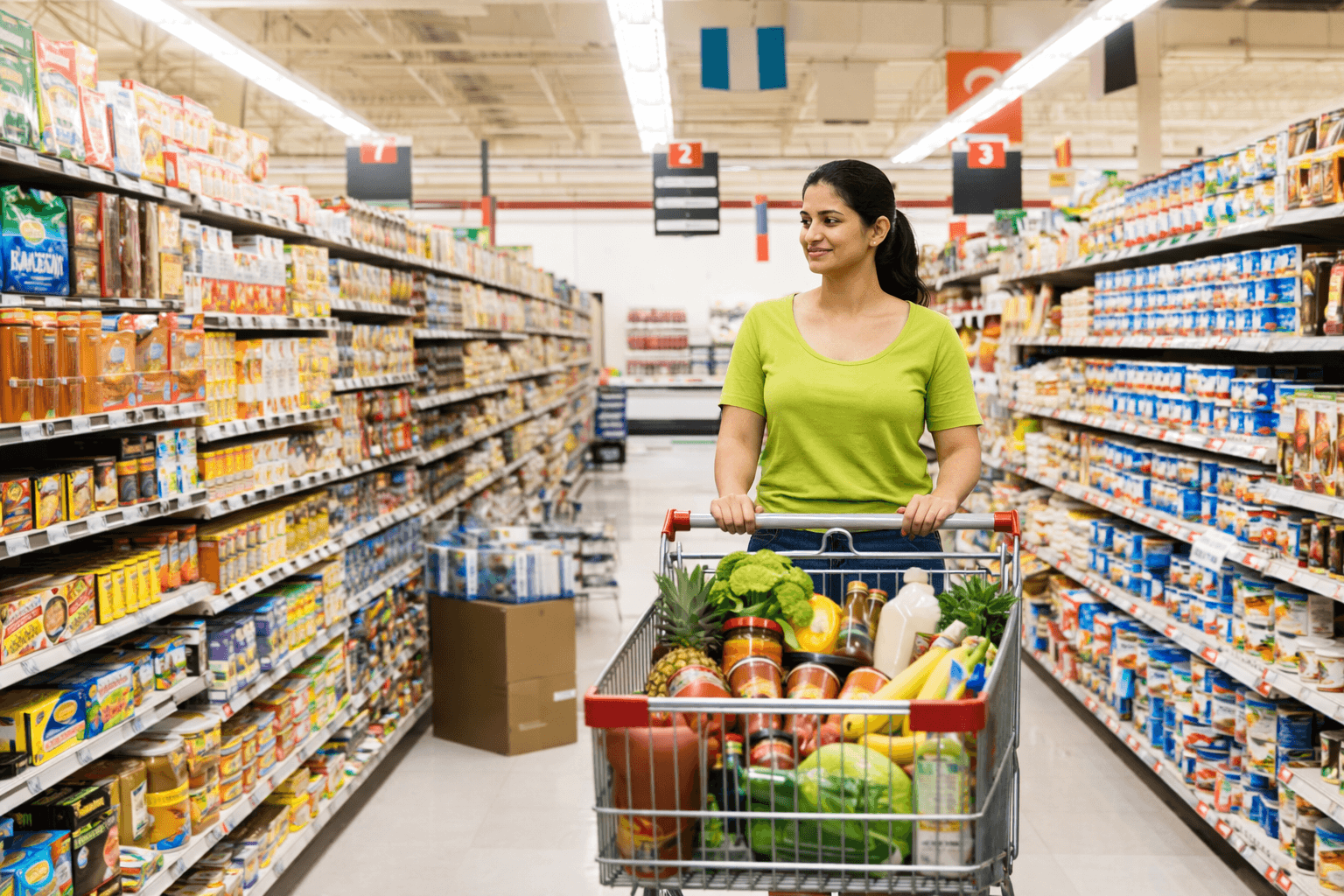

The February 2026 catalogue expansion marked a structural shift in DMart’s online strategy: premiumisation. Data from Thurro’s platform shows a rise in average selling prices, which was driven by the entry of higher-priced brands into the catalogue. Crucially, discount levels remained stable across categories, indicating that DMart was upgrading basket composition while preserving its everyday low cost–everyday low price (EDLC–EDLP) framework.
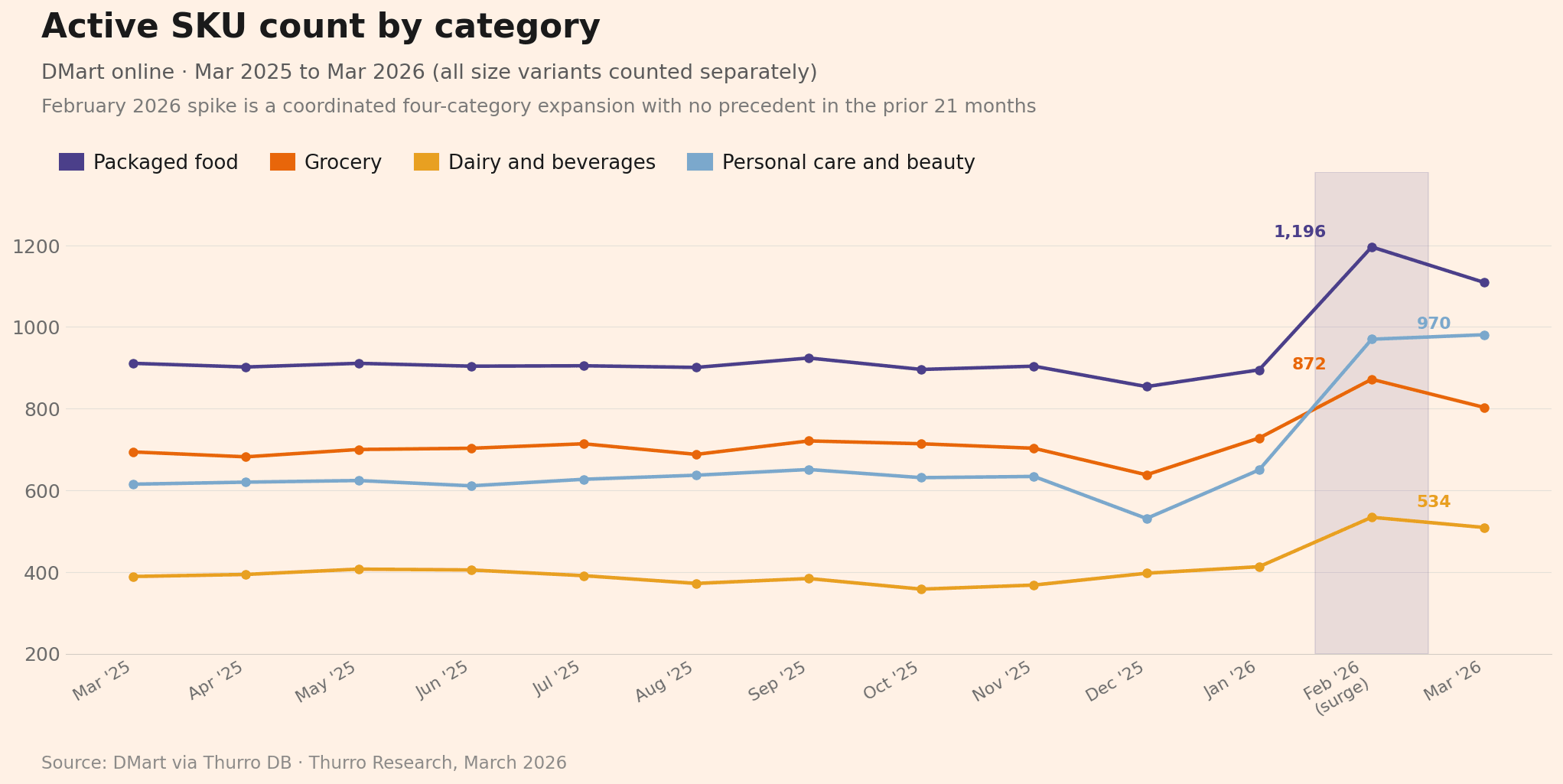
February 2026 marks a step-change in SKU additions
A February of expansion
Through most of 2025, DMart’s catalogue across core categories remained stable. Across the four evergreen categories—packaged food, grocery, dairy and beverages, and personal care, which together represent nearly 47% of the overall online stock keeping units (SKUs)—counts fluctuated within narrow bands, indicating churn rather than expansion.
That pattern broke decisively in February 2026. In that month, DMart added:
- 40 packaged food brands (144 SKUs)
- 38 personal care brands (152 SKUs)
- 27 dairy and beverage brands (71 SKUs)
- 12 grocery brands (56 SKUs)
This is a total addition of 117 new brands and over 500 SKUs, nearly 4x higher than the previous monthly peak of 30 brands in October 2025.
The scale of this expansion, combined with its concentration within a single month, suggested a strategic shift, pointing to a step-change in assortment strategy—one that prioritises breadth and mix over incremental additions. Importantly, this expansion is concentrated in categories that influence discretionary spend—packaged food and personal care—rather than staples.
A look at the prices of the products suggests a conscious shift towards premiumisation, even though the movement was not uniform across categories. For example, new entrants in packaged food were significantly more expensive than the existing catalogue. The average maximum retail price (MRP) of the new products in the segment was INR 332 compared with an MRP of INR 152 for the existing catalogue, representing a 118% premium. As a result, the average selling price—after discounts on MRP—in the segment rose from INR 107 in August 2025 to INR 122 in March 2026, up 14%.
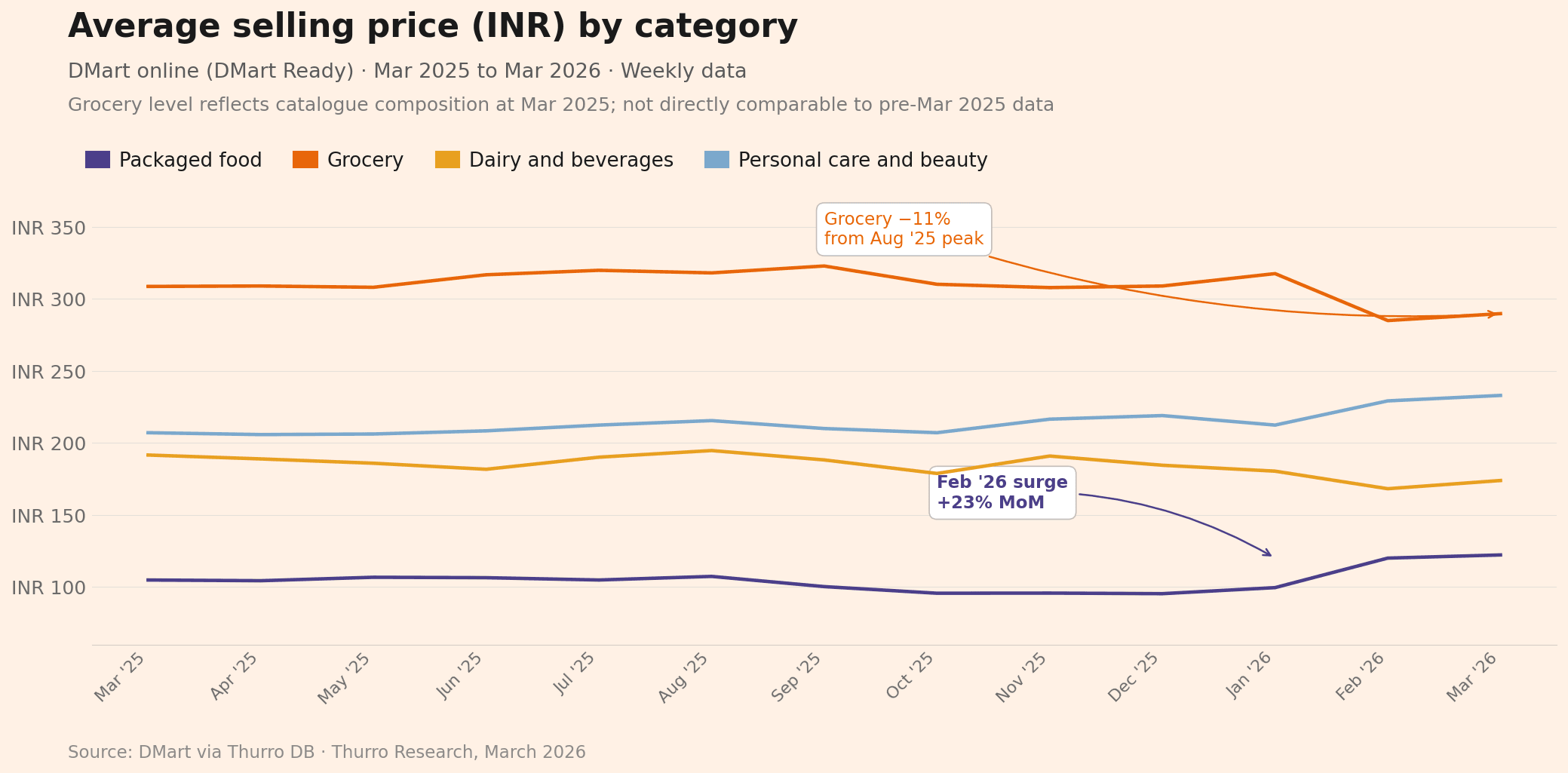
Prices rise in packaged food and personal care, while grocery and dairy decline
A similar trend was seen in the personal care category, in which new products carried an average MRP of INR 413, a 28% increase from the average MRP of INR 322 for the existing products, which increased the average selling price by 7% to INR 233 from INR 216 in August 2025.
In contrast, grocery and dairy categories experienced the opposite effect. In grocery, new entrants carried an average MRP of INR 186 versus INR 409 for the existing catalogue. This difference was driven by a shift in product mix towards lower-ticket categories such as spices and staples. Dairy and beverages saw new entrants at INR 177 versus INR 224 for the existing products. As a result, the average selling price in these categories fell nearly 9% to INR 290 and 11% to INR 174, respectively.
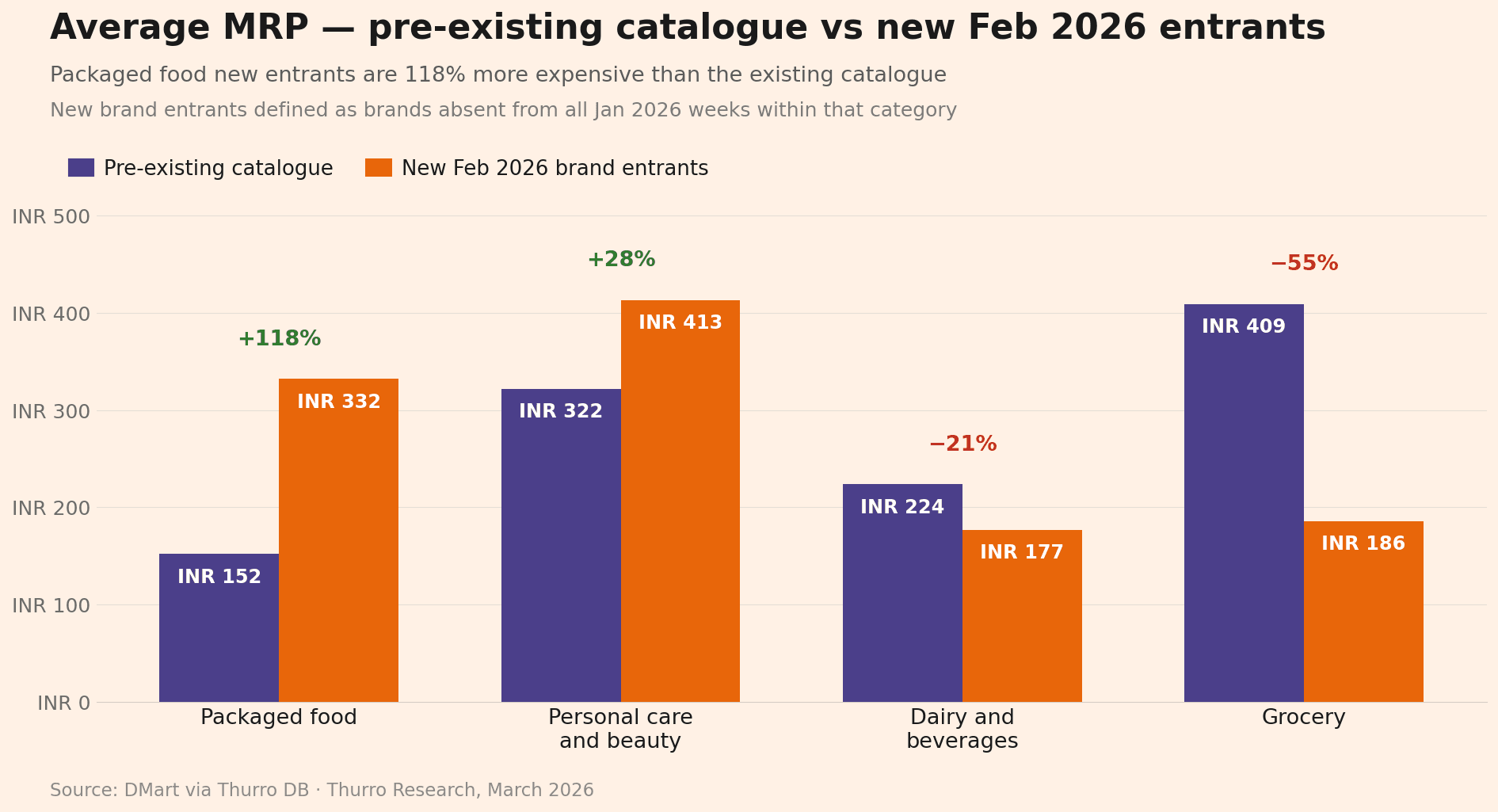
New entrants are premium in packaged food and personal care, but lower-priced in grocery and dairy
The softening of grocery prices aligns with management commentary that revenue growth was impacted by deflation in staples—edible oils, pulses, rice, flour, and sugar. The data shows that lower-MRP entrants in spices and basic grocery categories contributed to this decline, alongside broader commodity softening.
Discount discipline remains intact
Despite the influx of premium brands, discount depth—the percentage reduction from MRP [1 − (selling price ÷ MRP)]—has remained stable across the entire observation period. Packaged food continues to operate at roughly 28–34% discount to MRP, grocery at 25–27%, dairy at 21–24%, and personal care at 25–34%.
More importantly, new entrants are not being given promotional pricing. Their discount levels are broadly aligned with the existing catalogue. It indicates that DMart is not subsidising entry for new brands or using discounts to accelerate trial. Instead, it is enforcing uniform pricing discipline across both incumbents and entrants.
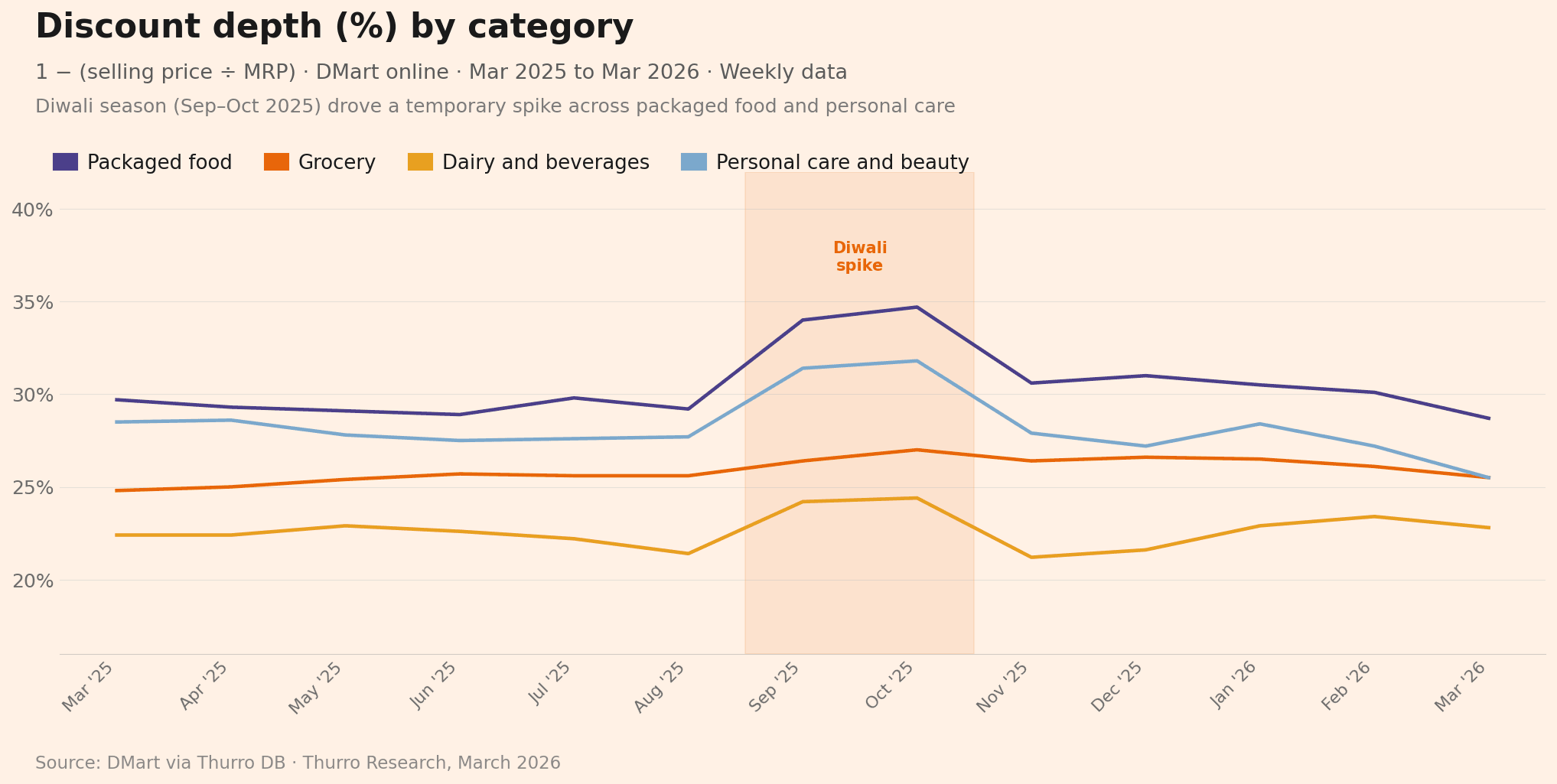
Discount levels remain stable across categories despite the influx of higher-priced brands
Pricing power remains concentrated
Brand-level data reinforces the structural hierarchy within the catalogue. Large incumbents such as Amul and Patanjali operate at price realisation—selling price as a percentage of MRP—levels above 90%, implying minimal discounting. Even within new entrants, select brands such as Gillette achieve high realisation (89%), indicating strong negotiating power and established demand.
At the other end of the spectrum, newer or D2C brands show significantly lower realisation. Caresmith, for instance, operates at roughly 32%, implying steep discounts.
This divergence highlights a key feature of DMart’s model: access is not neutral. Brands effectively “pay” for distribution through pricing concessions unless they bring pre-existing demand strength. The presence of high realisation among select new entrants (e.g., Gillette) suggests that pricing power is driven by brand strength rather than tenure in the catalogue.
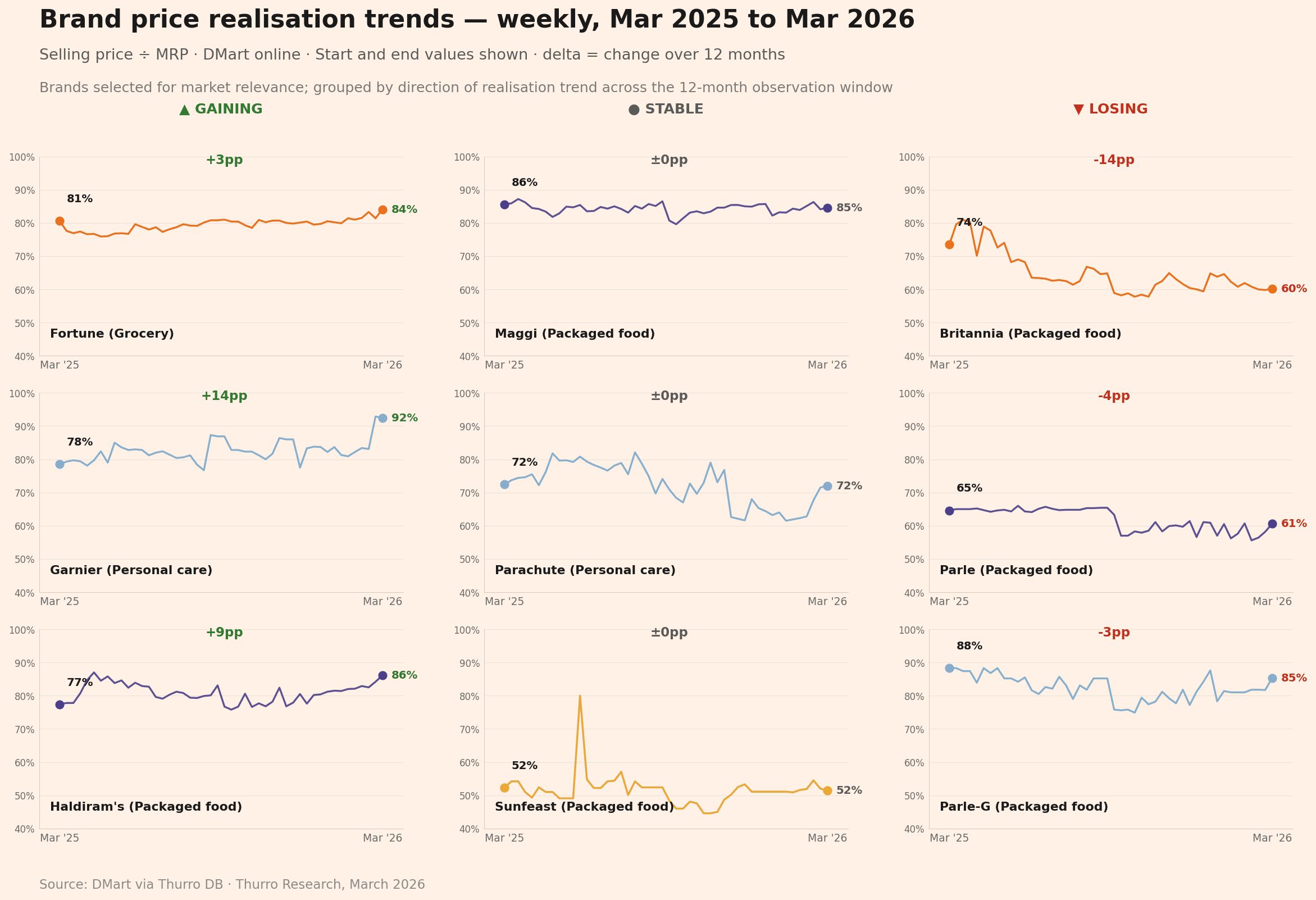
Brand pricing power diverges, with both gains and declines visible across incumbents and peers
Basket expansion in focus
The evidence across pricing, discounting, and assortment converges on a single strategic objective: increasing basket size. Data from Thurro’s platform shows average bill value increased to approximately INR 1,710 in Q3 FY2026 from around INR 1,691 in Q3 FY2025.
Notable new entrants in February include:
- Premium chocolates and ice creams (Ferrero Rocher, Baskin Robbins, London Dairy)
- Protein supplements (Optimum Nutrition)
- Clinical and premium skincare (Cetaphil, Lotus Herbals)
These are higher-ticket categories relative to staples, which expand discretionary spend per visit. At the same time, maintaining discount discipline ensures that the value perception of the platform remains intact. This aligns with prior management commentary that “basket size is the holy grail”.
The February expansion is, therefore, best understood as execution of this strategy—broadening the catalogue upwards without disrupting the core value proposition.
What’s next
Three variables will determine whether this shift becomes structural. First, retention: how many of the 117 new brand–category combinations persist beyond the initial onboarding phase? Second, offline translation: this analysis is based on the online catalogue. Whether similar premiumisation appears in physical stores will determine if this is a channel-specific strategy or a system-wide shift.
Third, competitive positioning: as premium brands enter DMart without additional discounting, whether DMart can maintain its price advantage relative to platforms such as Amazon becomes a critical variable. The February 2026 expansion reflects a change in assortment, not pricing policy. DMart is introducing premium brands to lift basket size while maintaining strict pricing discipline. What remains to be seen is whether the company can sustain this balance of premium mix expansion without diluting its value identity.
Cover photo credit: AI generated image
View disclaimer
Unlock the power of alternative data
Do not just follow the market — stay ahead of it. Thurro helps you transform raw filings and alternative datasets into actionable insights.
Explore Thurro AltData Book a demoRelated Articles
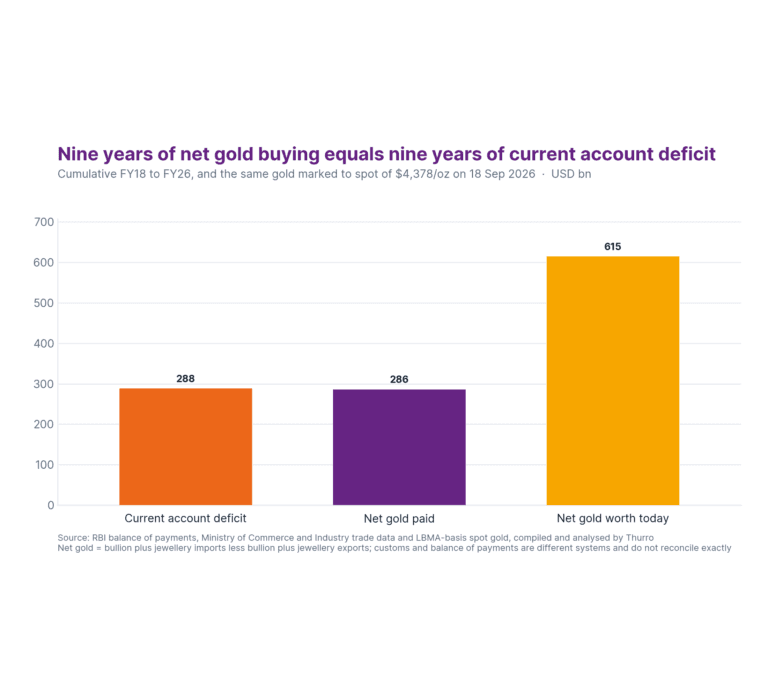
Nine years of net gold buying equals nine years of current account deficit — and it has doubled in value
India paid out $286bn for net gold between FY18 and FY26. Its cumulative current account deficit over the…
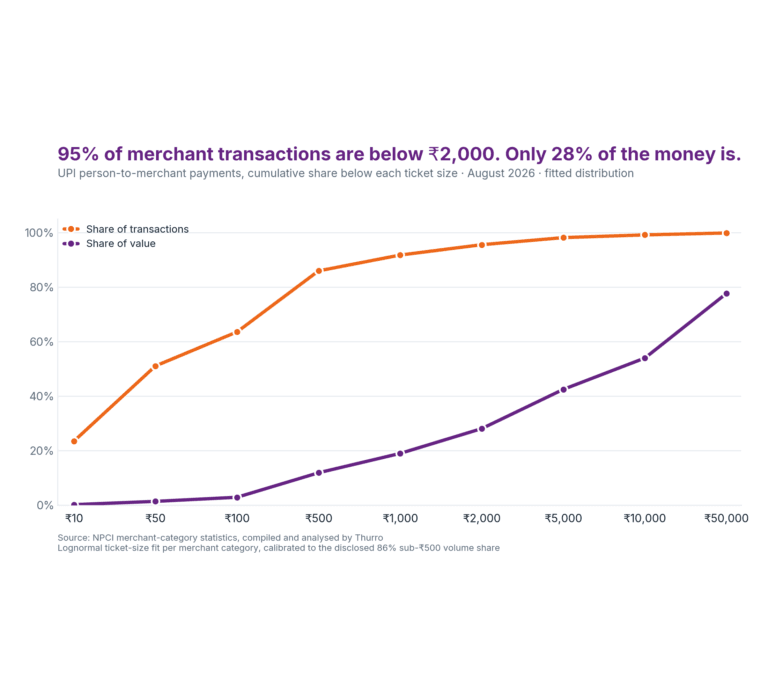
The UPI MDR pool is about ₹1,000 crore a month, and two-thirds of it sits where nobody can see it
Parliament has cleared the way for merchant charges on UPI. The merchant-category data says the revenue is real…
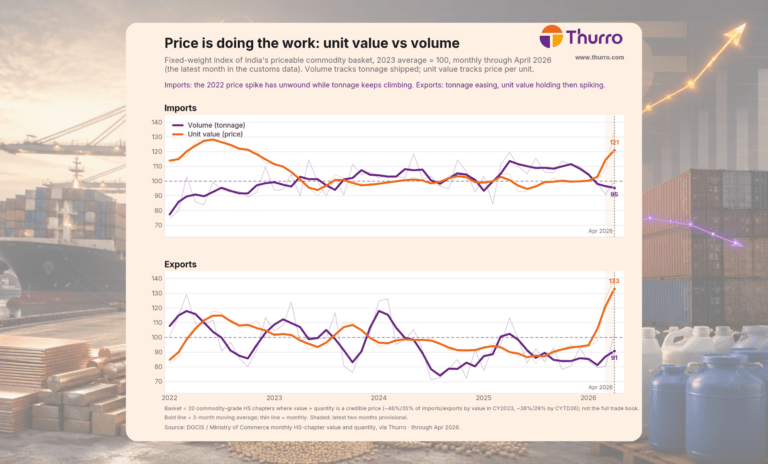
India’s commodity trade is running on price, not volume
India's trade value is still climbing — imports up about 18 percent and exports about 8 percent in…