



As the Q3 FY2026 earnings season gathers momentum, all eyes have been focused on an unexpected but specific component of the profit and loss statement: employee costs.
What initially appears to be an accounting change is, in fact, a change in the underlying cost structure. Take, for example, Tata Consultancy Services. The information technology sector bellwether reported a one-time exceptional charge of INR 21.28 billion in Q3 FY2026 to account for the implementation of India’s new labour codes, which came into effect on 21 November 2025.
The immediate market reaction is that this is a messy but contained accounting adjustment. That interpretation, however, is incomplete. What Q3 FY2026 revealed was not a transient earnings shock, but the beginning of a structural reset in how Indian companies—especially IT services firms—price labour, manage workforce risk, and protect margins.
The accounting trigger
At the heart of the issue lies the redefinition of wages under the Code on Wages. For years, IT companies optimised statutory costs by keeping “basic pay” as a share of the total cost-to-company (CTC) low, with the balance paid as allowances. The new framework caps allowances at 50% of remuneration, forcing a higher wage base for calculating provident fund, gratuity, and other social security benefits.
Accounting standards left no room for gradualism. Under IAS 19 and Ind AS 19, legislative changes to employee benefit plans constitute a plan amendment, requiring immediate recognition of past service costs. That is why Q3 FY2026 absorbed such large charges in a single quarter.
As a result, profitability has taken a significant hit. TCS, for example, reported a 14% year-on-year decline in net profit, driven largely by the labour code provision. Management disclosed that INR 18.16 billion of the total charge related to incremental gratuity. Excluding this, profit would have grown in high single digits. HCL Technologies reported a USD 109 million impact at the EBIT level, largely booked through cost of revenues. Other companies too disclosed smaller but directionally similar provisions.
Beyond a one-time hit
It would be wrong to ring-fence these charges as “exceptional”. The changes to the labour code have longer-term implications.
First, the higher wage definition permanently raises the base on which statutory contributions are calculated. Even after the past-service adjustment is absorbed, annual service costs for gratuity and other benefits will remain structurally higher. For labour-intensive firms, analysts see this translating into a recurring 5–10% increase in employee-related costs, depending on prior wage mix.
Second, the economics of workforce buffering are changing. The traditional IT “bench”—a pool of idle but billable-ready employees—was viable partly because statutory costs were low. With higher per-employee fixed costs, firms are being pushed toward tighter utilisation, more project-linked hiring, and greater use of fixed-term employment, now explicitly recognised under the new codes.
The rising cost of maintaining a permanent bench also intersects with another structural change introduced by the labour codes: the formal recognition of Fixed Term Employment (FTE). By legalising and normalising project-based contracts with statutory parity on wages and benefits, the new framework gives companies a clearer alternative to carrying large pools of permanent, underutilised employees. Over time, this may encourage firms to shift away from traditional bench-heavy models toward more flexible staffing structures, reducing long-term gratuity and social security liabilities. In effect, the labour codes may not only make idle labour more expensive, but also reshape incentives around how employment itself is structured.
Third, compliance itself has become more operationally demanding. The requirement to complete full and final settlement of dues within two working days of employee exit imposes new systems and liquidity discipline, particularly for firms with large headcounts and double-digit attrition. Non-compliance now carries sharper penalties, turning HR execution into a financial risk.
There is also a second-order effect of the labour codes: the divergence between employer cost and employee take-home pay. While companies face a higher wage bill due to expanded social security contributions, employees may see little or no increase in immediate cash compensation—and in some cases, even a decline in take-home pay. A larger portion of compensation is now deferred into provident fund, gratuity, and other statutory benefits. This creates a social security versus liquidity trade-off: long-term financial protection improves, but short-term disposable income tightens.
A narrowing cost advantage
There is also a strategic dimension. India’s IT model has long rested on a large offshore cost arbitrage. Labour codes do not eliminate that advantage, but they compress it at the margin, especially when combined with slowing global tech demand and pricing pressure.
This helps explain why management commentary is increasingly linking cost discipline with productivity-led growth. TCS, for instance, highlighted USD 1.8 billion in AI-related revenue this quarter. Such disclosures are not incidental. As wage costs rise structurally, technology-led productivity is shifting from optional upside to margin defence.
What Q3 FY26 really signalled
Q3 FY26 should be read less as an aberration and more as a line of demarcation. The transfer of value from corporate balance sheets to employee retirement and social security pools is deliberate policy design, not an accounting anomaly. For companies, the adjustment path will involve compensation restructuring, tighter workforce management, and sharper capital allocation trade-offs.
For investors, the key risk lies in misclassification. Treating labour code impacts as “one-off” may flatter forward earnings estimates. In reality, the quarter marked the beginning of a new cost regime for India’s largest white-collar employers—one that will shape margins, hiring strategies, and competitiveness well beyond FY2026.
Cover photo credit: Unsplash
View disclaimer
For a detailed explanation of the new labour codes and their sectoral impact, access this Thurro Answers Notebook, an interactive workspace showing the questions, data and AI responses behind the insights. You can also download the PDF version below to read offline.
Unlock the power of alternative data
Do not just follow the market — stay ahead of it. Thurro helps you transform raw filings and alternative datasets into actionable insights.
Explore Thurro AltData Book a demoRelated Articles
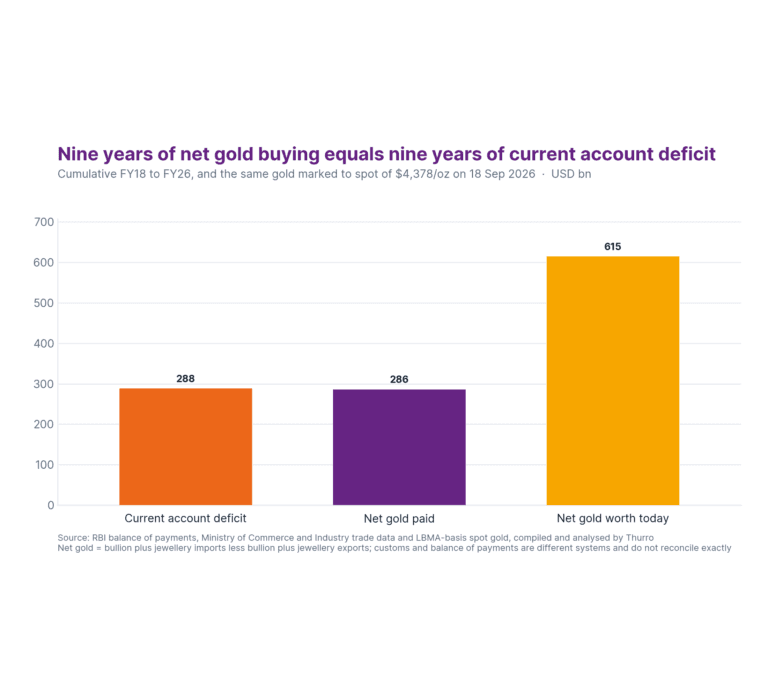
Nine years of net gold buying equals nine years of current account deficit — and it has doubled in value
India paid out $286bn for net gold between FY18 and FY26. Its cumulative current account deficit over the…
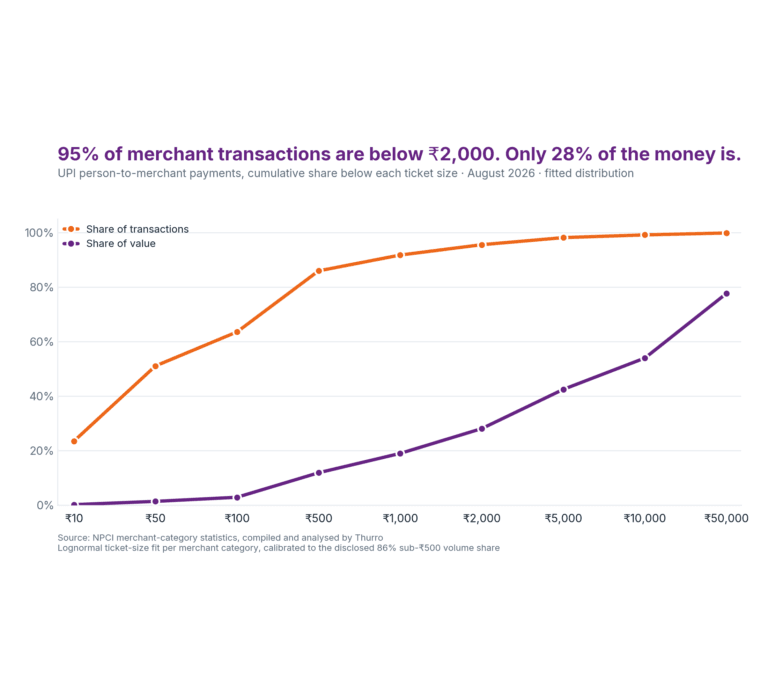
The UPI MDR pool is about ₹1,000 crore a month, and two-thirds of it sits where nobody can see it
Parliament has cleared the way for merchant charges on UPI. The merchant-category data says the revenue is real…

India’s commodity trade is running on price, not volume
India's trade value is still climbing — imports up about 18 percent and exports about 8 percent in…