


This analysis is based on Thurro’s AI-led reading of Union Budget speeches between FY2019 and FY2026. Instead of examining each Budget as a standalone event, Thurro’s AI-driven platform processes Budget speeches across years, allowing shifts in language, structure, emphasis, and time horizon to be identified at scale.
By structuring Budget documents into a searchable, comparable database and applying AI-assisted thematic and linguistic analysis, Thurro enables patterns to emerge that are difficult to detect through manual reading alone. This approach makes it possible to trace how the function of the Union Budget itself has evolved over time—beyond individual announcements or headline measures.
Earlier in this series, we analysed how the Budget speeches have evolved, redefined their intended audience, reframed employment, realigned sectoral priorities over time. We have also analysed how the Economic Survey has evolved over this period. In this note, we turn to the social contract embedded in the Budget: how successive speeches have spoken to different social groups, and what that reveals about who the State sees as central to its growth story.
Read across FY2019 to FY2026, the Budget appears to have progressively repositioned social groups, moving from protection and entitlement toward capability, participation, and contribution. This reflects a broader shift away from a predominantly paternal framing of the State toward a more agency-oriented one. This transition, however, is uneven. While some groups are repositioned as economic actors within growth systems, others continue to be addressed primarily through protection and inclusion, reflecting a differentiated and evolving social contract.
Farmers: from income protection to economic engine
Farmers remain the most consistently mentioned constituency across FY2019–FY2026. However, the framing around their role in the nation’s development and growth has changed materially.
In the early years (FY2019–FY2021), farmers are addressed primarily through income protection and stability. Phrases such as doubling farmers’ income, along with repeated references to MSPs, direct income transfers, crop insurance, and irrigation, positioned farmers as recipients of State support, insulated from volatility. The Pradhan Mantri Kisan Samman Nidhi (PM-KISAN)—one of the largest direct income transfer schemes—was launched in FY2019 and has since disbursed around INR 4 trillion across 21 instalments to over 110 million farmers nationwide.
From FY2022 onwards, however, this framing began to shift. Farmers are increasingly discussed through value chains, infrastructure, and productivity. References to agri-logistics, storage, digital agriculture, Kisan Drones, and Shree Anna—the attempt to reposition millets as a strategic, globally relevant food system—repositioned agriculture as a system rather than a safety net.
From among the most vulnerable social groups to an economic actor in charge of food systems, the farmer’s position evolved materially. The social contract evolved from protection to participation, with farmers increasingly addressed as contributors to growth rather than only as beneficiaries of support. By FY2026, agriculture was explicitly framed as the first engine of growth, marking a transition from income assurance to economic centrality.
For a deeper analysis of how the Budget has spoken to farmers over the years, see the accompanying Thurro Notebook or download the PDF version below to read offline
Women: from welfare beneficiaries to growth participants
Women’s presence in Budget speeches has expanded both in frequency and in framing. Early references focused on welfare and protection—nutrition, maternal health, sanitation, and safety—placing women primarily within a protection-oriented narrative. This framing dominated FY2019–FY2021, where women were largely positioned as beneficiaries of social support and empowerment schemes.
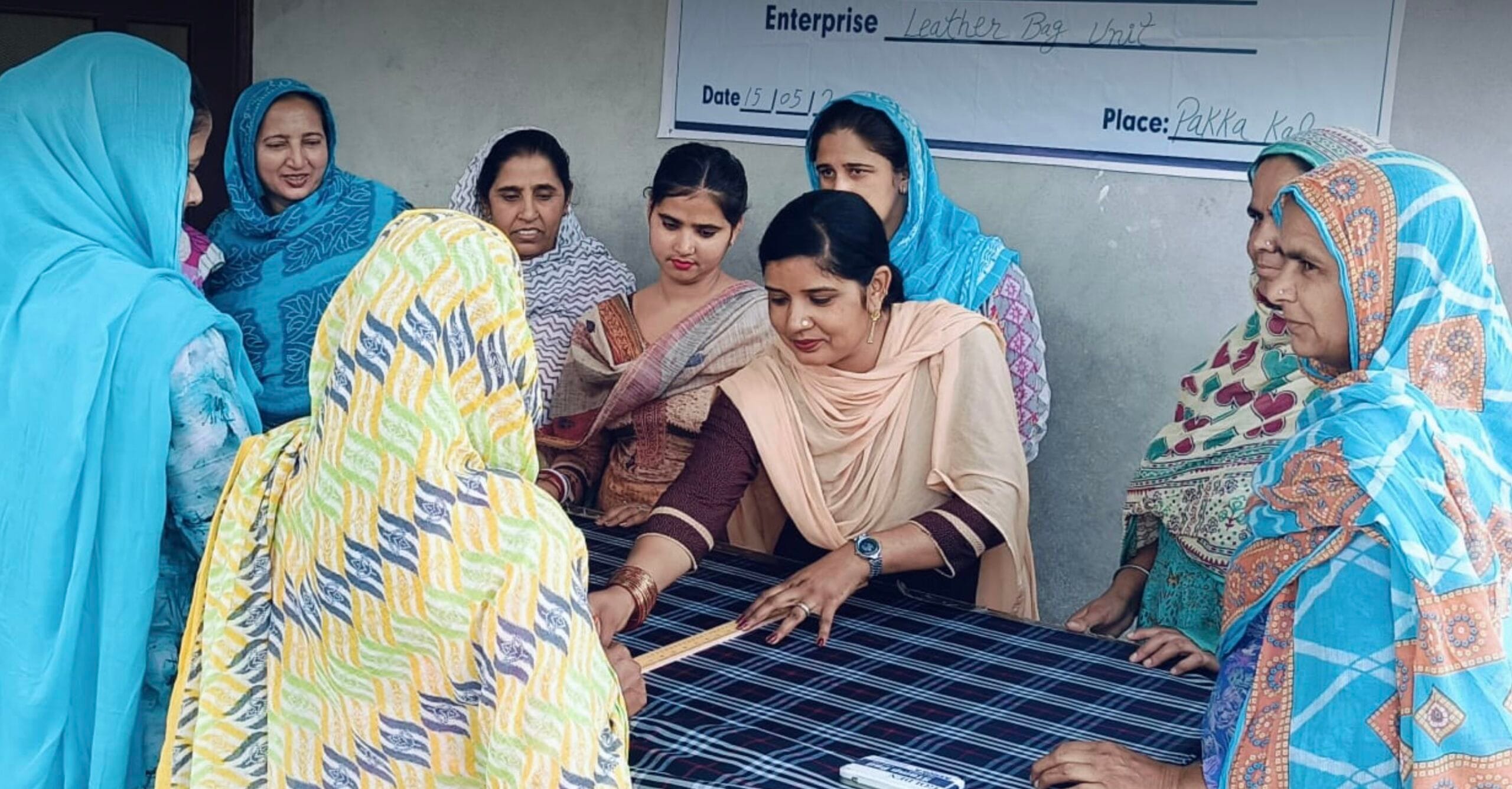
Over time, particularly from FY2023 onwards, the language shifted toward agency. A clear inflection point appears in FY2023–24, when the Budget explicitly moved from the language of women’s development to women-led development, marking a formal change in how women were positioned within the growth narrative.Phrases such as women-led development anchor the narrative, alongside greater emphasis on entrepreneurship, self-help groups (SHGs), skilling, credit access, and workforce participation. Subsequent Budgets reinforced this shift through initiatives such as Lakhpati Didis and targeted support for first-time women entrepreneurs, placing women not merely as recipients of support but as economic contributors and productive actors. Rather than disappearing, welfare framing was layered with capability framing, recasting women as economic agents central to household income, enterprise formation, and community-level growth. By FY2025 and FY2026, this framing was embedded within the Viksit Bharat@2047 vision, where women’s economic participation is treated as integral to long-term growth.
For a deeper analysis of how the Budget has spoken to women over the years, see the accompanying Thurro Notebook or download the PDF version below to read offline
Youth: from employability to nation-building
Youth have been consistently invoked as the future of the economy, but the meaning of that future has changed. In earlier Budgets, youth appeared largely through aspirational language such as education access, demographic dividend, and long-term opportunity.
From FY2022 onwards, the framing sharpened. Youth were increasingly discussed through employability, skilling pipelines, apprenticeships, and technology readiness. Education was no longer treated as an end in itself, but as a bridge to work, productivity, and contribution.
This phase was also marked by policy experimentation. Early iterations of employment incentives—such as EPF contribution supports—saw uneven uptake and were recalibrated over time, reflecting an emerging willingness to test, adjust, and refine employment architectures.From FY2025 onwards, youth were explicitly elevated as a core social category. Terms such as Amrit Peedhi and large employment-linked packages reposition youth not merely as job-seekers, but as builders of Viksit Bharat. By this point, employment policy was increasingly framed as an adaptive, performance-linked system—through wage subsidies and industrial internships—rather than a static welfare promise. The social contract shifted from promise to preparation—positioning youth less as future beneficiaries of growth and more as the workforce through which growth would be realised.
For a deeper analysis of how the Budget has spoken about youth over the years, see the accompanying Thurro Notebook or download the PDF version below to read offline
The poor: from emergency protection to system delivery
The economically weaker sections of society emerged most prominently during the crisis years, and the treatment of this social group underwent the sharpest shift during the pandemic. FY2022 marked a clear moment where protection dominated. Free foodgrains, direct benefit transfers, housing, sanitation, and health coverage dominated the Budget’s narrative. The tone was – immediate and protective, focused on survival, dignity, and ensuring a basic floor of consumption, shelter, and access to essential services.
Programmes such as MNREGA played a central stabilising role during this phase—absorbing labour shocks and functioning as a wage and employment floor rather than an engine of income growth. While allocations fluctuated and, in some years, declined, the scheme continued to operate as a fallback mechanism for the rural poor rather than a pathway for upward mobility.
As the pandemic receded, the protective framing began to evolve. Welfare measures were increasingly embedded within delivery systems such as digital transfers, housing completion, and infrastructure-linked access rather than framed as open-ended entitlement. The narrative moved from relief to capability, signalling a transition from emergency support toward long-term inclusion within economic systems.
For a deeper analysis of how the Budget has spoken about the poor and vulnerable group of people over the years, see the accompanying Thurro Notebook or download the PDF version below to read offline
SC/ST communities: continued protection with selective system inclusion
References to the Scheduled Castes and Scheduled Tribes remain present across Budgets, but their role is framed within relatively narrow expectations.
Across years, the language remains largely distributive—allocations, sub-plans, scholarships, and targeted development initiatives. Earlier language emphasised inclusion and justice, primarily through welfare schemes and earmarked spending.
Later Budgets place greater emphasis on education, skilling, entrepreneurship, and regional development, embedding these groups within broader capability-building systems. However, this inclusion is largely mediated through protection and eligibility rather than through expectations of productivity or economic contribution, and the dominant framing continues to emphasise support and inclusion over economic agency.
For a deeper analysis of how the Budget has spoken about the SC/ST communities over the years, see the accompanying Thurro Notebook or download the PDF version below to read offline
The middle class: from near invisibility to explicit recognition
For the first half of the last eight years, the middle class occupied an ambiguous place in Budget speeches—rarely named directly, often implied through consumption, housing, or tax policy.
From FY2023 onwards, this began to change. The middle class emerged more explicitly as a recognised constituency, framed around spending power, confidence, and participation in economic momentum. Tax relief, housing access, and financial stability were increasingly discussed as levers to sustain consumption-led growth.
The middle class was no longer an invisible assumption within growth models, but an active economic participant whose actions mattered for growth.
For a deeper analysis of how the Budget has spoken about the middle class over the years, see the accompanying Thurro Notebook or download the PDF version below to read offline
What remains absent
One notable absence across Budget speeches is the limited and episodic reference to religious minorities as an economic constituency. Where minorities do appear, the language is largely confined to education, skill support, or institutional safeguards rather than participation in growth systems. Unlike farmers, women, or youth, minorities are not consistently addressed as economic actors within the Budget’s growth narrative—an absence that is itself revealing. Even where mentions occur, they are framed primarily through constitutional safeguards and basic welfare, rather than through the language of productivity, participation, or growth systems.
What this evolution reveals
Across FY2019–FY2026, the Union Budget speeches have reweighted the social contract. Protection has ceded space to participation. Entitlement language, while not being fully replaced, has increasingly shared ground with capability, productivity, and contribution.
Read together, these shifts reveal a State that increasingly imagines growth as something built with its citizens rather than delivered to them. The Budget still speaks to vulnerability—but it increasingly speaks in the language of agency.
Cover photo credit: HMEL
View disclaimer
This is the sixth in a series of Thurro newsletters in the run-up to the Union Budget 2026. The underlying analysis for this piece is available in the accompanying Thurro Notebook
Next: Budget vibe check
Unlock the power of alternative data
Do not just follow the market — stay ahead of it. Thurro helps you transform raw filings and alternative datasets into actionable insights.
Explore Thurro AltData Book a demoRelated Articles

India’s consumption story is deepening
India’s consumption base is widening, formalising, and upgrading, strengthening balance sheets and shifting demand toward higher-value categories

US bankruptcy filings rise 13% in Sep-Dec 2025
Over the past 12 quarters, filings have recorded double-digit annual growth in all but one quarter

A tale of two markets
Cash equities are increasingly delivery-led, even as derivatives premium turnover surges, revealing a bifurcated market structure beneath speculation…