


The competitive structure of UPI is beginning to shift at the margin. The combined share of the top two apps has declined from roughly 84% in mid-2025 to 81.4% by February 2026, continuing a gradual erosion from the post-Paytm peak (see chart 1). The Reserve Bank of India’s action on Paytm Payments Bank in early 2024 temporarily pushed volumes toward the two dominant platforms, lifting their combined share to 87.4% by August 2024. PhonePe—which has filed its IPO papers—remains the dominant player in the ecosystem.
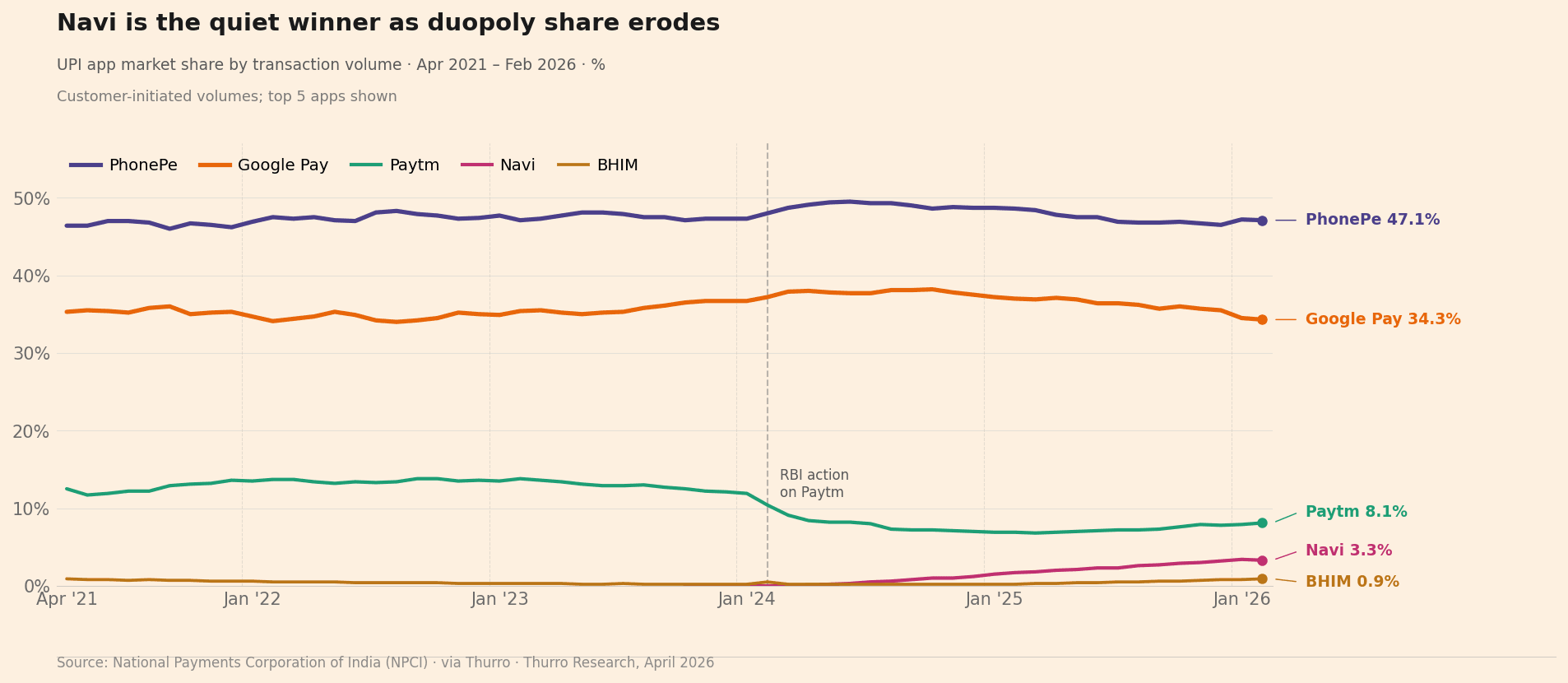
The combined share of the top two apps has declined to 81.4% by February 2026
The shift, however, is occurring at the margins. Data from Thurro’s platform shows that Navi has emerged as the primary beneficiary, growing from 2.3% to 3.3% share over the same period.
The divergence between volume and value is also visible at the app level. PhonePe’s share of total value stands at 50% and exceeds its volume share, indicating a skew toward higher-ticket transactions, while Google Pay remains broadly aligned across both metrics.
UPI continues to grow in scale
Overall, UPI continues to set new records, even as the system shows signs of structural maturity. Data from Thurro’s platform shows that in March 2026, the UPI processed 22.6 billion transactions worth INR 29.5 trillion (see chart 2). This represents an increase from roughly 20.4 billion transactions worth INR 26.8 trillion in February, marking one of the stronger sequential expansions in recent months.
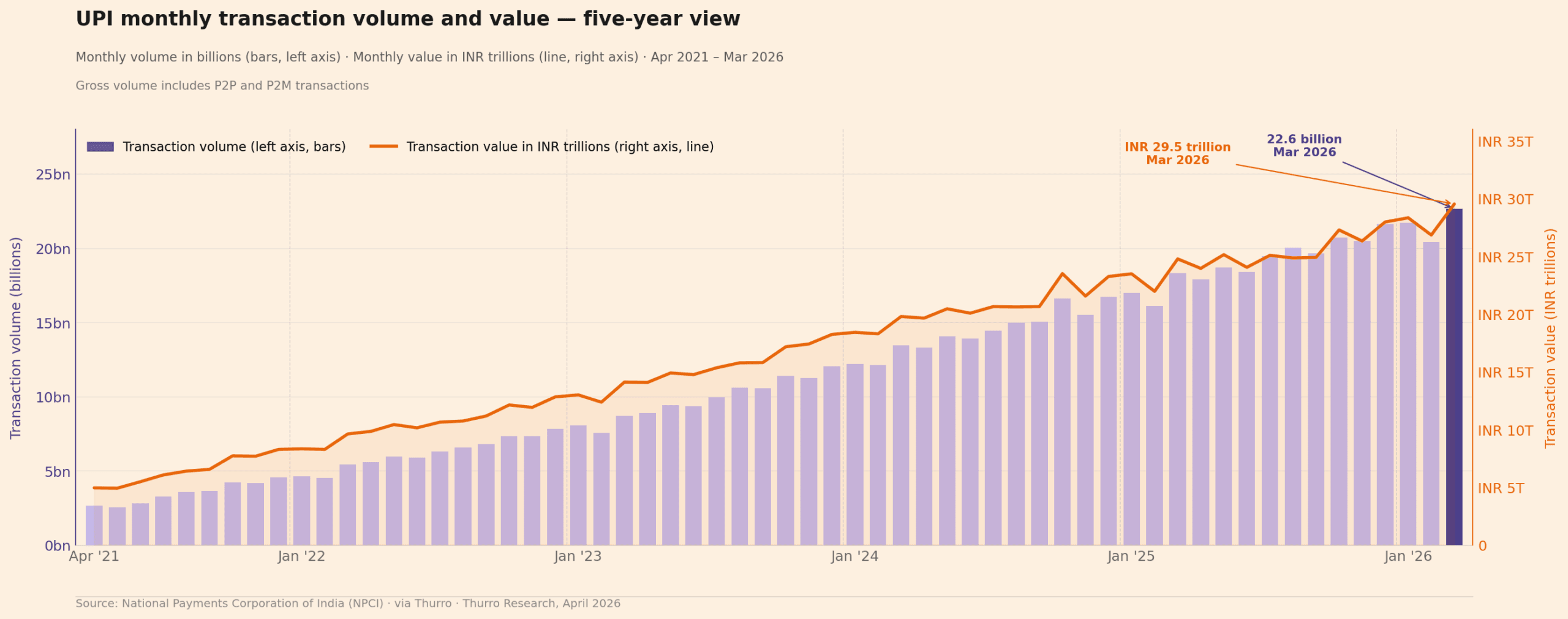
UPI continues to scale in both volume and value
Growth, however, is no longer being driven by new user behaviour, but by the stabilisation and redistribution of existing usage.
Two signals point to this transition. First, user behaviour has reached a near-term equilibrium. Peer-to-merchant (P2M) transactions (payments from consumers to merchants) now account for approximately 62–63% of total volumes, a share that has remained stable since mid-2025. In value terms, however, P2M transactions account for only 29% of total value (see chart 3).
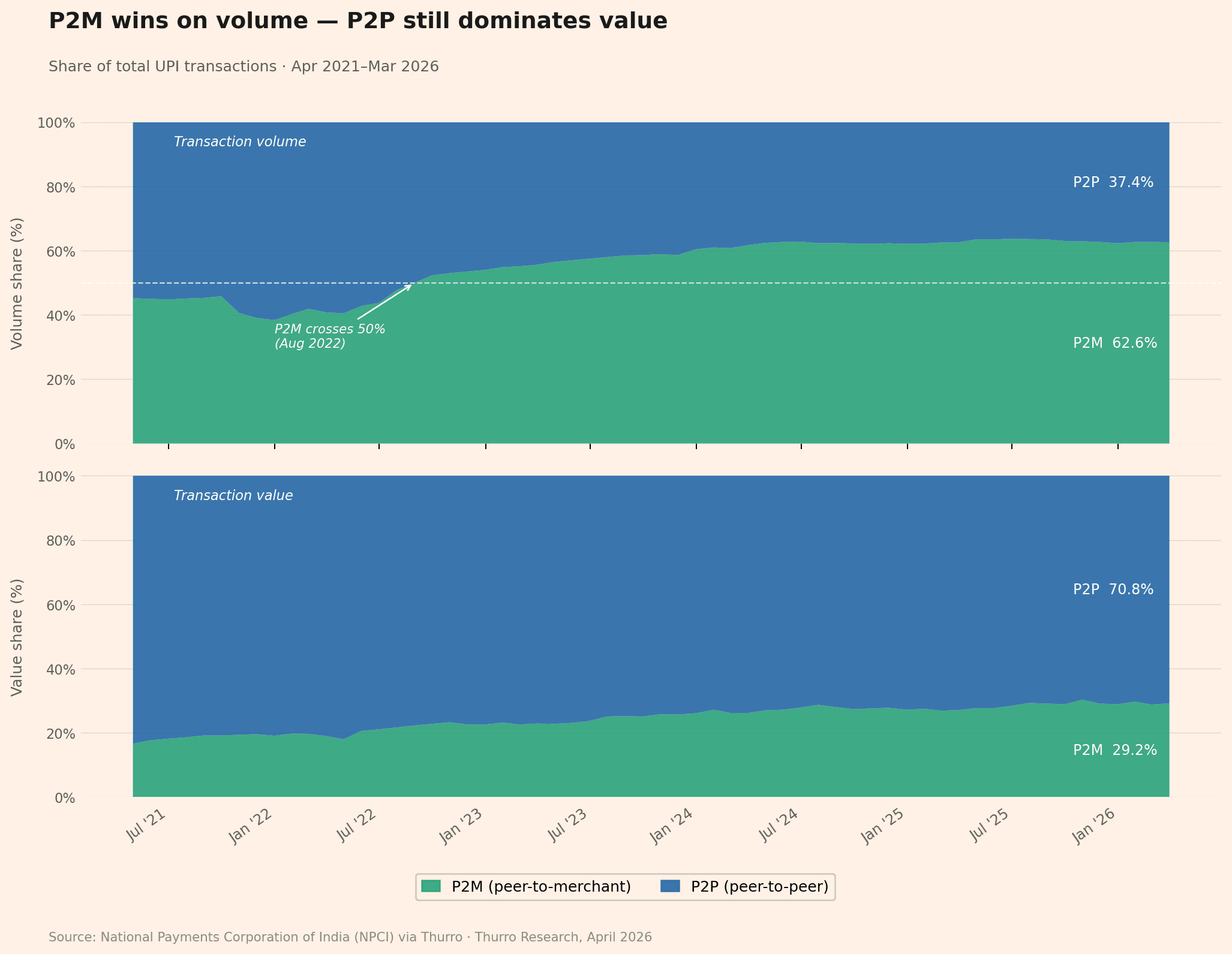
P2M vs P2P volume vs value share
This divergence is driven by the difference in ticket sizes. Average P2M transaction stood at INR 608 compared with INR 2,472 for P2P transfers in March 2026.
Second, at the system level, transaction values have stabilised. Average ticket sizes, which declined by roughly a third between 2021 and 2025, have stabilised in a narrow INR 1,285–1,318 range (see chart 4). Our note in January had identified a sustained compression, driven by UPI’s expansion into low-value, high-frequency use cases. The system appears to have reached a steady-state ticket size, suggesting that the behavioural transition from value-led to frequency-led usage is complete.
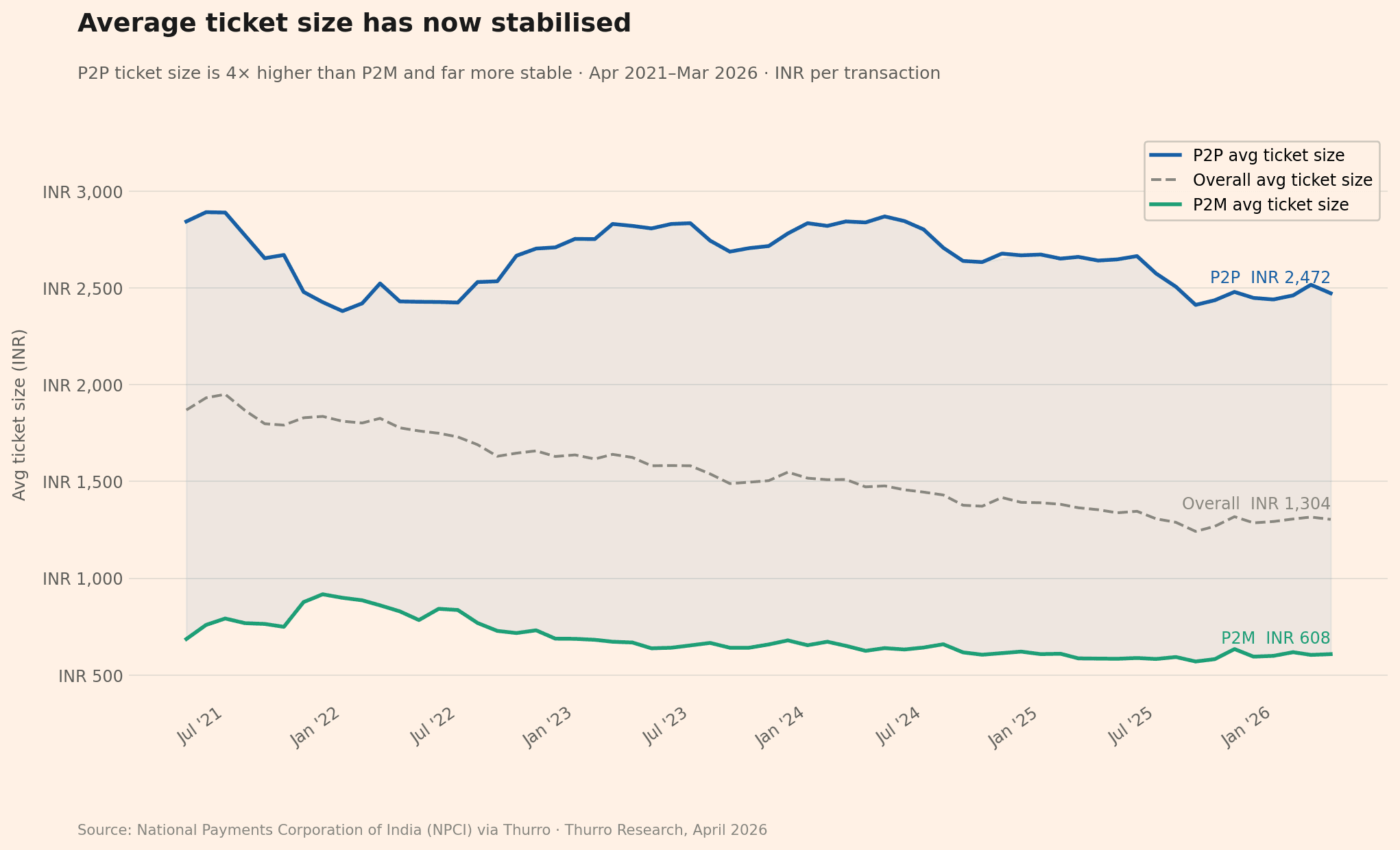
Average ticket size has stabilised in the INR 1,285-1,318 range
The most revealing evidence of system maturity, however, lies in how UPI is used. The category split shows a clear divergence between volume and value. High-frequency categories such as groceries and everyday retail dominate transaction counts, while financial categories—such as securities—account for a disproportionate share of value despite far fewer transactions (see chart 5). This indicates that UPI is no longer a single payments market, but two overlapping systems: a low-ticket, high-frequency rail for daily consumption, and a lower-frequency, high-value rail for financial activity.
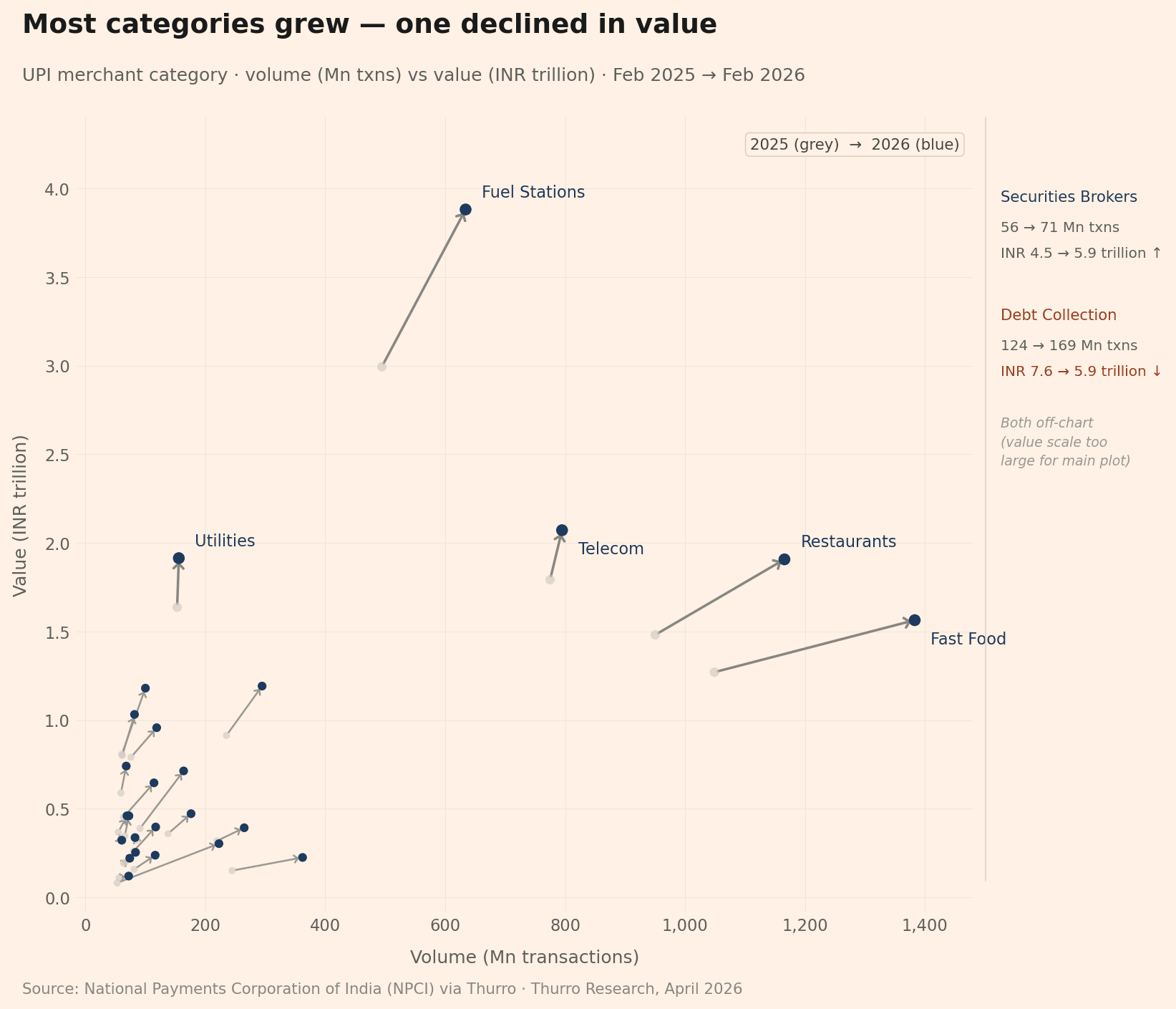
UPI splits into two distinct usage patterns
Usage patterns also exhibit clear temporal structure. Daily and monthly data show three recurring seasonal nodes. October remains the most visible spike, with Diwali consistently driving transaction volumes 10%-20% above baseline each year (see chart 6). At the same time, March is the highest month on average, reflecting a systematic financial year-end effect driven by business settlements, salary disbursements, and tax payments. A third, smaller peak appears around December–January, linked to year-end consumption. These patterns repeat consistently across years, indicating that UPI usage is now closely tied to the rhythm of both consumption cycles and financial activity.
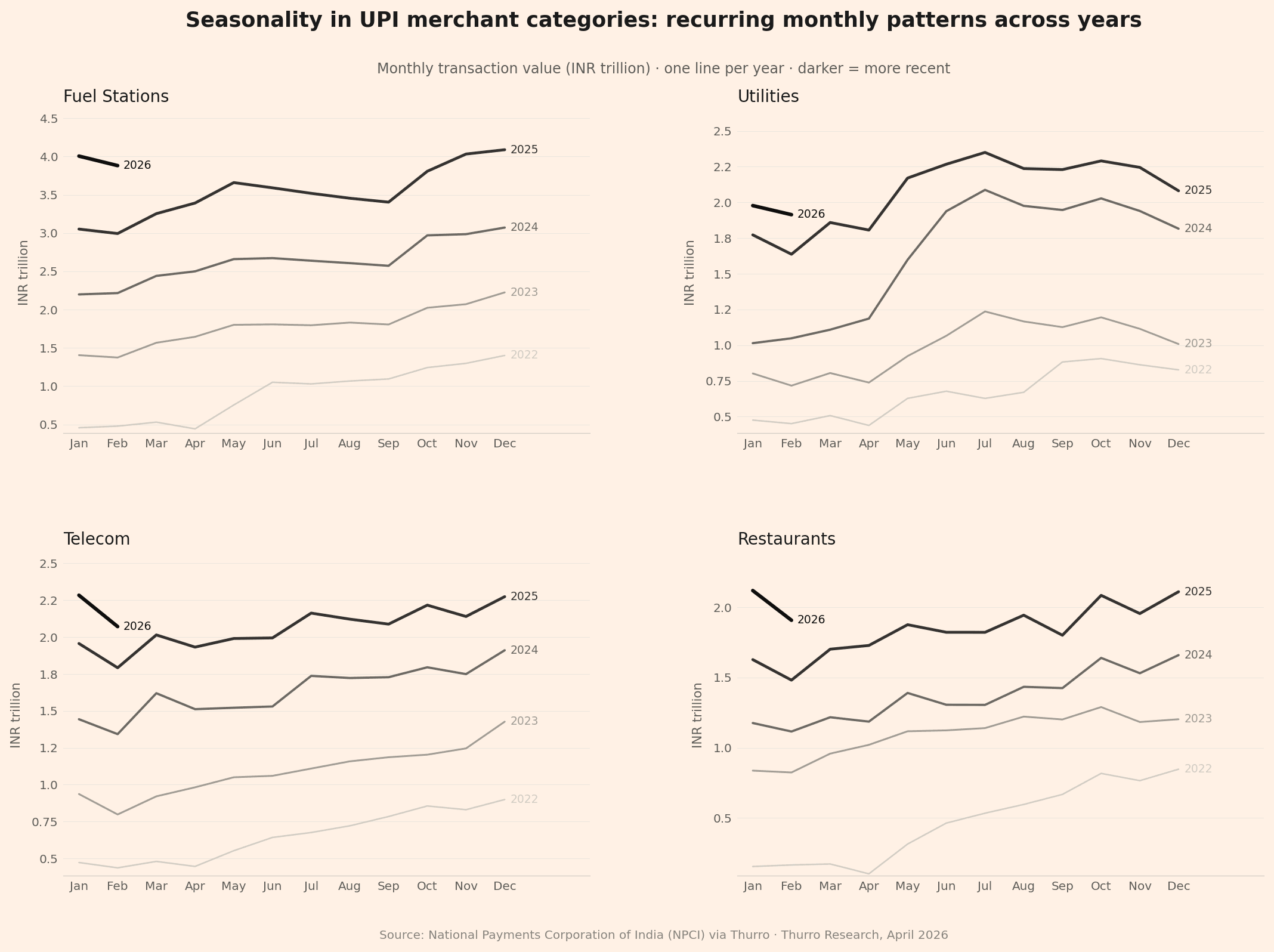
October remains the most visible spike, with Diwali consistently driving transaction volumes
UPI continues to expand in scale, but the nature of that growth has changed. What is emerging is a system defined by equilibrium: stable behaviour, incremental redistribution, and increasing intensity within an already mature payments network. The next phase will be less about expanding the system’s footprint, and more about who captures value within a system that has already scaled.
A more detailed version of this analysis, including underlying datasets and extended breakdowns, is available to clients on request. For access, please write to contact@thurro.com.
Cover photo credit: AI generated image
View disclaimer
Unlock the power of alternative data
Do not just follow the market — stay ahead of it. Thurro helps you transform raw filings and alternative datasets into actionable insights.
Explore Thurro AltData Book a demoRelated Articles
Nine years of net gold buying equals nine years of current account deficit — and it has doubled in value
India paid out $286bn for net gold between FY18 and FY26. Its cumulative current account deficit over the…
The UPI MDR pool is about ₹1,000 crore a month, and two-thirds of it sits where nobody can see it
Parliament has cleared the way for merchant charges on UPI. The merchant-category data says the revenue is real…
India’s commodity trade is running on price, not volume
India's trade value is still climbing — imports up about 18 percent and exports about 8 percent in…