


Growth in goods movement is outpacing Goods and Services Tax (GST) collections, reflecting a divergence between underlying activity and tax outcomes. Data from Thurro’s platform shows gross GST collections rose 5.8% year-on-year to INR 23.26 trillion in FY2026, while e-way bill assessable values grew 20.8% year-on-year in February 2026.
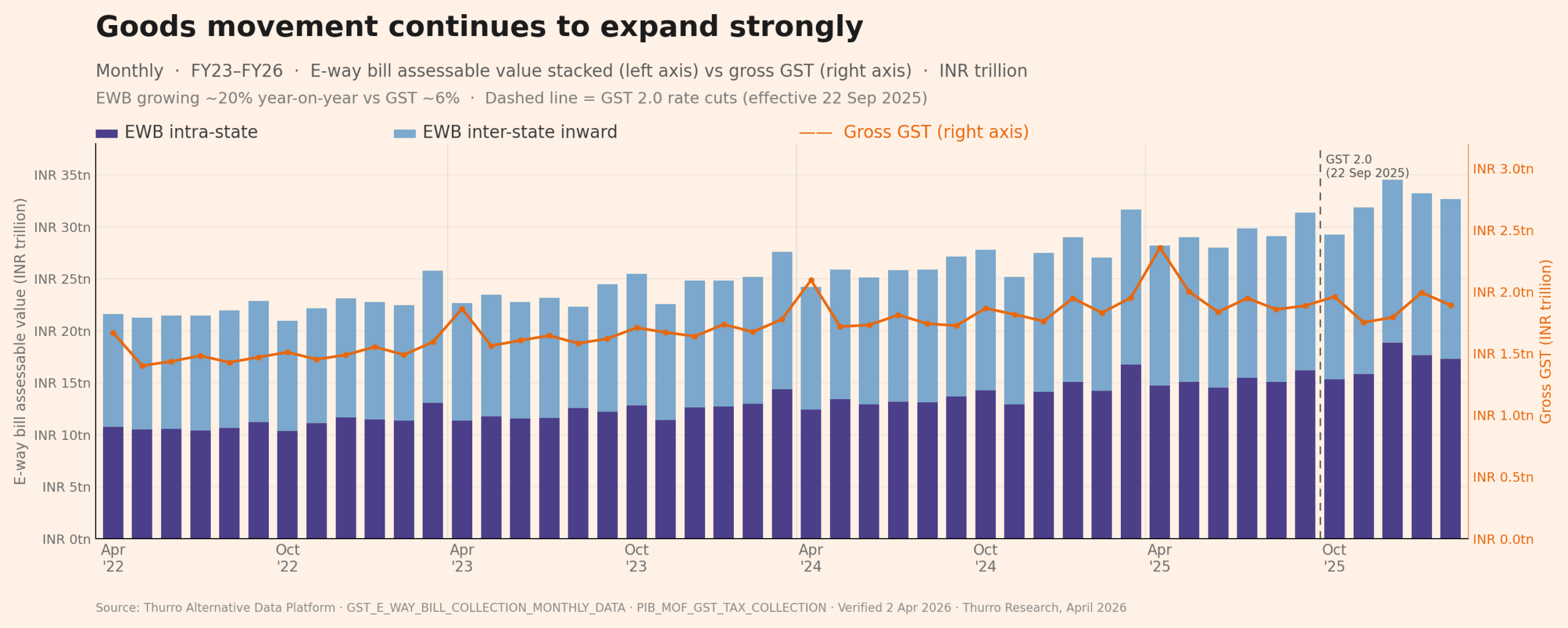
Assessable values rose around 20% year-on-year across both intra- and inter-state segments
However, this divergence is largely explained by the September 2025 GST rate rationalisation, which reduced effective tax rates even as underlying goods activity remained strong.
March 2026 GST collections stood at INR 2.00 trillion, up 2.6% from INR 1.95 trillion a year ago. At the monthly level, collections remained within a INR 1.75–1.99 trillion range for most of FY2026, indicating stable revenues despite the mid-year rate adjustment.
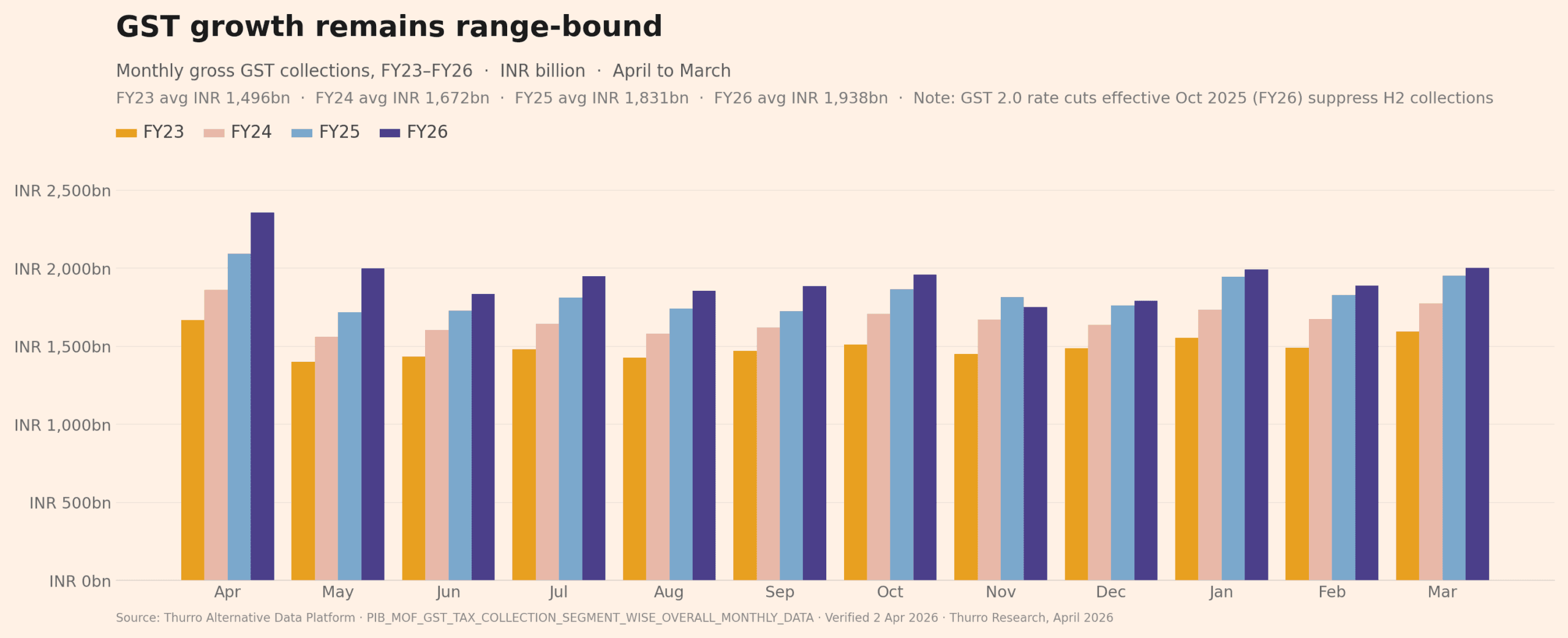
GST collections remained within a INR 1.75–1.99 trillion range for most of FY2026
By contrast, e-way bill data shows significantly stronger expansion in goods movement. Total assessable value of goods (inter-state inward plus intra-state) reached INR 32.65 trillion in February 2026, up 20.8% year-on-year. Intra-state and inter-state inward segments grew 21.4% and 20.2%, respectively.
Divergence driven by rate changes
The gap between goods movement and GST collections is primarily a rate effect. Lower GST rates mechanically reduce revenue growth relative to the pace of underlying activity.
E-way bill assessable values—capturing the value of goods movement within the GST-linked logistics system—continue to expand at a pace well above GST collections and nominal GDP growth of ~9–10% for FY2026.
Structural features of the data play a secondary role. GST aggregates both goods and services, while e-way bills capture only goods transactions. The GST composition is also shifting. March 2026 compensation cess collections fell to INR 1 billion from a typical ~INR 45–124 billion monthly range, reflecting the structural wind-down of the compensation cess mechanism.
System usage continues to expand. Total e-way bills generated reached 131.5 million in February 2026, up 19.6% year-on-year, while registered GST taxpayers increased 7.3% to 16.1 million, indicating rising transaction intensity per taxpayer.
Concentration and imbalances
A persistent feature in the data is the inter-state gap, where inward assessable value exceeds outward value. In February 2026, this gap stood at 3.96% of inward value, close to the 59-month average of ~4.5%. This reflects asymmetric GSTN classification of transactions rather than underlying trade imbalances.
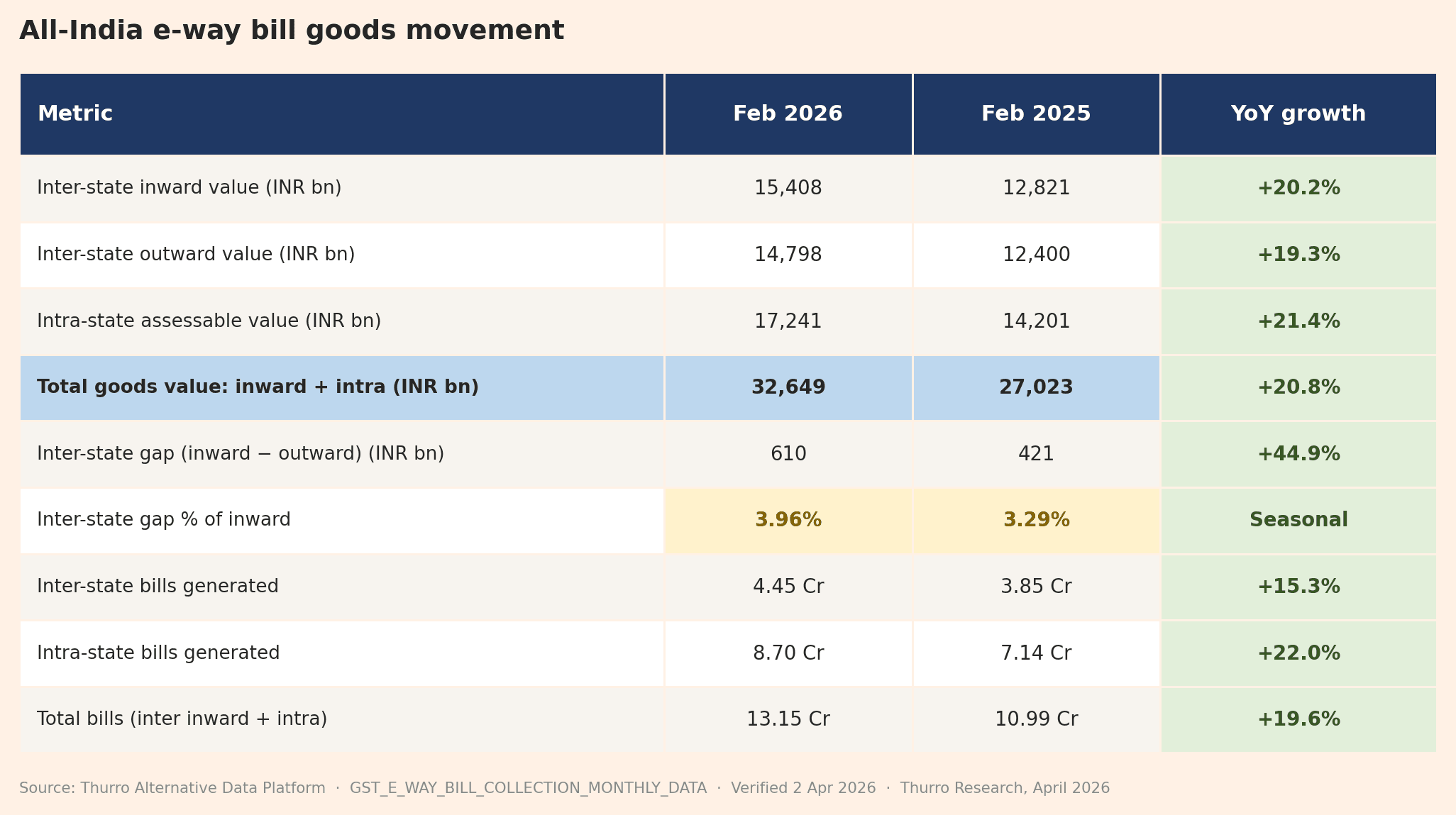
In February 2026, the inter-state gap stood at 3.96% of inward value
State-level concentration remains high. The top five states—Maharashtra, Karnataka, Gujarat, Tamil Nadu, and Haryana—accounted for 56.5% of total state GST collections in February 2026, reinforcing the concentration of tax generation within a limited set of industrial and consumption centres.
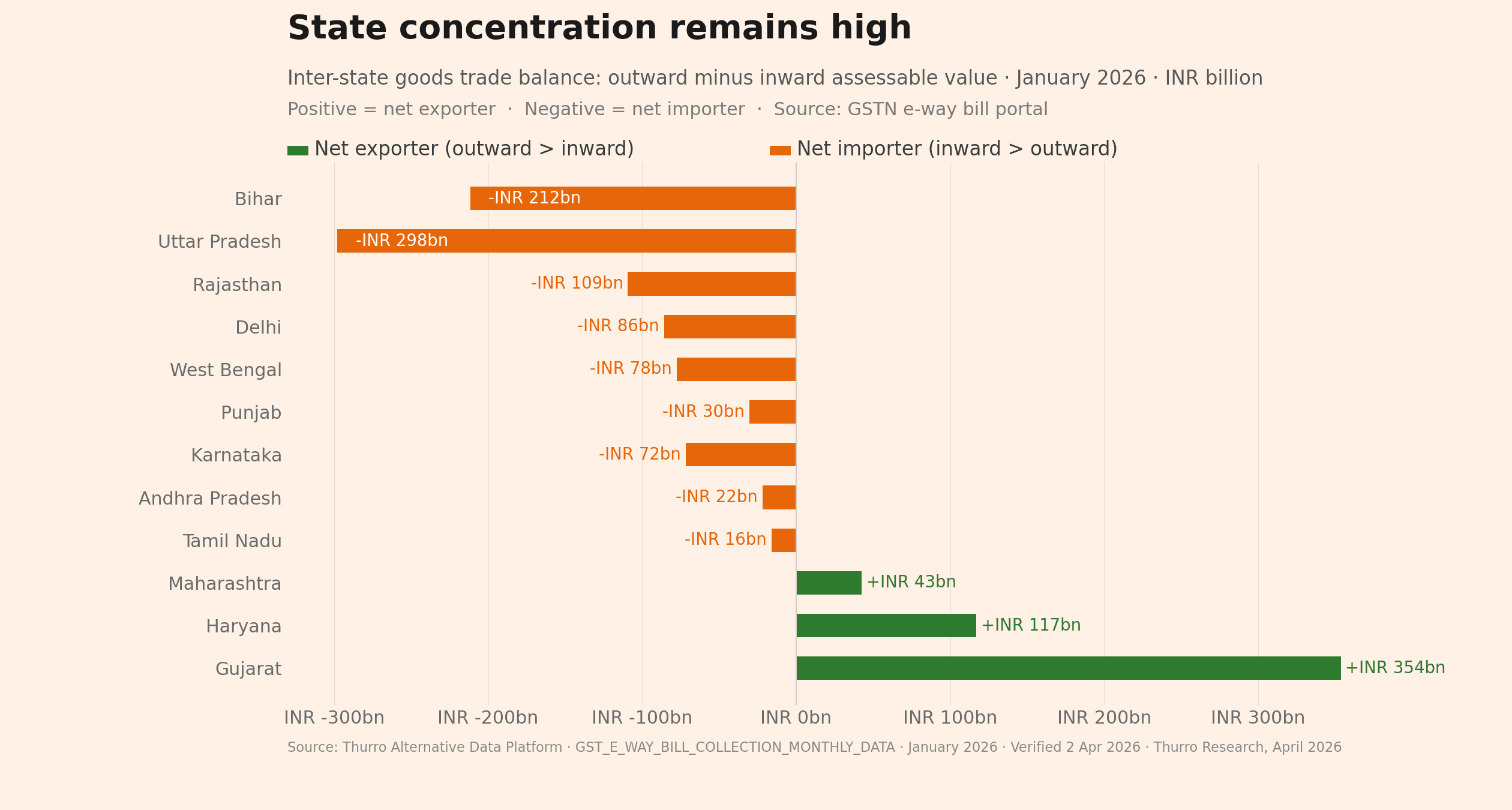
Inter-state trade balances remain asymmetric across states
A more detailed version of this analysis, including underlying datasets and extended breakdowns, is available to clients on request. For access, please write to contact@thurro.com.
Cover photo credit: AI generated image
View disclaimer
Unlock the power of alternative data
Do not just follow the market — stay ahead of it. Thurro helps you transform raw filings and alternative datasets into actionable insights.
Explore Thurro AltData Book a demoRelated Articles
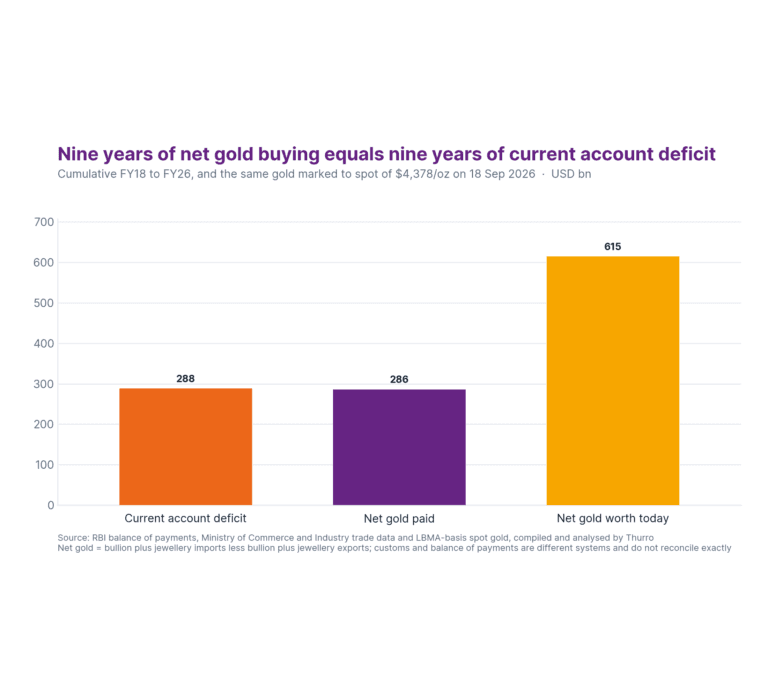
Nine years of net gold buying equals nine years of current account deficit — and it has doubled in value
India paid out $286bn for net gold between FY18 and FY26. Its cumulative current account deficit over the…
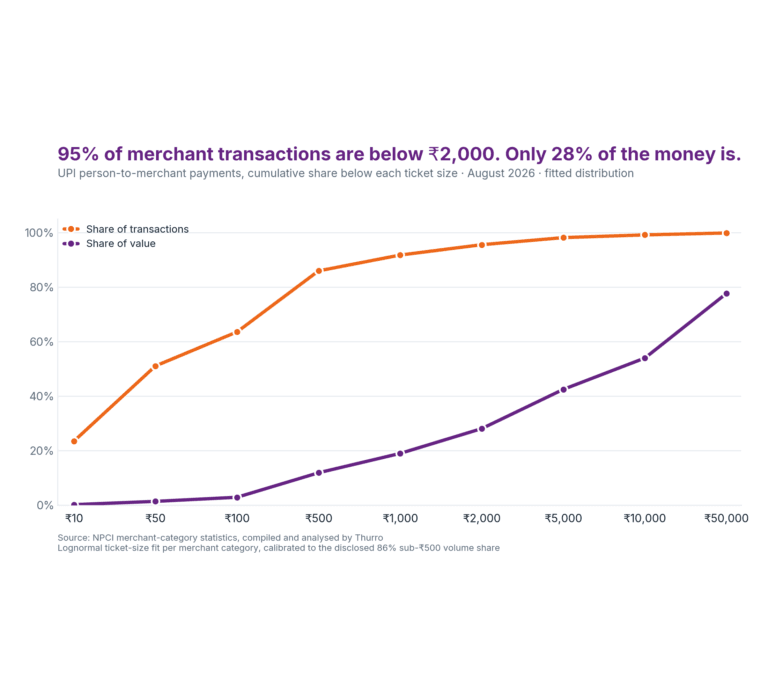
The UPI MDR pool is about ₹1,000 crore a month, and two-thirds of it sits where nobody can see it
Parliament has cleared the way for merchant charges on UPI. The merchant-category data says the revenue is real…
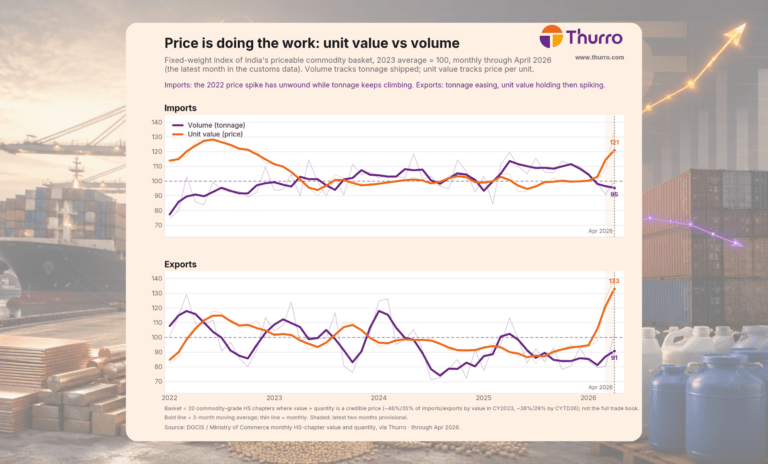
India’s commodity trade is running on price, not volume
India's trade value is still climbing — imports up about 18 percent and exports about 8 percent in…