

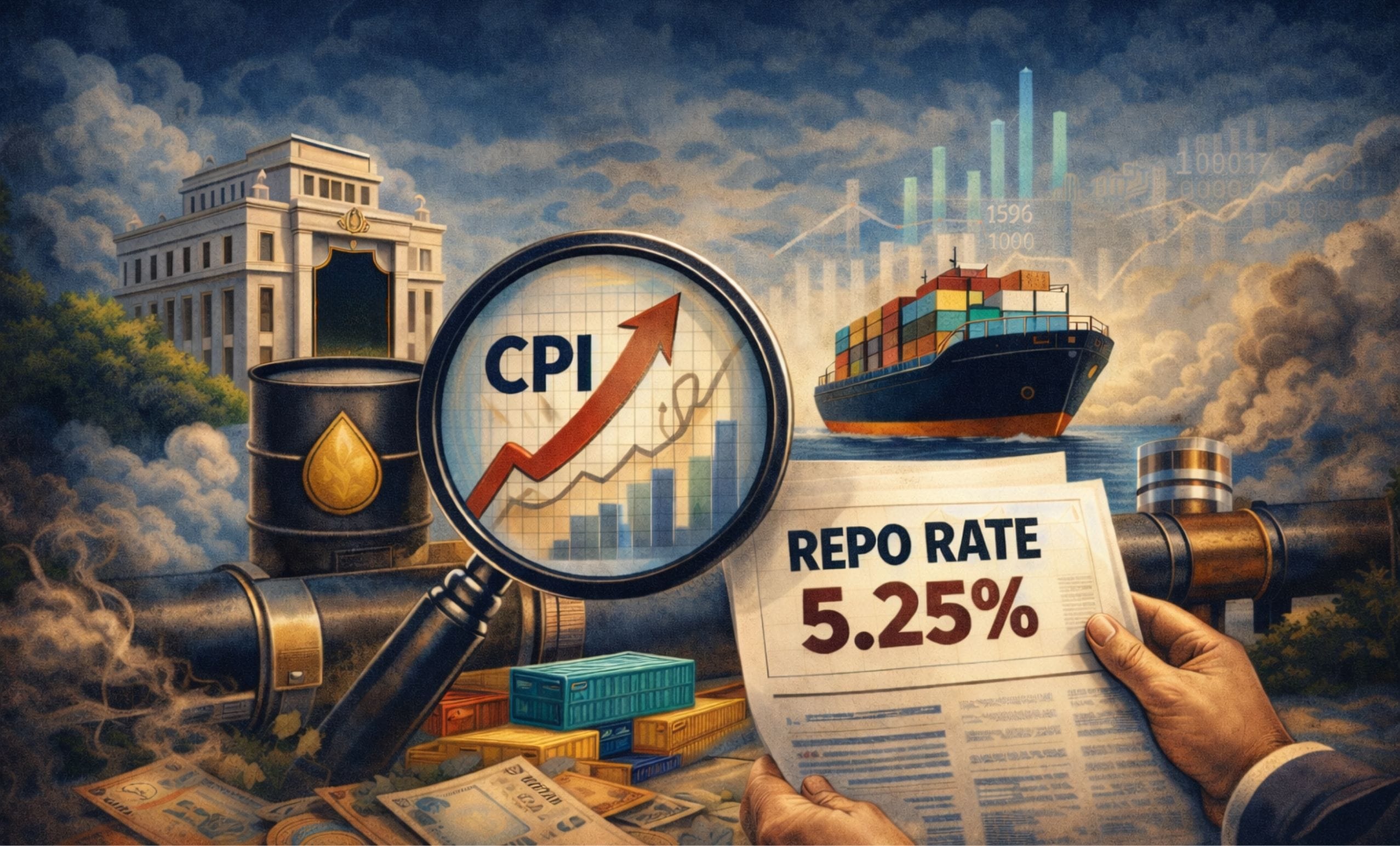

The Reserve Bank of India (RBI) on Wednesday kept its key policy rate unchanged at 5.25%, extending its pause while retaining a neutral stance, as the Monetary Policy Committee (MPC) chose continuity over pre-emption. That caution comes against an unsettled global backdrop, with volatile energy markets, fragile shipping routes, and tightening financial conditions.
Growth projections remain broadly intact. The RBI expects GDP growth at 7.6% for FY2026 and 6.9% for FY2027, supported by consumption, investment, and services. Inflation, meanwhile, appears contained in current data. Headline CPI stood at 3.2% in February 2026, with core inflation subdued.
The risks, however, are clearly identified by the RBI:
- volatility in global energy prices
- disruptions in supply chains and shipping routes
- food price uncertainty
- and the risk of second-round effects
This is a supply-driven risk environment, with inflation pressures shaped primarily by external shocks rather than domestic demand, as the RBI noted in its Monetary Policy Report.
Inflation remains the anchor for policy
Despite the shifting global backdrop, the RBI’s framework remains unchanged.
Inflation control continues to be the central objective of policy. The committee has reiterated its commitment to keeping inflation aligned with the 4% target, while managing growth trade-offs.
This makes inflation the binding constraint for policy decisions. The issue, however, is not whether the RBI recognises these risks—the policy statement explicitly does. The RBI’s communication reflects clear awareness of these risks, including the uncertainty around their magnitude and timing, as seen in its use of charts and scenario-based projections. The constraint lies in how these risks are measured within the policy framework.
The RBI’s own projections reflect this uncertainty. The inflation fan chart released with the policy shows a wide distribution of outcomes, with the upper bound extending into double digits and the central tendency closer to 6%. This indicates that the committee is explicitly incorporating the risk of a sharp inflation shock.
The February policy statement came at a time when Brent crude was at USD 68.05 per barrel, broadly stable since October 2025. What followed was a sharp regime shift. The Iran war pushed Brent to USD 108.23 by 8 March, and prices have held above USD 100 since. As of 6 April, Brent stood at USD 109.77—an increase of over 60% from the February MPC meeting.
This shift is not yet visible in the realised CPI data that anchors policy decisions.
The primary variable guiding policy—CPI inflation—does not yet reflect this shift in measurable form. No CPI print yet captures any part of this move. Even the March inflation numbers, due next week, will only partially reflect the shock. By then, crude would have been elevated for nearly six weeks—long enough to begin transmitting through fuel, logistics, and core inflation channels. The 3–5 June MPC will be the first meeting where the committee can act on data reflecting today’s energy reality.
Policy, therefore, incorporates forward-looking risk assessment, but remains anchored to realised inflation that updates with a lag.
The inflation pipeline has already turned
Inflation in this cycle follows a sequence: energy → logistics → wholesale → retail → CPI. By the time it appears in CPI, it is already several weeks old.
The early stages of this transmission are already visible.
Data from Thurro’s platform shows that upstream price signals have begun to shift. Wholesale pulses have moved first, with tur/arhar prices up 11.1% since October and remaining elevated for three consecutive months. Edible oils, which are directly linked to global energy prices, are beginning to respond, although domestic wholesale prints still understate the international move.
Freight costs are also reversing direction. The Drewry World Container Index, which had been in a sustained downtrend, has risen around 20% from its February trough, indicating a break in the disinflationary trend in logistics.
At the same time, the energy shock itself remains only partially visible in retail prices. LPG prices have been raised, but petrol and diesel remain administratively frozen, absorbing the shock at the government level rather than transmitting it immediately into CPI.
This creates a staggered inflation pipeline: energy prices adjust first, followed by logistics and wholesale prices, with CPI reflecting the impact last. CPI therefore reflects price movements from several weeks earlier.
Most of inflation is already observable in real time
Approximately 56% of India’s CPI basket can be mapped to high-frequency, market-linked prices that are updated daily or weekly.
This includes:
- Energy: daily prices of Brent crude, LPG, kerosene
- Transport: petrol and diesel prices, airline fares
- Food: mandi-level agricultural prices (via eNAM), wholesale prices (Consumer Affairs), and retail prices from e-commerce platforms
- Housing inputs: cement prices, rental listings
- Electricity: intraday power prices from exchanges
Each of these data streams captures a different stage of the inflation transmission process, often several weeks ahead of official CPI releases.
Brent crude prices, for instance, move daily and lead CPI by several weeks. Wholesale food prices, mandi prices, and retail digital prices provide progressively closer signals to final consumer inflation.
Taken together, these datasets provide a near real-time view of inflation formation, complementing the official CPI framework. And it could be done by nowcasting.
Why a full CPI NowCast is not yet feasible
While a large share of the CPI basket can be tracked through high-frequency, market-linked prices, a complete NowCast of headline inflation is not yet feasible.
Thurro’s food and beverage inflation NowCast has historically tracked official MoSPI prints closely. For most of 2024 and 2025, the model aligned with realised inflation across periods of sharp inflation, disinflation, and deflation. However, this continuity was disrupted with the transition to the new CPI series.
The shift to the 2024 base and the adoption of the COICOP 2018 classification framework altered the statistical architecture of the index. Detailed sub-component histories are available only from January 2025 onwards, with no comparable back-series at the level required for model calibration. As a result, historical coefficients cannot be directly applied, and division-level mappings have been disrupted.
While the necessary weights and structural data are now available under the new series, the limited post-base time series—starting only from January 2025—restricts the model’s ability to recalibrate. With a shorter history, statistical relationships remain relatively unstable compared to what a full business cycle of data would allow, affecting the reliability of current NowCast outputs.
In addition, a significant share of the CPI basket—covering categories such as health, education, clothing, and parts of housing—does not have reliable real-time price proxies. These components are measured through surveys or administered pricing structures and update at a lower frequency.
The limiting factor
The RBI’s current stance is internally consistent. Inflation is within target, core pressures are subdued, and growth remains stable. However, the framework relies on inflation data that updates with a lag relative to the speed of the current shock.
In a supply-driven cycle, where price movements originate externally and transmit quickly across sectors, this lag can become a structural constraint on policy calibration. The challenge, therefore, lies in observing inflation dynamics in real time within the variables that guide policy decisions. High-frequency data can improve this visibility, complementing existing frameworks rather than replacing them.
Cover photo credit: AI generated image
View disclaimer
Unlock the power of alternative data
Do not just follow the market — stay ahead of it. Thurro helps you transform raw filings and alternative datasets into actionable insights.
Explore Thurro AltData Book a demoRelated Articles
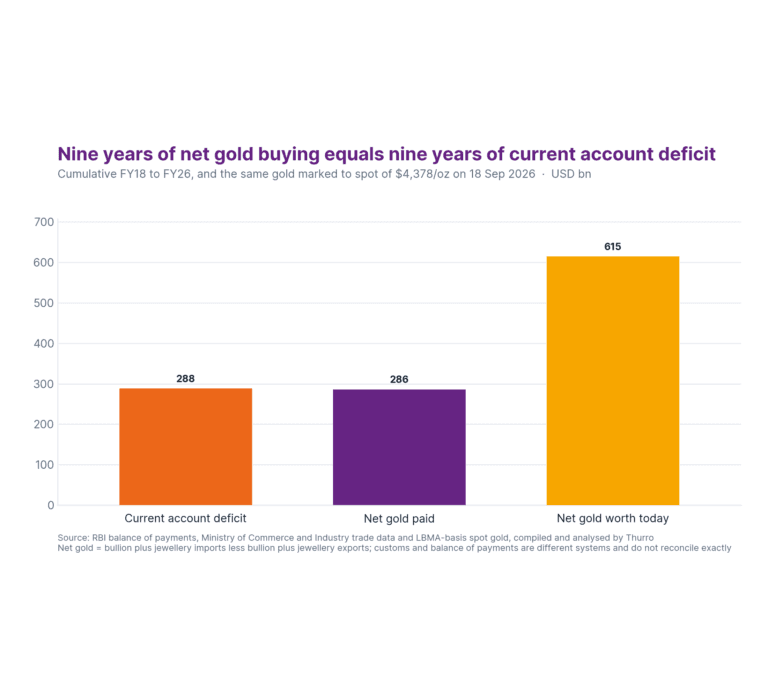
Nine years of net gold buying equals nine years of current account deficit — and it has doubled in value
India paid out $286bn for net gold between FY18 and FY26. Its cumulative current account deficit over the…
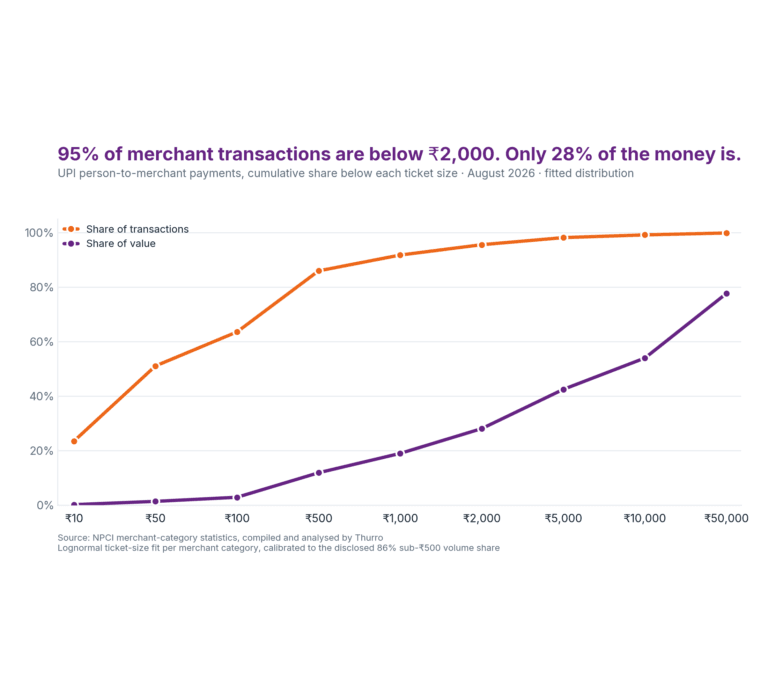
The UPI MDR pool is about ₹1,000 crore a month, and two-thirds of it sits where nobody can see it
Parliament has cleared the way for merchant charges on UPI. The merchant-category data says the revenue is real…
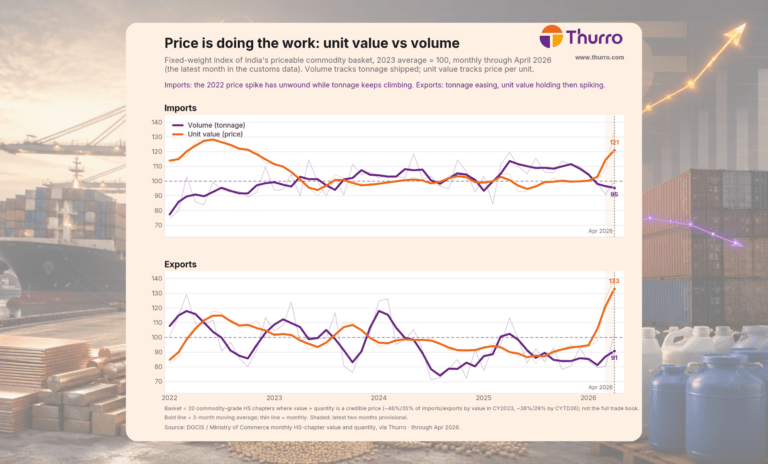
India’s commodity trade is running on price, not volume
India's trade value is still climbing — imports up about 18 percent and exports about 8 percent in…