



India’s electricity system continues to remain overwhelmingly coal-driven, insulating it from global oil shocks even as logistics constraints create some localised shortages.
Data from Thurro’s platform shows that coal continues to dominate India’s power generation in unit terms, not just installed capacity. Thermal generation accounts for roughly three-quarters of total electricity produced, with coal alone contributing close to 70% of all units generated.
Capacity metrics often overstate the role of renewables, but in actual electricity delivered to the grid—measured in units (kWh)—coal remains the backbone of the system. The implication is straightforward: the bulk of electricity in India is still coal-fired. This reliance on coal is reflected in plant-level inventories, which remain broadly stable in aggregate but uneven across regions (see Chart 1).
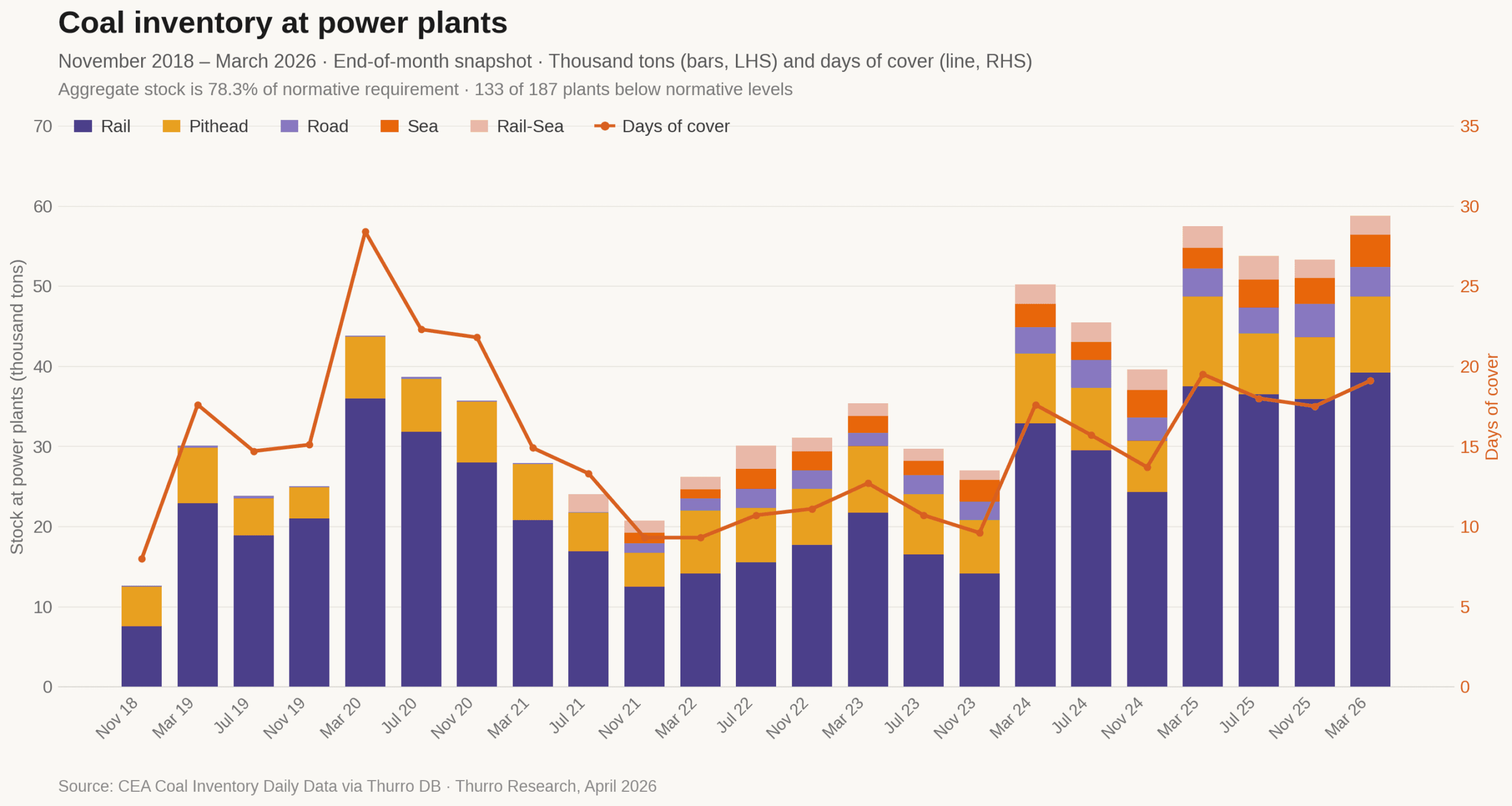
Aggregate coal stocks at thermal power plants have remained around 18–20 days of consumption over the last 12 months
It also means that India’s electricity sector is structurally insulated from crude oil price shocks —not just at the point of generation, but across the supply chain. Coal movement is dominated by rail and pithead linkages, with the railway network now largely electrified.
Recent data show that coal production has remained robust, exceeding 100 million tons per month since December 2025. However, despatch has lagged production, creating a persistent gap between output and usable supply (see Chart 2).
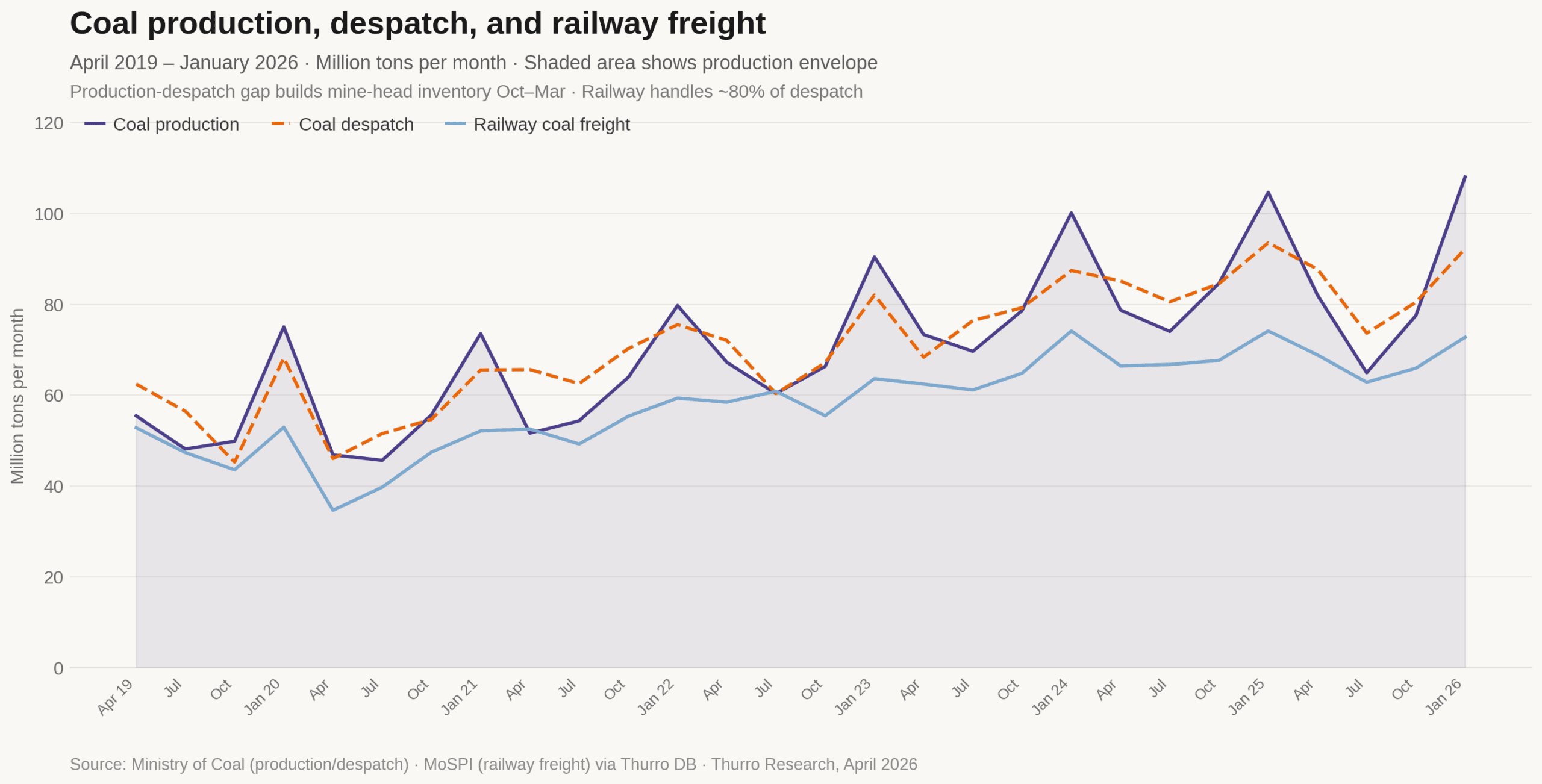
Coal despatch has lagged production, creating a persistent gap between output and usable supply
Notably, despatch remains relatively stable even during monsoon months, when production typically softens, reflecting the system’s ability to smooth seasonal supply fluctuations. However, due to the lag between output and usable supply, incremental production is not fully translating into coal available at the plant level.
The effect is visible in plant-level inventory patterns. Aggregate coal stocks at thermal power plants have remained around 18–20 days of consumption over the last 12 months. However, this headline number masks sharp regional disparities. Plants linked to rail-sea routes and coastal supply chains continue to report lower inventory cover, reflecting uneven distribution.
This is where recent tighter inventory positions at ports such as those operated by Adani and other coastal handling facilities need to be interpreted carefully (see Chart 3). In many cases, lower inventory reflects operational choices and not supply stress, particularly among private operators that run leaner, just-in-time systems. These patterns reflect frictions in the logistics chain—particularly in the movement of coal from pithead mines in eastern and central India, through rail corridors, to coastal ports and onward to end-users.
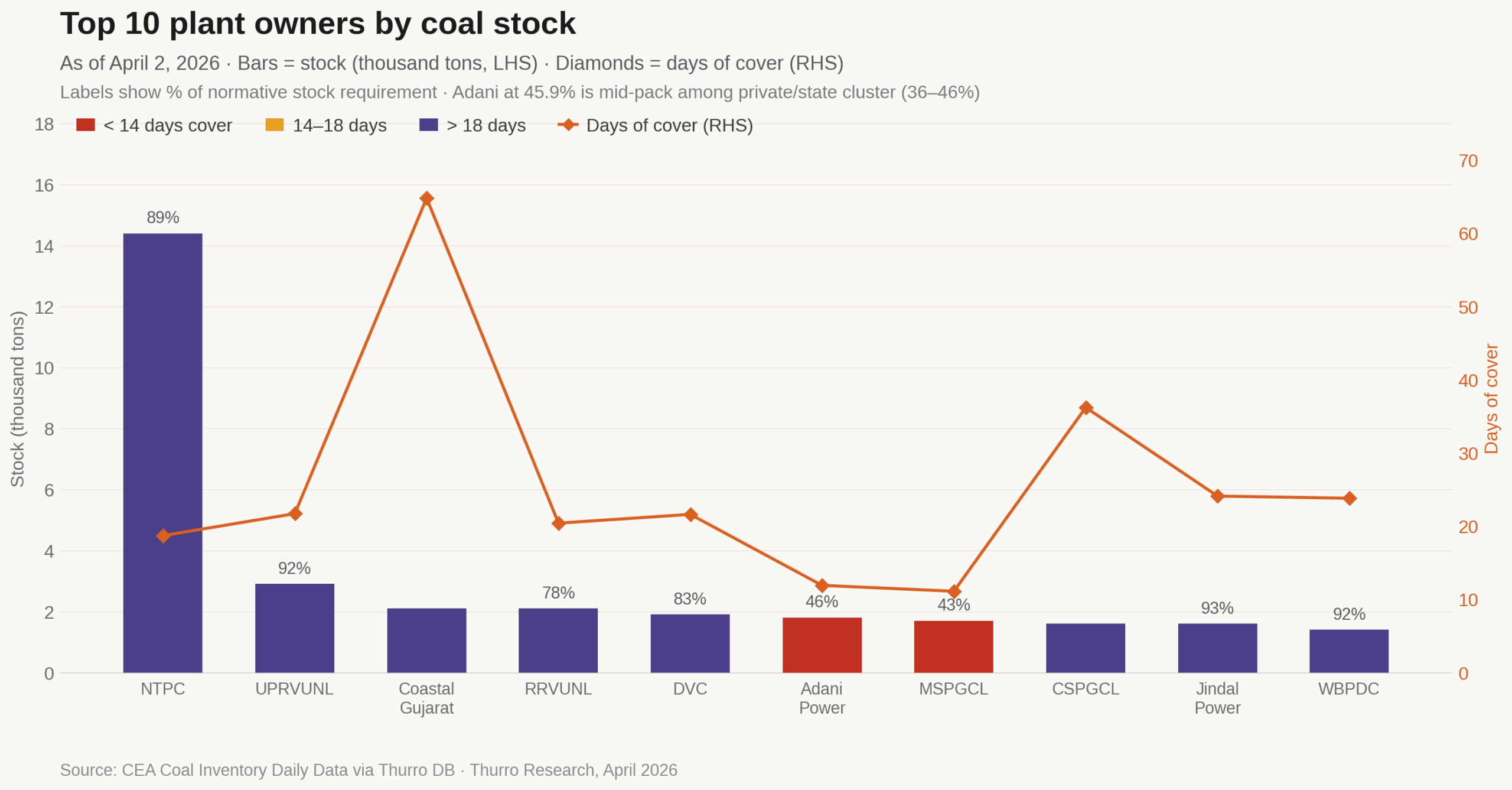
Frictions in the supply chain have constrained the flow of coal
A large share of coal supply to power plants—nearly 50,000 tons of daily inventory—is routed through rail and pithead linkages, both largely insulated from crude price movements. Road-based transport accounts for only a small share, limiting the system’s exposure to diesel-driven cost volatility.
Plants dependent on longer-distance coal movement—whether coastal or inland—are more exposed to these disruptions. Congestion in key rail corridors, combined with limited rake availability and long turnaround times, continues to constrain coal flows.
The railway system remains the central backbone of coal evacuation, providing consistent despatch even as production fluctuates. However, capacity constraints in high-density corridors limit how quickly incremental production can be absorbed. In several high-density corridors, rake cycle times—the time taken for a rake to be loaded, transported, unloaded, and returned for reuse—have stretched significantly, with mines waiting multiple days—sometimes weeks—for allocation (see Chart 4).

In several high-density corridors, rake cycle times have stretched significantly
This effectively caps the amount of coal that can be delivered to power plants, regardless of how much is produced at the source. This means that localised supply tightness can emerge even when overall coal availability remains adequate.
This also explains the persistence of periodic “shortage” narratives despite improving headline metrics. Coastal plants, which rely on blended supply chains involving rail and port handling, are particularly exposed to these disruptions.
Policy responses are increasingly focused on addressing this bottleneck. Investments in railway capacity, dedicated freight corridors for coal, and first-mile connectivity projects aim to reduce loading times and improve evacuation efficiency.
Unlike oil-dependent systems, India’s electricity sector remains insulated from crude shocks. The constraint is internal: logistics, not fuel availability.
A more detailed version of this analysis, including underlying datasets and extended breakdowns, is available to clients on request. For access, please write to contact@thurro.com.
Cover photo credit: AI generated image
View disclaimer
Unlock the power of alternative data
Do not just follow the market — stay ahead of it. Thurro helps you transform raw filings and alternative datasets into actionable insights.
Explore Thurro AltData Book a demoRelated Articles
Nine years of net gold buying equals nine years of current account deficit — and it has doubled in value
India paid out $286bn for net gold between FY18 and FY26. Its cumulative current account deficit over the…
The UPI MDR pool is about ₹1,000 crore a month, and two-thirds of it sits where nobody can see it
Parliament has cleared the way for merchant charges on UPI. The merchant-category data says the revenue is real…
India’s commodity trade is running on price, not volume
India's trade value is still climbing — imports up about 18 percent and exports about 8 percent in…