

Overview
The AltData section in Thurro Answers provides access to visualised alternative datasets that reveal trends in companies, sectors, and the broader economy.
These charts combine data from multiple sources to surface real-world signals such as demand trends, market share changes, and operational indicators.
AltData allows you to quickly explore insights through interactive charts, making it easier to identify patterns and developments across industries.
What you will find in AltData
Inside the AltData section, you will find:
- Trending charts highlighting key market developments
- Search tools to quickly locate relevant datasets
- Filters for structured exploration across sectors and companies
- Data dictionary to browse all available charts and datasets
- Premium charts that provide forward-looking signals
Together, these tools help you move from broad discovery to focused analysis.
Exploring Trending charts
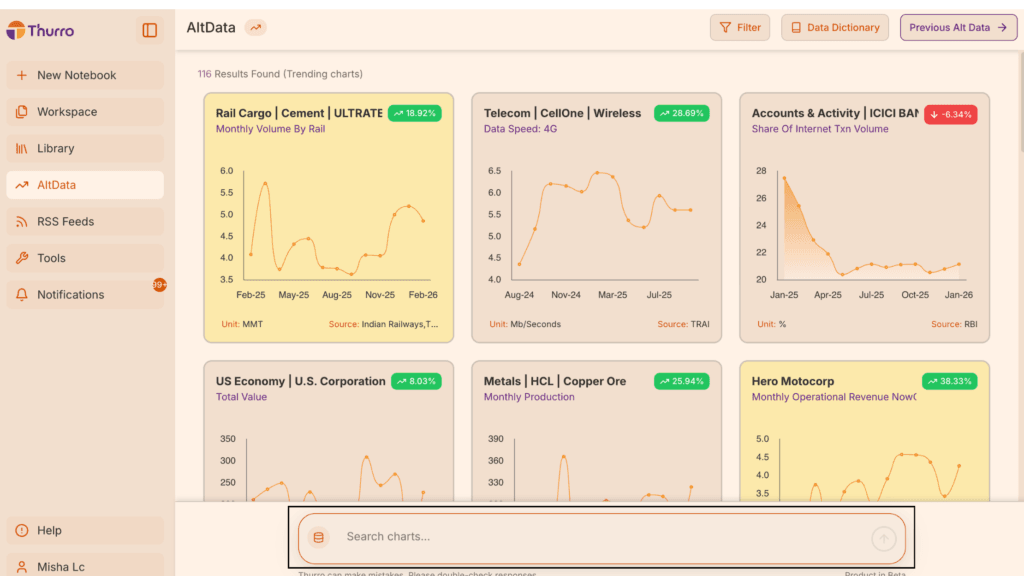
When you first open the AltData section, you will see Trending Charts at the top of the page.
These charts highlight important developments across sectors and companies based on recent data trends.
Trending charts are useful for:
- Spotting signals across sectors and markets
- Quickly identifying emerging industry trends
- Discovering new datasets available on the platform
Searching for charts
The fastest way to find relevant charts is by using the search bar at the bottom of the AltData page.
Simply type a keyword related to the company, sector, or metric you want to explore.
Examples: Maruti, Maruti market share, EV demand, ATM transactions
The platform will return charts related to the keyword you entered.
This works similarly to a search engine and is often the quickest way to discover available datasets.
Navigating charts using filters
Filters allow you to explore datasets in a more structured way. This method is especially useful when conducting sector deep dives.
A typical workflow is:
- Select a sector
- Choose a sub-sector
- Select a company
- Apply data point filters
Each filter step narrows the results and helps you locate specific datasets.
The filter dropdown menus also act as a guide to the available data points, showing you what metrics exist within that category.
For example, applying filters for ATM-related datasets may reveal charts tracking ATM usage, transactions, or related metrics.
Using the Data Dictionary
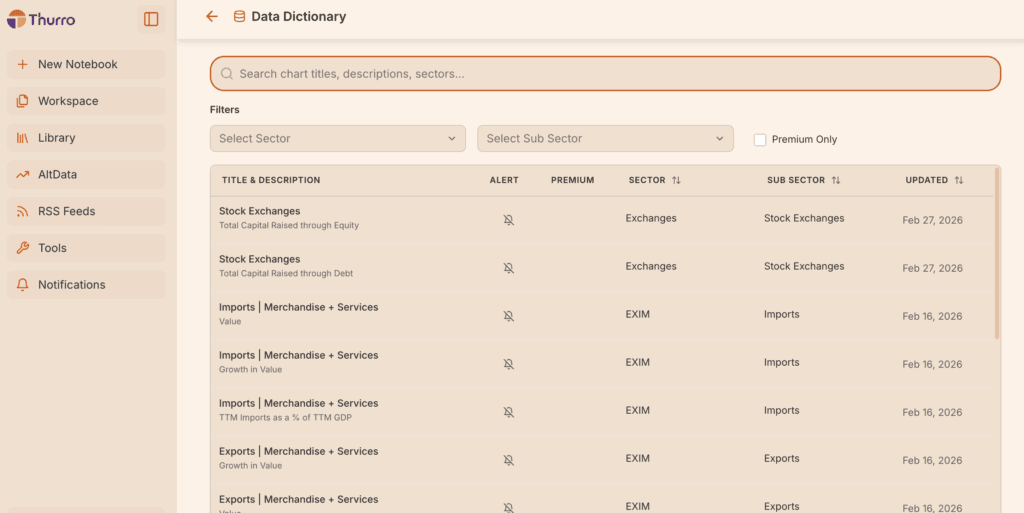
The Data Dictionary provides a complete list of all available charts on the platform.
Each entry includes:
- Chart title
- Dataset description
- Sector and sub-sector classification
- Last updated date
This helps you understand what the chart represents and how frequently the data is updated.
You can browse the Data Dictionary in two ways:
- Using the search bar
- Applying filters
The Data Dictionary is particularly useful when exploring datasets across unfamiliar sectors.
Premium charts
AltData also includes Premium Charts, which provide forward-looking insights.
These charts use proprietary models to estimate near-term trends and signals.
Premium charts may include forecasts related to:
- Demand signals
- Liquidity conditions
- Revenue trends
- Sector activity indicators
These charts help identify early signals of changes in company or sector performance.
Best practices
To get the most value from AltData:
Start with search
If you already know the company or metric you want to analyse, start with the search bar.
Use filters for structured research
Filters are ideal for systematic exploration across sectors and companies.
Explore the Data Dictionary
Use the Data Dictionary to discover new datasets and understand the structure of the available data.
Why use AltData?
Alt Data provides a deeper layer of intelligence by surfacing signals that traditional financial data may miss. Using Alt Data, you can:
- Track real-world activity across industries
- Identify early signals of demand shifts
- Monitor company performance beyond financial statements
- Discover trends across sectors and markets
Alt Data transforms raw datasets into actionable visual insights that can enhance your research and decision-making.