



This analysis is based on Thurro’s AI-led reading of Union Budget speeches between FY2019 and FY2026. Instead of examining each Budget as a standalone event, Thurro’s AI-driven platform processes Budget speeches across years, allowing shifts in language, structure, emphasis, and time horizon to be identified at scale.
By structuring Budget documents into a searchable, comparable database and applying AI-assisted thematic and linguistic analysis, Thurro enables patterns to emerge that are difficult to detect through manual reading alone. This approach makes it possible to trace how the function of the Union Budget itself has evolved over time—beyond individual announcements or headline measures.
In the earlier notes of this series, we analysed how the Budget speeches have evolved over time and how they redefined their intended audience and economic priorities over the years. In this note, we analyse one of the key topics—employment—and how its relationship with the Budget evolved between FY2019 and FY2026.
Rather than treating employment as a standalone policy category, the speeches consistently embed work within broader themes—skills, sectors, platforms, and systems—often framed around building a ‘future-ready workforce’. Read across years, a clear pattern emerges. Employment is framed as an outcome that follows growth, not as a direct target of fiscal policy.
Across Budget speeches since FY2019, references to work, livelihoods, and economic participation are frequent. Direct discussion of jobs, hiring, or labour markets is not. Employment appears most often through adjacent ideas: skilling, productivity, enterprise creation, infrastructure expansion, manufacturing competitiveness, and increasingly, digital platforms. The result is a framing in which work is everywhere, but jobs remain largely implicit.
Phase I: Skilling as aspiration (FY2019–FY2021)
In the years before the pandemic, employment-related language in the Budget was dominated by preparation and aspiration. Skills, education, training, and human capital development featured prominently. Work was framed as something citizens needed to be equipped for, rather than something the state would directly provide.
Initiatives around vocational education, higher education reform, apprenticeships, and capacity building formed the core employment narrative. Even when longer-term economic ambitions were articulated, employment outcomes were implied rather than specified.
The underlying logic was straightforward: better skills would lead to “gainful” and “meaningful employment” once growth accelerated. In this phase, the state positioned itself as a facilitator of readiness. Jobs were expected to be available once individuals were prepared.
Phase II: Employability pipelines (FY2022-FY2024)
As the pandemic disrupted labour markets and economic activity, the Budget’s employment framing evolved. Skilling did not disappear, but it became more explicitly connected to sectors and delivery mechanisms.
MSMEs, manufacturing, infrastructure, digital public platforms, and emerging technology ecosystems were increasingly described as channels through which employment would flow, often emphasised for their “multiplier effect on employment”, with production linked incentive (PLI) schemes positioned as a key mechanism for translating investment and output expansion into jobs. Work was discussed through systems rather than individuals. Training linked to enterprise, enterprise to production, and production to growth.
Notably, FY2024 marked a relative inflection. The speech carried more explicit references to jobs and employment—particularly in the context of youth, skilling pipelines, startups, and emerging sectors such as digital services, electronics, and green energy. The expansion of digital public infrastructure, platform-based work, and support for startups implicitly acknowledged new forms of employment, including gig work and “platform workers”.
Yet even here, the emphasis remained indirect. The Budget avoided sector-level hiring expectations or labour-market targets. Employment was discussed as something enabled by ecosystems—through credit, infrastructure, digital rails, apprenticeship-linked skilling frameworks connecting training to industry, and sectoral competitiveness—rather than promised through policy.
Phase III: Systems create work (FY2025–FY2026)
By FY2025 and FY2026, the framing became fully structural. Employment largely disappeared as a standalone term. In its place came the language of engines, missions, and architecture.
MSMEs, exports, manufacturing, investment, and technology were positioned as growth engines within an explicit system architecture. Digital systems, AI-led productivity, platformisation, and global competitiveness entered the employment conversation not as channels for job creation, but as design features of an economy assumed to generate work at scale.
In this phase, jobs were treated as an emergent property of economic design rather than a policy objective in their own right, aligning with the framing of “employment-led development”. The state’s role was articulated as that of an architect—building frameworks, platforms, and incentives within which work would be created—rather than as an employer or direct job creator.
What this framing implies
Across all phases, certain elements remain absent. There is little sustained discussion of labour markets, wages, job quality, or employment security. The Budget focuses on macro systems and enabling frameworks. Even as the economy digitises and new forms of work emerge—platform-based jobs, gig work, and AI-adjacent roles—the Budget largely treats employment as something systems will generate, not something to be measured, targeted, or guaranteed.
This marks a clear departure from earlier development thinking, when the state, through public enterprises and large infrastructure projects—the so-called “temples of modern India”—was expected to directly create stable, high-quality employment. Read over time, the Budget reflects a long transition from the state as employer to the state as facilitator, designing conditions under which work is expected to follow growth. The Union Budget’s treatment of employment follows a clear trajectory:
Across FY2019 to FY2026, the Union Budget’s implied audience follows a clear progression:
- From preparing individuals for work
- To building sectoral pathways for employability
- To designing systems assumed to generate jobs
This evolution does not assess employment outcomes. It reflects how the state conceives its role in relation to work: as an enabler and architect of growth, with employment emerging as a consequence rather than a promise.
Cover photo credit: Unsplash
View disclaimer
Next: The sectoral story—how Budget priorities have evolved over time
This is the third in a series of Thurro analysis notes in the run-up to the Union Budget 2026. You can explore the underlying analysis interactively on our Thurro Answers Notebook or download the PDF version below to read offline.
Unlock the power of alternative data
Do not just follow the market — stay ahead of it. Thurro helps you transform raw filings and alternative datasets into actionable insights.
Explore Thurro AltData Book a demoRelated Articles
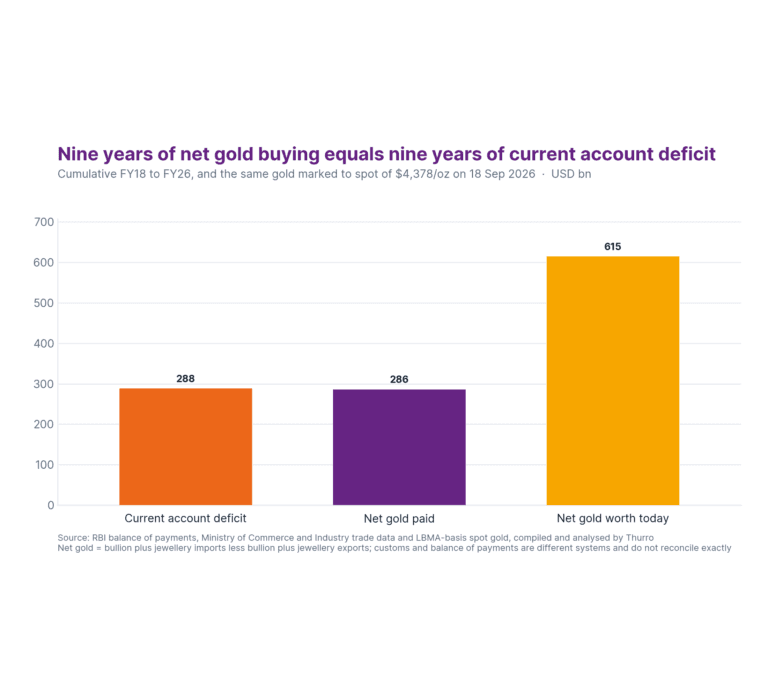
Nine years of net gold buying equals nine years of current account deficit — and it has doubled in value
India paid out $286bn for net gold between FY18 and FY26. Its cumulative current account deficit over the…
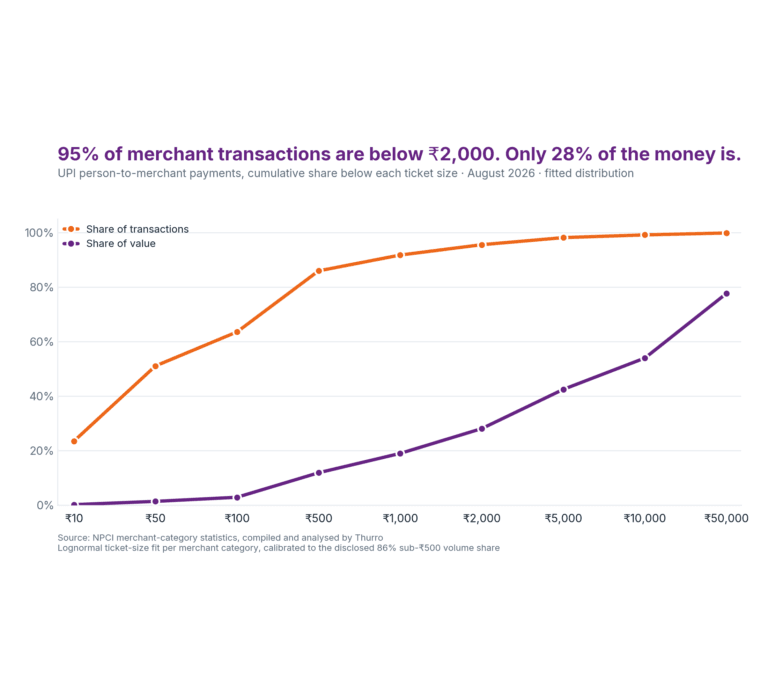
The UPI MDR pool is about ₹1,000 crore a month, and two-thirds of it sits where nobody can see it
Parliament has cleared the way for merchant charges on UPI. The merchant-category data says the revenue is real…
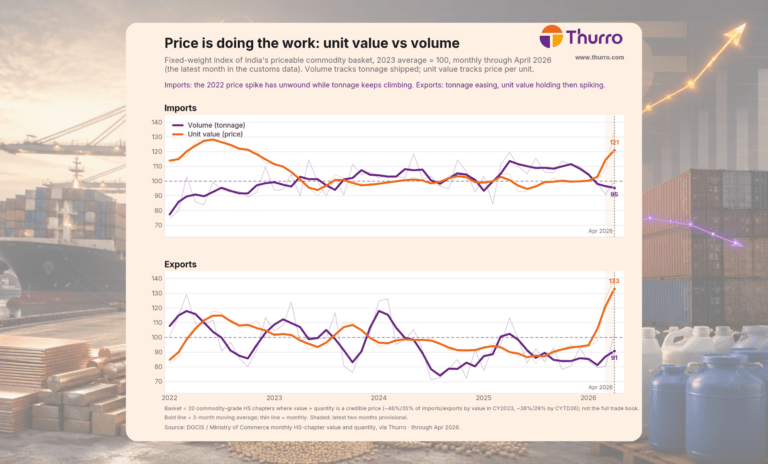
India’s commodity trade is running on price, not volume
India's trade value is still climbing — imports up about 18 percent and exports about 8 percent in…