

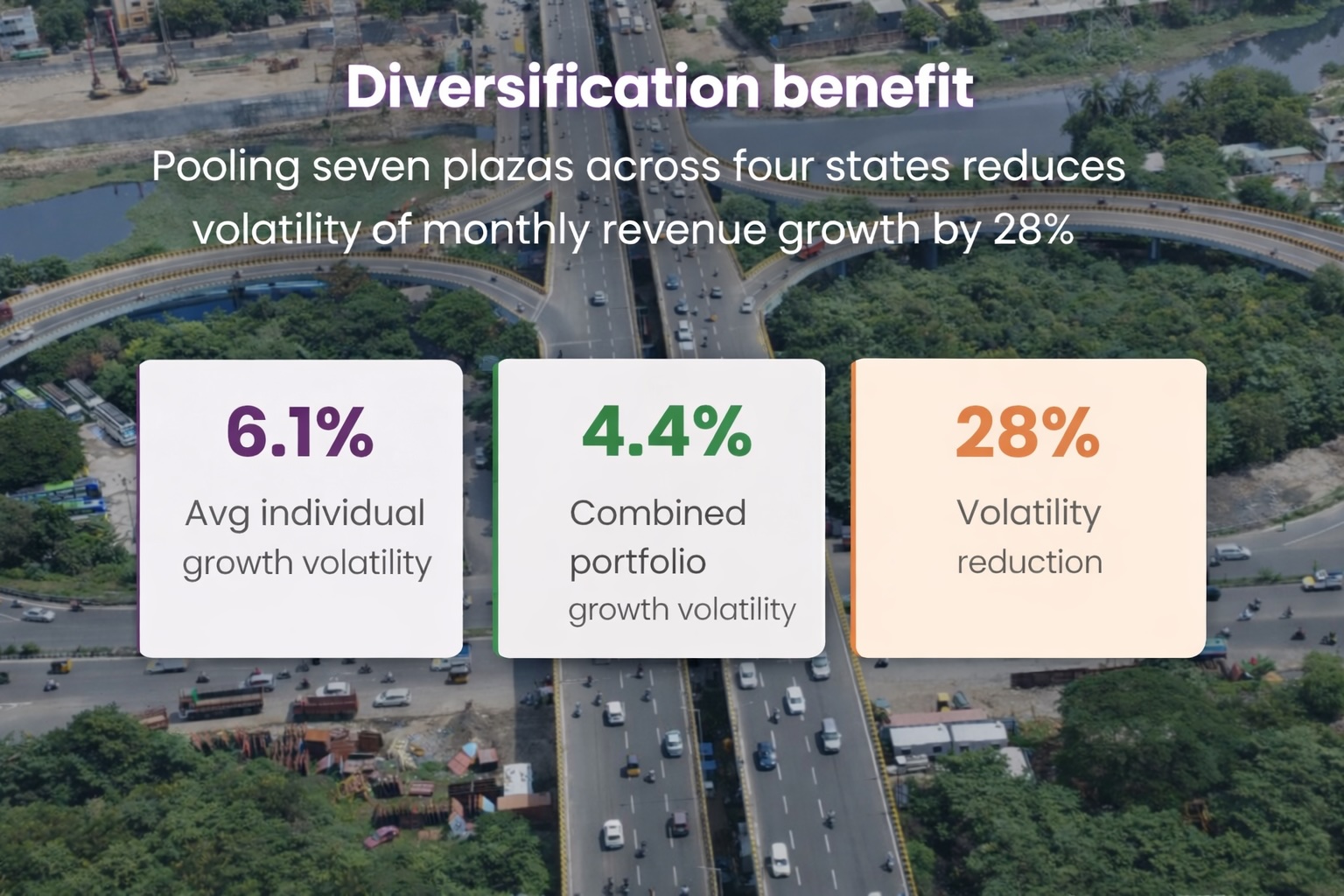

Raajmarg Infra Investment Trust, sponsored by the National Highways Authority of India (NHAI), pools five operational toll road stretches spanning roughly 260 km across Jharkhand, Andhra Pradesh, Tamil Naduand Karnataka. The InvIT, whose IPO opens on 11 March at INR 99–100 per unit, aggregates seven toll plazas that generated INR 967 crore in revenue in the last twelve months (Feb 2025–Jan 2026). Combining these toll corridors within a single InvIT portfolio reduces revenue volatility from about 6.1% at the individual plaza level to roughly 4.4% for the combined portfolio.
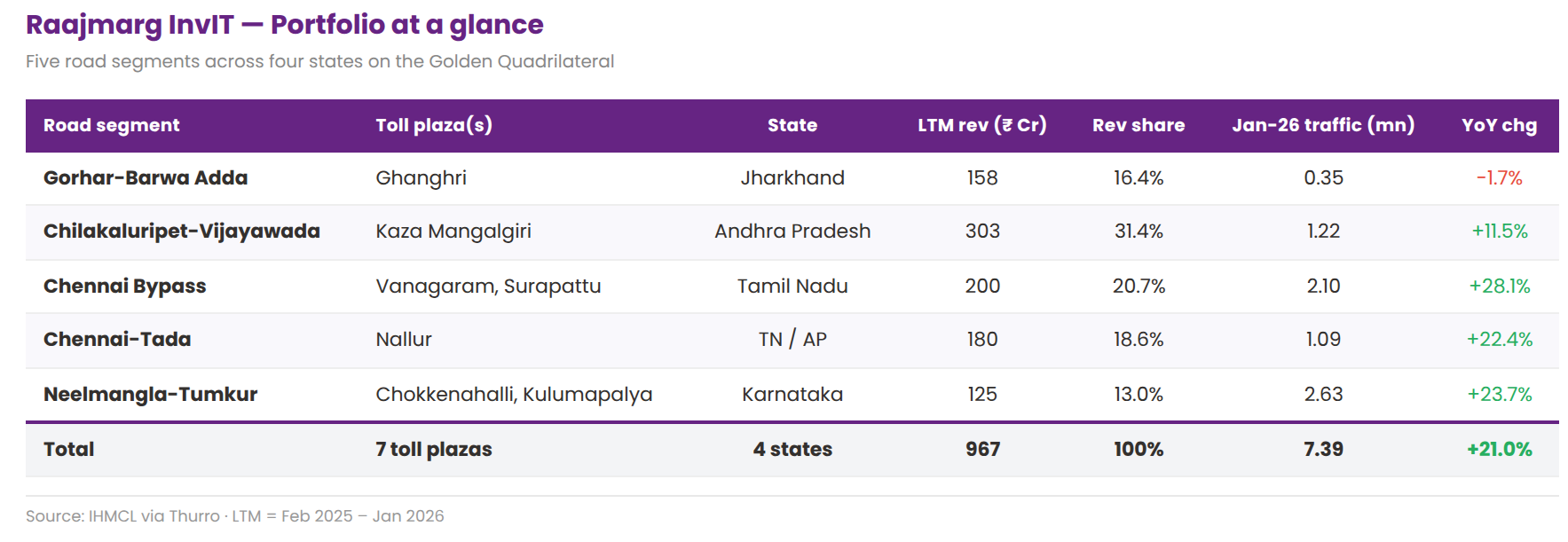
Structured under the Toll-Operate-Transfer (TOT) model, the assets operate under 15-year concession agreements with toll escalation of 3% annually plus 40% of WPI inflation. NHAI will retain a 15% sponsor stake and has indicated a pipeline of around 1,500 km of additional highway assets that could be added over time.
Commercial vehicles drive revenue
Across the portfolio, commercial vehicles account for roughly 73% of toll revenue, reflecting the location of several stretches on freight corridors.
The Gorhar–Barwa Adda corridor in Jharkhand, running through the region’s coal belt, derives nearly 90% of its revenue from commercial vehicles, with the highest average toll in the portfolio at around INR 402 per vehicle.
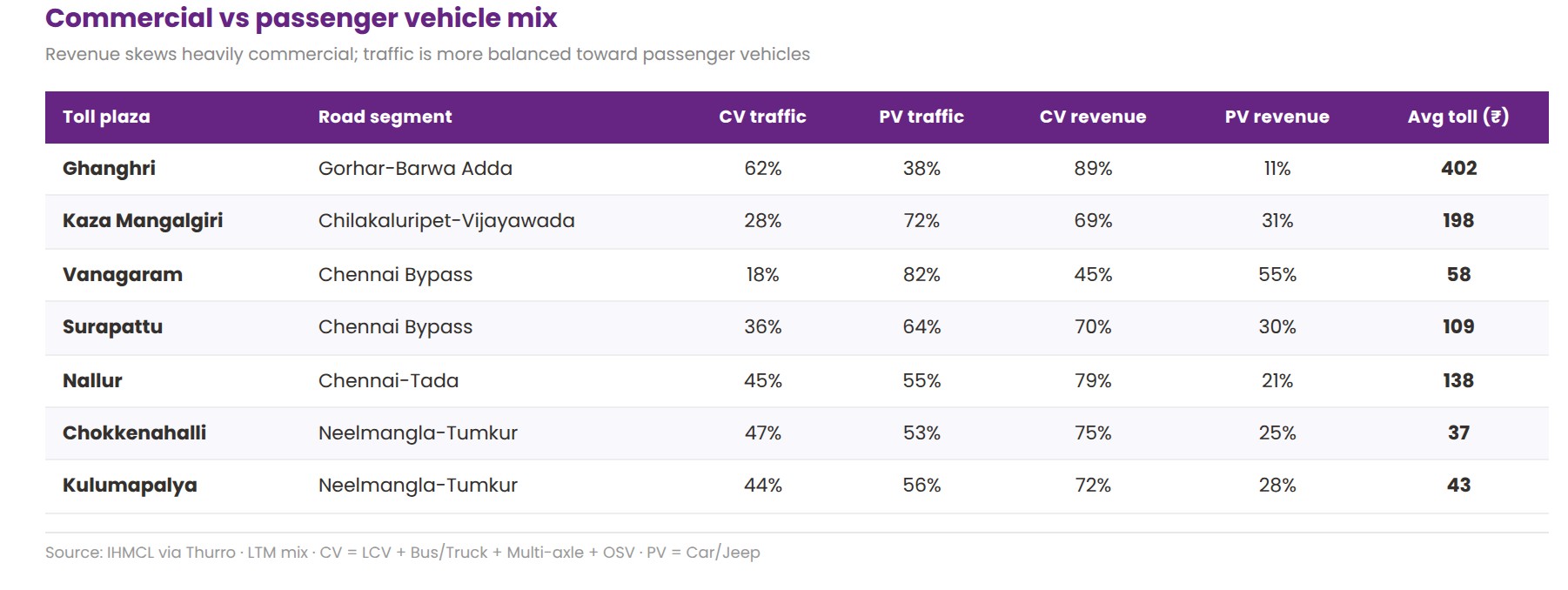
The Chilakaluripet–Vijayawada corridor in Andhra Pradesh, a manufacturing and port-linked route, also leans heavily commercial, with about 69% of revenue generated by freight traffic.
These freight-heavy segments provide the portfolio’s yield, as trucks and multi-axle vehicles pay substantially higher tolls than passenger cars.
Urban corridors provide volume stability
Not all assets behave the same way. Some stretches are dominated by commuter traffic.
On the Chennai Bypass, for example, passenger vehicles account for about 82% of traffic at the Vanagaram toll plaza, with non-commercial vehicles generating more than half of revenue. Average toll rates here are significantly lower—around INR 58 per vehicle—consistent with short-distance urban travel.
Similarly, the Neelmangla–Tumkur stretch near Bengaluru sees passenger traffic exceed 50%, reflecting suburban commuting patterns.
This mix creates two different revenue drivers within the portfolio: freight corridors tied to industrial activity, and commuter routes anchored by daily mobility.
Pooling assets reduces volatility
To test whether the portfolio genuinely reduces risk, we analysed 36 months of toll-plaza revenue data and calculated month-on-month growth correlations across the seven plazas.
The average correlation is 0.46, indicating moderate linkage rather than uniform movement across assets.
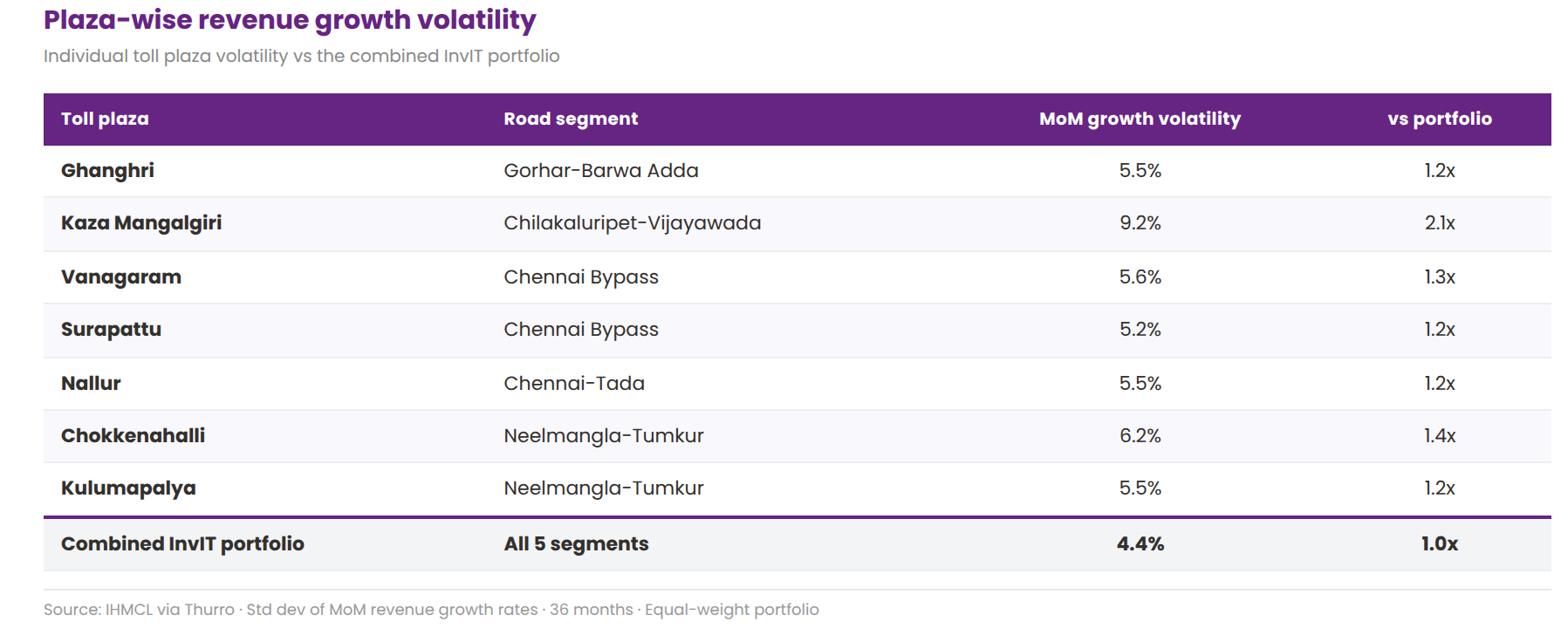
The diversification effect is visible in volatility. Individual plazas show average monthly revenue volatility of about 6.1%, while the combined portfolio reduces this to 4.4%—a decline of roughly 28%.
For an InvIT whose primary purpose is to distribute stable cash flows, that reduction is significant. By combining freight-heavy highways with commuter corridors across different regions, the Raajmarg portfolio converts individually variable toll assets into a more predictable revenue stream.
The underlying toll-plaza traffic and revenue data used in this analysis are available on Thurro’s platform.
Thurro does not make buy or sell recommendations on any security. This analysis is based on publicly available data and is intended for informational purposes only. It does not constitute investment advice.
Cover photo credit: Raajmarg Invit
View disclaimer
Unlock the power of alternative data
Do not just follow the market — stay ahead of it. Thurro helps you transform raw filings and alternative datasets into actionable insights.
Explore Thurro AltData Book a demoRelated Articles
How a Strait of Hormuz shock would affect India’s gas-dependent industries
Fertiliser plants, refineries, and city gas distributors face the most immediate operational risks from a disruption in Gulf…
India’s LNG imports run through Hormuz
Qatar and the UAE account for nearly three-quarters of India’s LNG imports, tying supply to a single maritime…
Russian crude may cushion India from a Middle East oil shock
US–Iran tensions have lifted crude prices, but India’s pivot to Russian oil since 2022 provides a partial hedge…