



Introduction
Q1 FY26 earnings calls reveal a shift in how India Inc leaders discuss AI with investors. Instead of broad strategic statements, management teams are now citing specific metrics, revenue targets, and operational improvements that highlight AI’s tangible impact.
An analysis by Thurro Answers of recent earnings call disclosures highlights three key trends reshaping enterprise AI adoption: AI applied to solve complex, vertical-specific challenges, a focus on quantifying AI’s impact with measurable metrics; and the rise of autonomous AI agents.
Vertical specialisation
AI adoption is moving beyond generic applications to specialised, industry-specific solutions addressing unique operational challenges. Current enterprise deployments show three dominant patterns: data processing automation, customer experience enhancement, and decision-support systems.
Healthcare
The sector is applying AI to complex operational tasks such as automated medical coding and claims denial analysis. Sagility India illustrates this shift with AI-powered denial validation, appeal generation, and automated extraction of payer–provider agreements. This helps streamline operations while improving patient outcomes.
Financial services
Institutions are adopting AI for automated underwriting, expanded credit scoring, and collections optimisation. Poonawalla Fincorp is targeting 5–10% gains in processing volumes through AI- driven credit decisioning and risk management. Bajaj Finserv has deployed an AI-enabled cattle pre-inspection app using live image capture, showcasing highly specialised applications that create competitive differentiation.
Utilities and energy
Critical infrastructure management is being transformed by AI. Use cases include automated vegetation inspection to prevent outages and advanced energy audits. For its clients, TCS has implemented AI/ML models for utility infrastructure monitoring and developed AI assistants to optimise plant energy consumption.
Technology services and data analytics
Enterprises are realising productivity gains through AI-powered code generation, knowledge management, and vendor management automation. Tracxn Technologies demonstrates scalability, using AI for company profiling and industry classification to expand data coverage 5x while reducing headcount by 10%.
Quantifying AI impact- measurable productivity and efficiency gains
The era of vague ‘AI will transform our business’ statements is over. Management teams are providing specific metrics that demonstrate tangible business value. Data shows that technology and services companies are achieving the largest gains, particularly in development processes and operational workflows.
Productivity improvements
Leading organisations are reporting substantial productivity increases across multiple areas. Hinduja Global Solutions reported a 25% overall productivity gain, supported by 40% improvement in training optimization and 30% cost reduction. Info Edge (India) achieved 15-20% improvements in key metrics across various business verticals through its AI investments.
Development acceleration
Software development processes show particularly strong gains. One Mobikwik Systems achieved 30% faster development cycles through AI-assisted coding tools, improved code quality through intelligent suggestions, and automated repetitive tasks to free developers for higher-value work.
Operational efficiency
Manufacturing and operations are experiencing significant optimisation through AI analytics and real-time monitoring. Ceat reported an 18% reduction in cycle times and 31% increase in operational efficiency, showcasing AI’s impact on traditional industrial processes. Piramal Pharma’s AI-led maintenance automation reduced unplanned downtime by up to 50%. Zensar Technologies used model context protocol to streamline retail workflows, helping a South African retailer cut manual effort by 65%.
Process automation benefits
AI is also delivering dramatic time savings in routine processes. TCS reduced insurance quote generation time from 30 minutes to just 5 minutes, an 83%-time reduction that directly improves customer experience and operational capacity.
AI agents gain traction
AI agents are autonomous systems designed to perform end-to-end tasks with minimal human input. Unlike simple chatbots, these sophisticated agents drive large-scale automation and productivity gains across business functions. The emphasis on production deployments, measurable outcomes, and integration into client environments signals that the AI agent era has begun in the Indian IT sector.
Production-scale deployments
Enterprise adoption is reaching a meaningful scale. Infosys leads with over 300 AI agents built across its operations, reporting a 25% gain in developer productivity. L&T Technology Services (LTTS) has deployed 175 AI agents across 70+ production programs, focusing on ‘physical AI through agentic AI’ with emphasis on intelligent robotics.
Customer service automation excellence
AI agents are delivering high automation rates in customer-facing operations. Le Travenues (ixigo) reports 60% of voice queries and 88% of chat inquiries are now resolved autonomously. This frees human staff to handle complex issues requiring empathy and creative problem-solving.
Domain-specific specialisation
Companies are moving beyond generic deployments to develop highly specialised, industry-specific solutions. Persistent Systems has built targeted agents including an underwriter agent for financial services and a SciMitra agent for healthcare research and scientific discovery, demonstrating how AI agents can tackle complex, knowledge-intensive tasks. Infosys AI agents are being applied to enhance production quality in refineries while orchestrating dynamic pricing in their retail stores and automate contract management for trading operations.
Platform-based enterprise strategy
Leading organisations are building scalable, platform-based solutions to support broad AI agent deployment. HCL Technologies, through its AI Force platform, has implemented 70+ deployments across 35 clients, enabling proactive issue resolution, workplace management, and ‘zero-touch operations’ through hyper-automation.
Advisory
Discipline, not technical depth, is what separates the leaders. The companies reporting AI gains are not necessarily more advanced than you. They are more rigorous in execution. When evaluating AI investments, use these earnings calls as a guide: partner with vendors who understand your industry’s specific challenges and can prove measurable outcomes in similar environments. And if you are worried about falling behind, take note: most of these implementations happened in just the last 12–18 months. The competitive window is still open, but it is closing fast.
View disclaimer
Run your own analysis on Thurro Answers. Explore how AI adoption is being discussed across sectors, companies, and quarters, directly from earnings call transcripts and structured disclosures. Start your journey here
Unlock the power of alternative data
Do not just follow the market — stay ahead of it. Thurro helps you transform raw filings and alternative datasets into actionable insights.
Explore Thurro AltData Book a demoRelated Articles
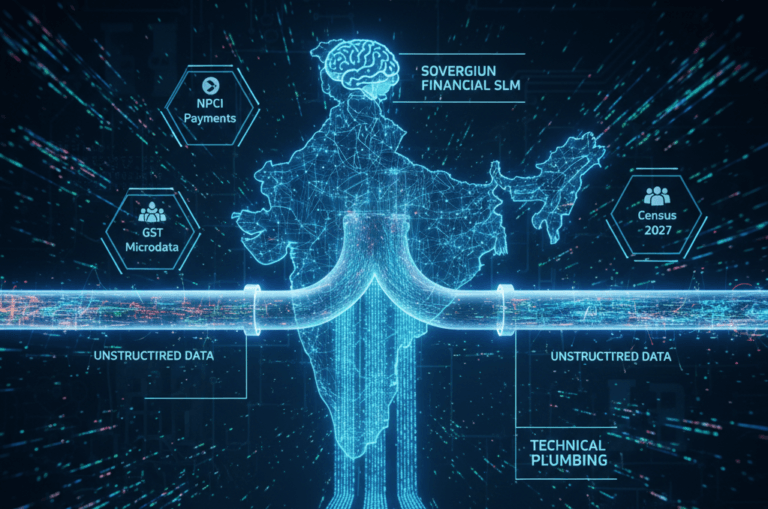
India has the data. Now make it AI-ready
India’s data is abundant yet unstructured, requiring AI-ready APIs and a sovereign language model to transform raw signals…

Human AI collaboration using Thurro Answers
How does the language of the Union Budget evolve as […]

Five learnings from building AI for finance in India
What building institutional AI has taught us about data, discipline, and the future of financial workflows in India