



Credit card transactions in India are growing significantly faster than the card base.
Data from Thurro’s platform shows that credit card transaction volumes grew 24.4% year-on-year in February 2026, while cards in force increased 7.7% over the same period. This indicates that growth is being driven by existing cardholders using their cards more frequently, rather than expansion of the card base.
Monthly transaction volumes increased to 494 million in February 2026 from 397 million in February 2025, while cards in force rose to 117.7 million from 109.3 million. Monthly spends increased 6% to INR 1.77 trillion from INR 1.67 trillion over the same period.
Over a longer horizon, since January 2015, the expansion is sharper—monthly spends have grown over 10x, while the card base has increased over 5x.
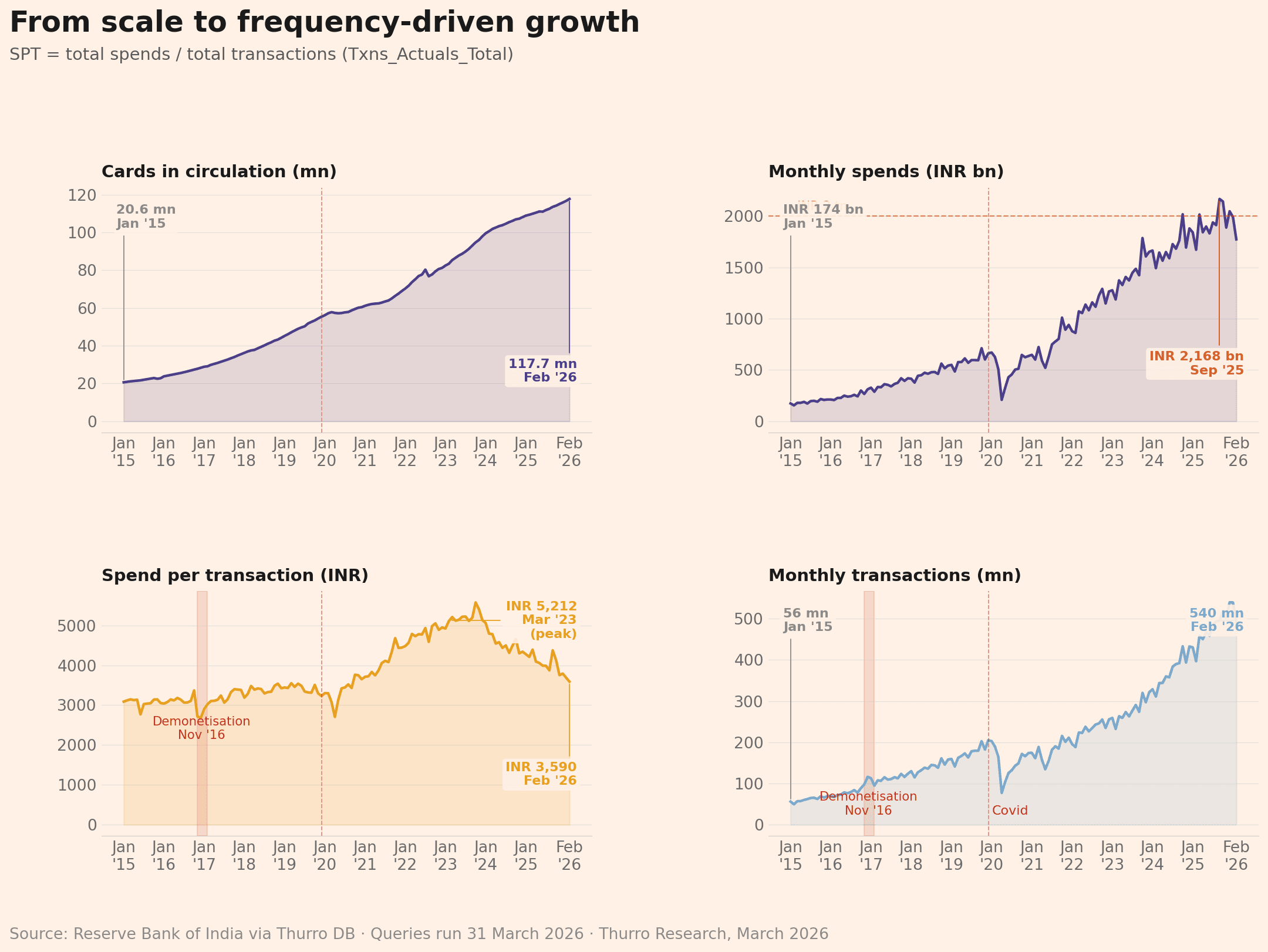
Transactions have scaled faster than cards in circulation over time
However, usage patterns have shifted. Spend per transaction declined from INR 4,212 in February 2025 to INR 3,590 in February 2026, while spend per card remained broadly stable at INR 15,062. This reflects an increase in transaction frequency, with more transactions at lower average values.
A concentrated market
The industry is now defined by concentration among four issuers. HDFC Bank, SBI Cards, ICICI Bank, and Axis Bank together account for 76% of total spend share as of February 2026.
This structure emerged following the March 2023 exit of Citi’s consumer business, which held 16.2% of spend share in March 2015. The redistribution of this share has been absorbed primarily by ICICI Bank and Axis Bank, alongside the sustained scale of HDFC Bank and SBI Cards. The implication is that competitive dynamics are now occurring within a fixed set of large issuers, with limited evidence of new entrants gaining material share.
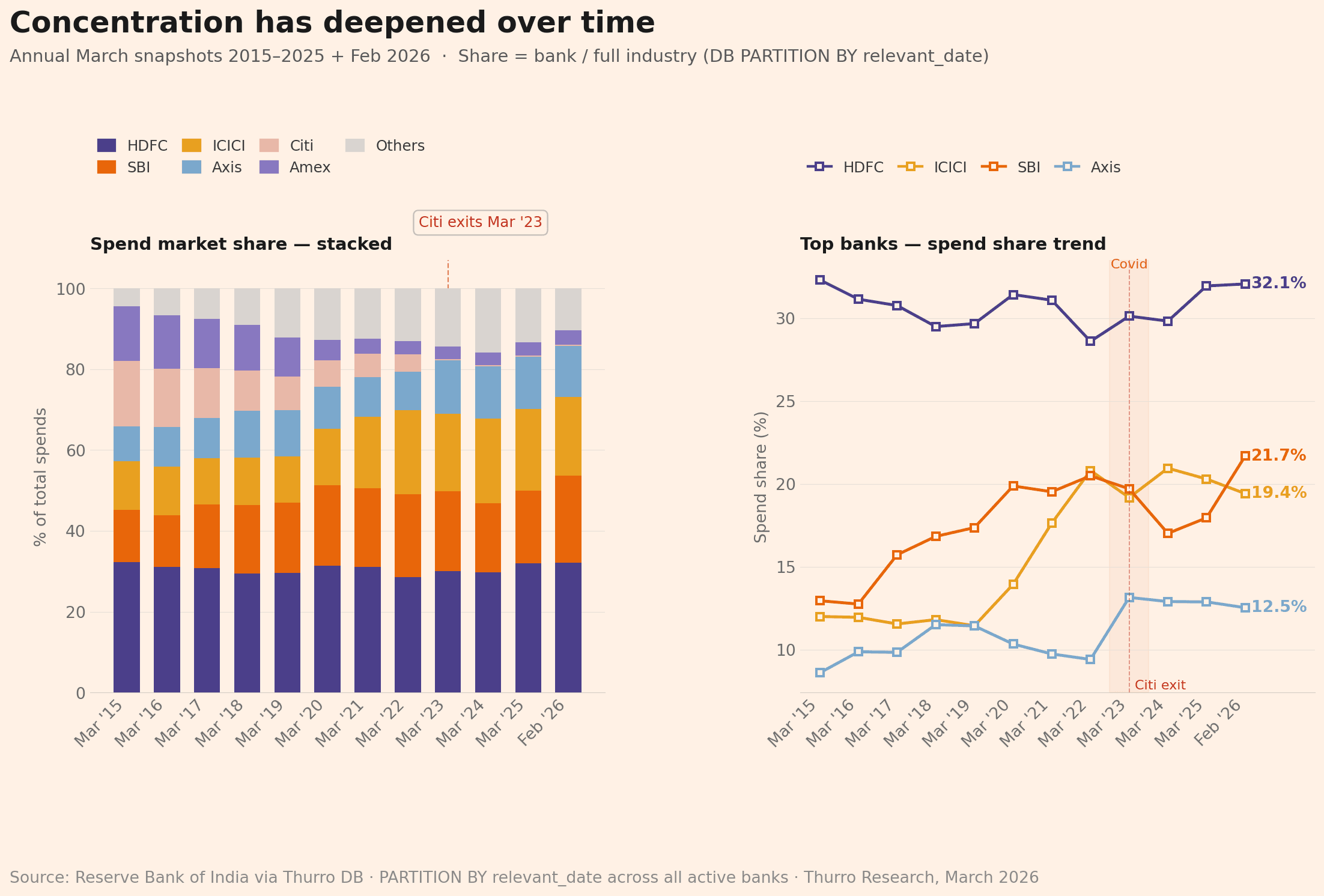
Spend is concentrated among four large domestic banks
Lower tickets, stable economics
Average transaction values have declined, but spend per card remains stable at the industry level and has increased significantly over longer time horizons for key issuers. Industry-wide spend per card was INR 15,062 in February 2026, broadly unchanged over the past two years, even as transaction volumes increased sharply.
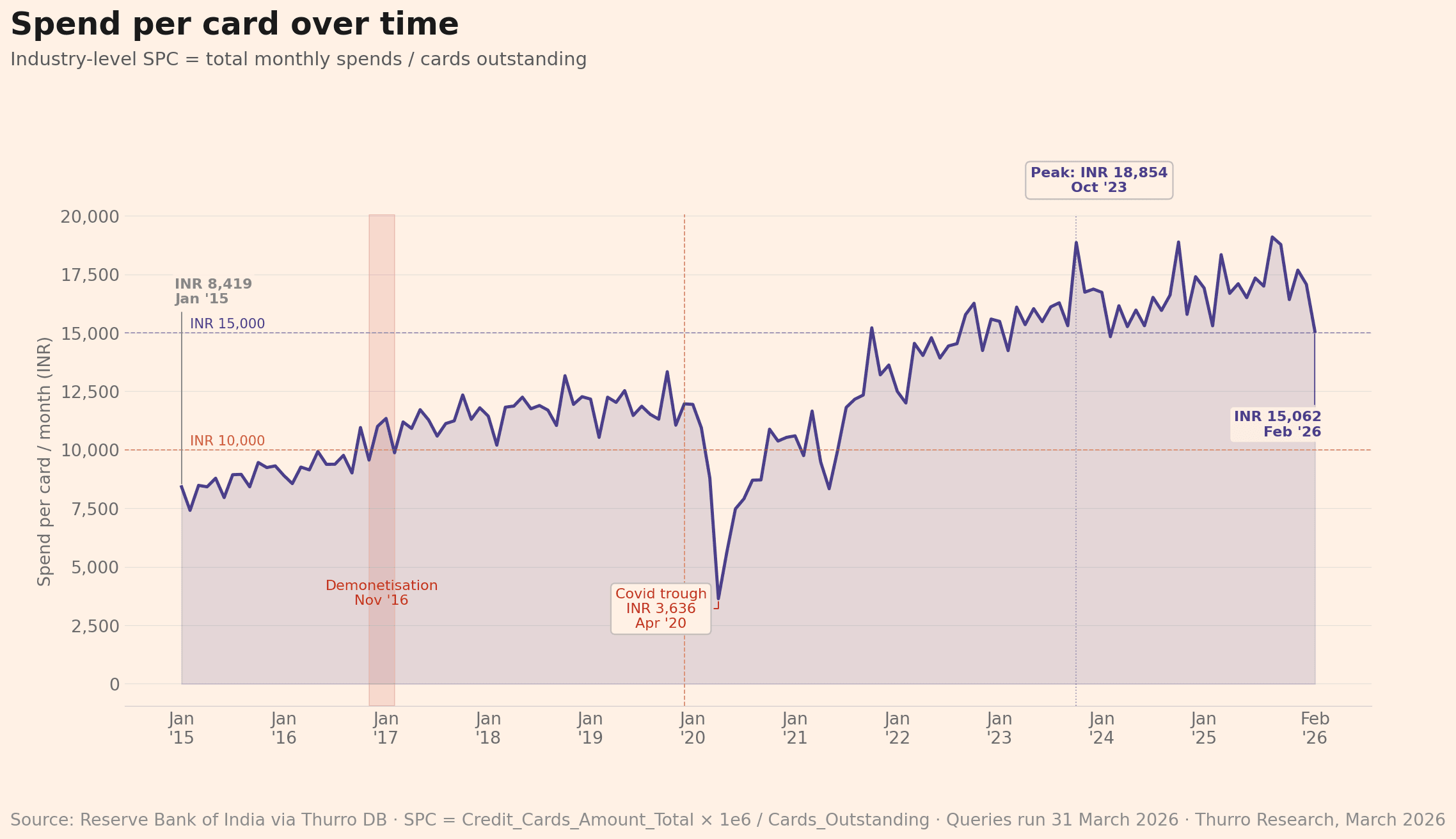
Spend per card trends upward over time, with a brief pandemic disruption
Issuer-level data shows a longer-term increase in spend per card. ICICI Bank’s spend per card rose 172% to INR 16,144 in February 2026 from INR 5,941 in March 2015. HDFC Bank reported a 116% increase to INR 19,195, SBI Cards 130% to INR 15,524, and Axis Bank 52% to INR 12,404 over the same period.
This indicates that higher transaction frequency is occurring alongside sustained aggregate spend per card.
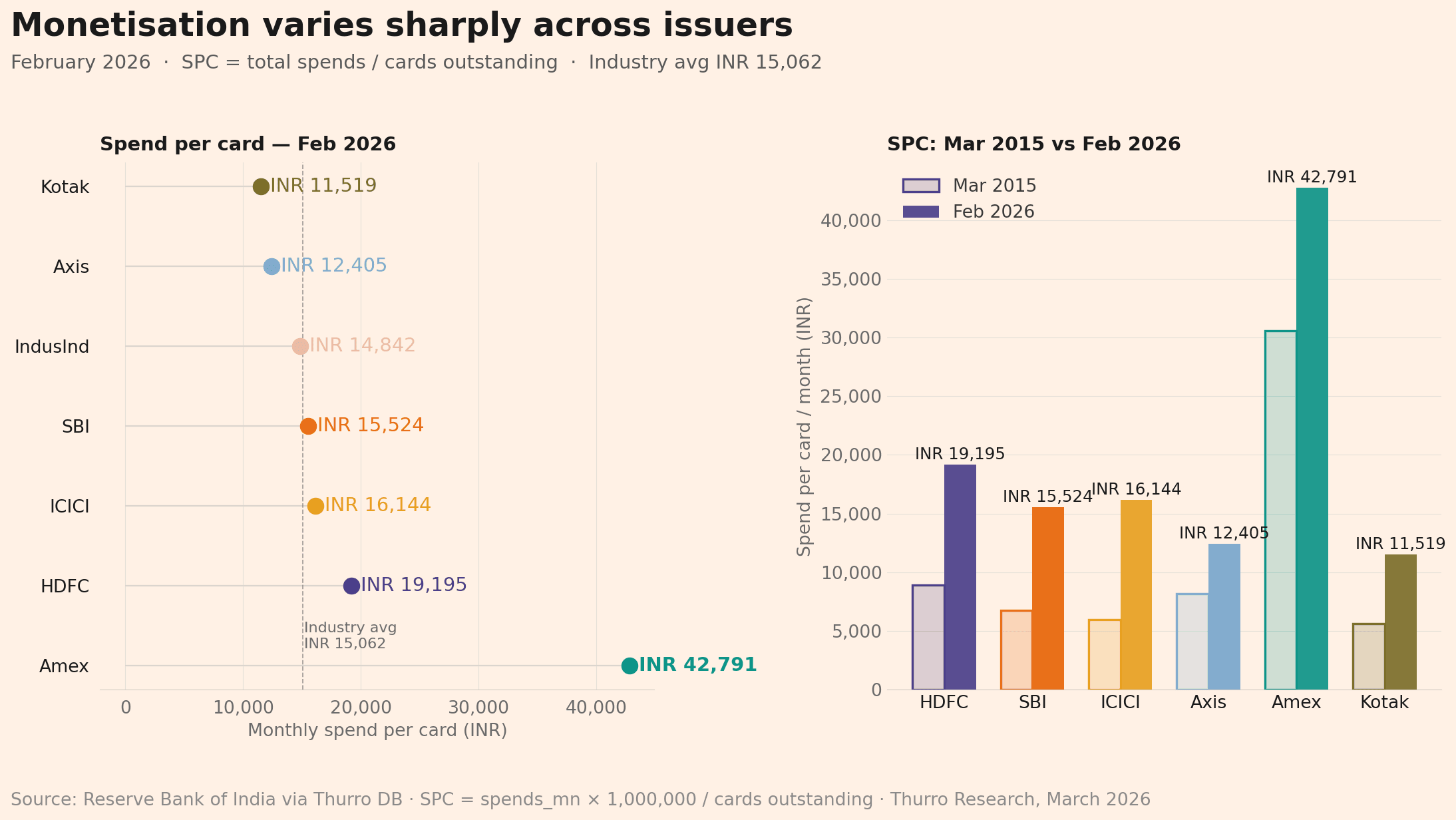
Spend per card varies widely across issuers
The Amex divergence
American Express (Amex) illustrates how share-based metrics can diverge from absolute performance. Its spend share declined from 13.5% in March 2015 to 3.2% in February 2026, while absolute monthly spends increased from INR 22 billion to INR 56 billion over the same period, a 155% increase.
American Express also reported the highest spend per card at INR 42,791 in February 2026, up 40% from INR 30,552 in March 2015 and approximately 2.8 times the industry average, reflecting a portfolio concentrated in higher-spending users.
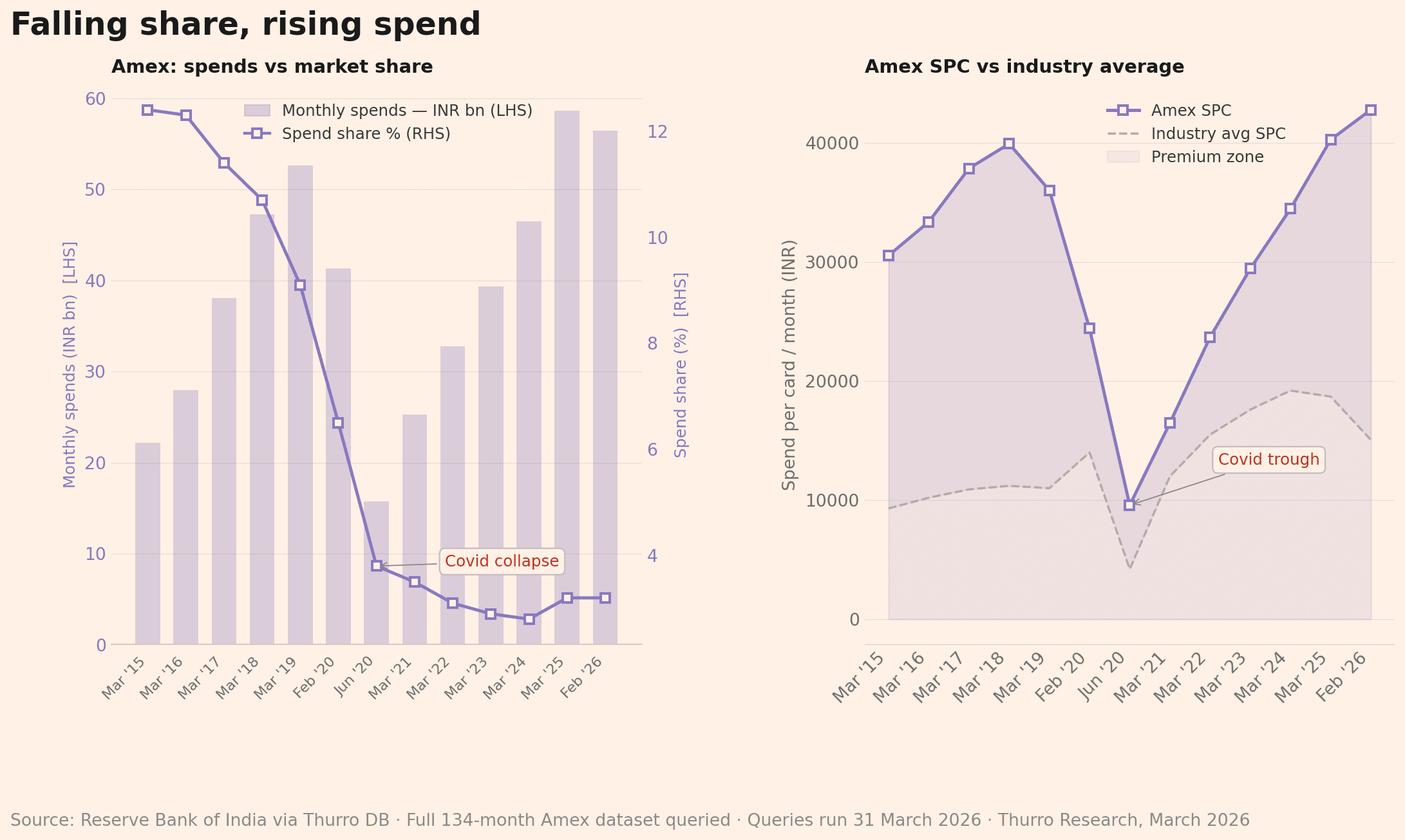
Amex has the highest spend per card at INR 42,791 in February 2026
A structural shift
The defining feature of India’s credit card market is the shift from issuance-led growth to usage-led growth. Transaction volumes are increasing significantly faster than the number of cards, reflecting deeper integration of credit cards into everyday spending. The market has also consolidated into a small set of large issuers, with issuer-level economics driven by spend per card. Growth from here will be determined by how deeply cards penetrate everyday spending.
A more detailed version of this analysis, including underlying datasets and extended breakdowns, is available to clients on request. For access, please write to contact@thurro.com.
Cover photo credit: AI generated image
View disclaimer
Unlock the power of alternative data
Do not just follow the market — stay ahead of it. Thurro helps you transform raw filings and alternative datasets into actionable insights.
Explore Thurro AltData Book a demoRelated Articles
Recent SIP losses rise even as inflows hold steady
Recent SIP cohorts face negative returns after peak-period entries, even as sustained inflows indicate investor behaviour has not…

The real risk in India’s imports lies beyond oil
India’s import vulnerability is not limited to oil but extends to critical inputs that can constrain production and…

DMart’s February 2026 expansion reveals a premium shift
DMart’s online catalogue shows higher-priced brands could drive basket growth, while discounts remain stable and price trends vary…