



India’s first Consumer Price Index (CPI) print under the new 2024 base year shows headline inflation at 2.75% year-on-year in January 2026, according to provisional data released by the Ministry of Statistics and Programme Implementation (MoSPI). Retail inflation in December 2025 under the older base was 1.33%. The two figures are not directly comparable.
Rural housing inflation was published as part of CPI for the first time. It stood at 2.39% in January, compared with 1.92% for urban housing and 2.05% overall. The inclusion of rural house rent marks a structural expansion of rural inflation measurement.
The CPI 2024 series replaces the 2012 base after more than a decade. The revision is built on the 2023–24 Household Consumption Expenditure Survey and expands the basket from 299 to 358 items. Digital services—including streaming subscriptions—are now explicitly represented. Wireless communication accessories such as earbuds and other electronic peripherals enter the basket, reflecting the rise of smartphone-linked consumption. The inclusion of rural house rent formalises a cost that was previously unmeasured in the rural index.
A note on our NowCast
For the past 24 months, Thurro’s food and beverage inflation NowCast—which is released on the 2nd of every month, around 10 days before the official MoSPI release—has closely tracked the official MoSPIprint under the 2012 base framework. January 2026 disrupted that continuity because the statistical architecture of the CPI itself changed.
January 2026 marked the first material deviation in over two years between Thurro’s Food and Beverage NowCast and the official CPI print
The announcement of the intent, that January numbers will follow a new series and a new base, was given last month. But the detailed redistribution of weights and new division structure under the 2024 base was first released on 29 January in the Expert Group Report on Comprehensive Updation of Consumer Price Index.
Thurro’s nowcast model was built on food and beverage data extending back to 2012. Under the new base, detailed sub-component history of CPI and CFPI exists only from January 2025 onwards, with no granular breakdown of food and beverage sub-components comparable to the earlier series.
Historical coefficients, therefore, cannot be applied, division-level mapping is disrupted by the shift to the Classification of Individual Consumption According to Purpose (COICOP) 2018 framework, and back-series continuity exists only at the general index level. In effect, January’s inflation was computed under a statistical architecture that external analytical systems had neither the historical depth nor the recalibration window to fully adjust to.
From February onwards, we will switch to a Consumer Food Price Index (CFPI) NowCast, which accounts for 34.77% of headline CPI under the 2024 base, compared with our earlier Food & Beverages Inflation NowCast, which represented 45.86% of the CPI basket under the 2012 series.
Redistributing weights
The new series adopts the COICOP 2018 framework, replacing the earlier six-group structure with 12 divisions. Under COICOP 2018, expenditure is organised into 12 divisions, 43 groups, 92 classes, 162 subclasses, and 358 items. The classification shift improves international comparability but also alters how weights are distributed across categories.
The most consequential shift is in food. The share of food and beverages in the combined index has fallen by around nine percentage points to 36.75%, from 45.86% under the earlier structure, even though it remains the largest basket. According to MoSPI, if the 2012 classification had been retained, the food share would have declined to 40.10%. This implies that part of the shift reflects real consumption change, and part reflects reclassification under COICOP 2018.
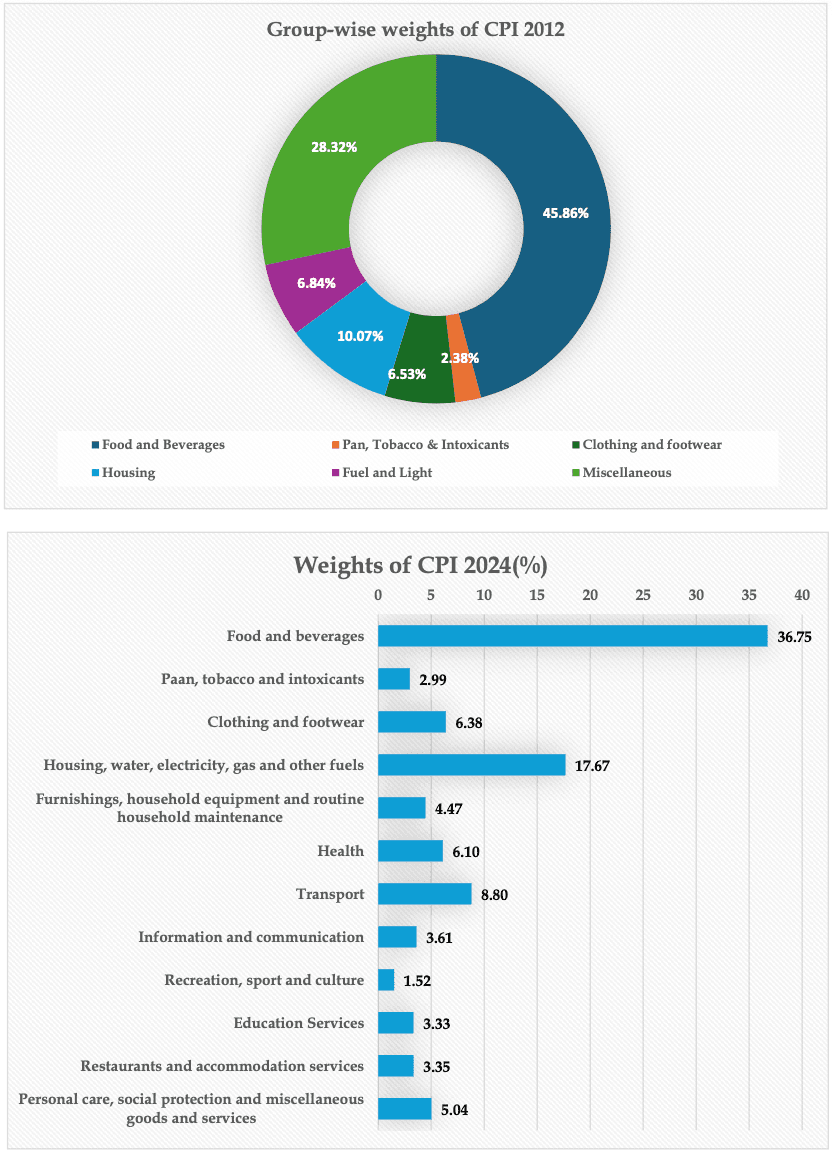
Revised weights and weighing diagram for CPI. Source: MoSPI
Housing, water, electricity, gas and other fuels now account for 17.7% of the combined basket, up from 16.9% previously. When furnishings and routine household maintenance are included, housing-related expenditure accounts for over 22% of the new CPI basket.
The weight shift also materially alters the balance between core (excluding food and fuel) and non-core inflation. Under the previous structure, food and fuel together accounted for around 52–53%. Under the 2024 base, fuel is folded into the housing division. This will materially change the effective core weight from around 47% to nearly 58%, a gain of around 11%-points based on the share of the fuel sub-components in the previous series.
The redistribution of weightage makes the new series more services-sensitive and comparatively less food-dominated.
What pushed inflation higher
The rise in January inflation appears concentrated in the personal care and miscellaneous category, which recorded inflation of 19.0%. Within this division, jewellery prices rose sharply, with silver jewellery up 159.7% year-on-year and gold and other precious metal jewellery up 46.8%.
This pattern is consistent with the divergence observed through 2025. In our January note, we documented how food prices declined sharply even as gold and silver surged, flattening the headline while masking dispersion beneath. That divergence appears to be carrying into 2026.
The Reserve Bank of India had already flagged this risk. In its February policy review, the Monetary Policy Committee raised near-term inflation projections, noting that the upward revision was driven largely by rising precious metal prices, as we highlighted in a note last week.
Education inflation stood at 3.35%, making it the second-highest major driver after personal care. Unlike food, education costs tend to be sticky and contract-driven, suggesting that part of the services component of inflation remains structurally firm even as headline pressures stay contained.
Transport inflation, by contrast, was just 0.09%. In an economy dependent on imported energy, this near-flat reading may reflect stable domestic fuel prices and has helped contain broader cost pass-through into goods and services.
Taken together, the inflation picture in January is one of sharp dispersion rather than broad pressure — asset prices and education pulling upward, food and energy pulling down.
With core now carrying greater weight in the index, the distinction between temporary asset-price effects and persistent services momentum becomes even more central to policy calibration.
Cover photo credit: Giva
View disclaimer
Unlock the power of alternative data
Do not just follow the market — stay ahead of it. Thurro helps you transform raw filings and alternative datasets into actionable insights.
Explore Thurro AltData Book a demoRelated Articles

India’s consumption story is deepening
India’s consumption base is widening, formalising, and upgrading, strengthening balance sheets and shifting demand toward higher-value categories

US bankruptcy filings rise 13% in Sep-Dec 2025
Over the past 12 quarters, filings have recorded double-digit annual growth in all but one quarter
A tale of two markets
Cash equities are increasingly delivery-led, even as derivatives premium turnover surges, revealing a bifurcated market structure beneath speculation…