


This analysis is based on Thurro’s AI-led reading of Union Budget speeches between FY2019 and FY2026. Instead of examining each Budget as a standalone event, Thurro’s AI-driven platform processes Budget speeches across years, allowing shifts in language, structure, emphasis, and time horizon to be identified at scale.
By structuring Budget documents into a searchable, comparable database and applying AI-assisted thematic and linguistic analysis, Thurro enables patterns to emerge that are difficult to detect through manual reading alone. This approach makes it possible to trace how the function of the Union Budget itself has evolved over time—beyond individual announcements or headline measures.
In the earlier notes of this series, we analysed how the Budget speeches have evolved, redefined their intended audience, reframed employment, realigned sectoral priorities, and social constituents over time. We have also analysed how the Economic Survey has evolved over this period. In this note, we examine how the Budget speech itself has changed—its tone, structure, and rhetorical function—and what this reveals about how the State now communicates policy.
Read across FY2019 to FY2026, the tone in the Budget speeches appears to have shifted from persuasion toward instruction, from narrative ambition toward operational direction and execution detail.
From persuasion to instruction
Early Budget speeches (FY2019–FY2021) in this period still carried the burden of persuasion. They explained, justified, and contextualised policy choices, often linking them to broader national goals or historical moments. References to goals such as doubling farmers’ income, building a USD 5 trillion economy, or invoking long historical arcs of reform were used to legitimise policy direction. The speech functioned as an argument, designed to build belief, legitimacy, and public alignment.
Over time, that posture changed. FY2023 onwards, the Budget speech increasingly read as a set of directions rather than a narrative appeal. The tone assumed acceptance. Policy was presented as settled; the emphasis shifted to rollout, timelines, platforms, and coordination. The speech no longer asked the listener to believe in the direction of travel. Instead, it instructed institutions, ministries, and economic actors on what would be executed—and how.
Speeches get shorter, denser
One of the most visible shifts has been in length and density. Earlier Budget speeches in this period (FY2019–FY2021) were longer, more discursive, and explanatory in tone. They spent time laying out context, rationale, and intent, often walking the listener through why a policy choice mattered before describing what would be done.
By contrast, FY2023 onwards, speeches became noticeably tighter and more compressed. Without necessarily becoming dramatically shorter in absolute duration, they packed more announcements, schemes, and sectoral priorities into fewer explanatory passages. Policy lists lengthened even as narrative scaffolding thinned. More ground was covered with fewer words.
This compression was not merely stylistic. It reflected a shift in posture. The state appeared more confident in institutional authority and more familiar with its audience. The Budget speech no longer felt compelled to restate first principles. It assumed a shared baseline—and moved directly to structure, sequencing, and delivery.
Structure replaces rhetoric
As speeches shortened, structure took on greater importance. Over time, the Budget increasingly organised itself around explicit frameworks—pillars, missions, engines, and priority blocks—rather than linear narrative flow. This shift is visible as early as FY2023, when the speech was organised around the Saptarishi, seven guiding priorities for Amrit Kaal, with policy announcements slotted under fixed thematic headings rather than woven into a persuasive arc.
By FY2024 and FY2025, this framework-led approach deepened. Green growth, digital public infrastructure, logistics, skilling, and investment were presented as discrete, self-contained policy systems, each with clearly enumerated components and delivery logic. Narrative transitions gave way to classification and sequencing.
By FY2026, this structural turn culminated in the explicit engine architecture of growth, where agriculture, MSMEs, investment, and exports were identified as separate engines, each assigned a defined economic role. Here, the organisation of the speech itself conveyed coherence, order, and policy intent, reducing the need for persuasive language.
Instead of emotional appeal, the speech conveyed coherence, order, and control. The form signalled governance capacity. The Budget was no longer persuading through words; it was persuading through design.
The emotional arc: assertion to empathy to neutrality
Read sequentially, the emotional tone of Budget speeches follows a clear arc. In the pre-pandemic years (FY2019–FY2021), the tone is assertive and confident. Speeches frame policy through ambition and forward momentum, invoking large national goals such as a USD 5 trillion economy, infrastructure-led growth, and India’s rising global stature. The language is declarative and optimistic, projecting certainty and control.
During the pandemic and its immediate aftermath (FY2022), the emotional register shifts sharply. The speeches explicitly acknowledge hardship, loss, and vulnerability. References to unprecedented times, collective resolve, and the need to protect the poorest and the most vulnerable introduce empathy into the fiscal narrative. Welfare measures are framed not just as policy tools, but as moral obligations in a moment of crisis.
From FY2023 onwards, that emotional tone recedes. The language becomes notably neutral—neither celebratory nor consolatory. Budget speeches adopt the voice of an administrator rather than a storyteller. Emotional appeals give way to enumeration, frameworks, and delivery mechanisms. Numbers, systems, and sequencing dominate. The speech no longer seeks to move the listener emotionally; it seeks to instruct, organise, and execute.
Poetry and culture as punctuation, not persuasion
Cultural references, poetry, and civilisational metaphors appear most prominently during periods of transition or uncertainty, where the speech seeks moral anchoring alongside policy intent. In the early part of this period, Budget speeches occasionally draw on classical literature and civilisational imagery—quoting Sanskrit verses, invoking ideas of dharma, balance, and collective effort—to situate economic policy within a broader philosophical frame. These references function as reassurance, linking fiscal choices to continuity, values, and national purpose rather than technocratic calculation alone.
In later speeches, these elements are clearly repositioned. By FY2023 and FY2024, poetry and cultural references typically appear only at the very beginning of the speech, often as a single verse or aphorism, before the address moves swiftly into numbers, frameworks, and implementation detail. Culture functions as punctuation rather than persuasion: a brief tonal cue that establishes legitimacy and confidence, then steps aside for execution. The speech no longer leans on metaphor to carry meaning; it uses structure, sequencing, and policy architecture to do the work.
What the new vibe signals
Taken together, these changes suggest a Budget that no longer sees itself as a moment of mass persuasion. Instead, it operates as a coordination document, addressed simultaneously to administrators, markets, institutions, and informed citizens.
The assumption underlying recent speeches is striking: legitimacy is established, authority is accepted, and the primary challenge is implementation. The Budget speech reflects a state that believes it is past the phase of convincing—and firmly in the phase of delivering.
The evolution of the Budget speech mirrors the evolution of governance itself. As policy frameworks stabilise and systems deepen, rhetoric thins out. Emotion recedes. Structure takes over. The Union Budget has become less performative. In doing so, it reveals a state increasingly confident that it no longer needs to inspire belief, but to coordinate execution.
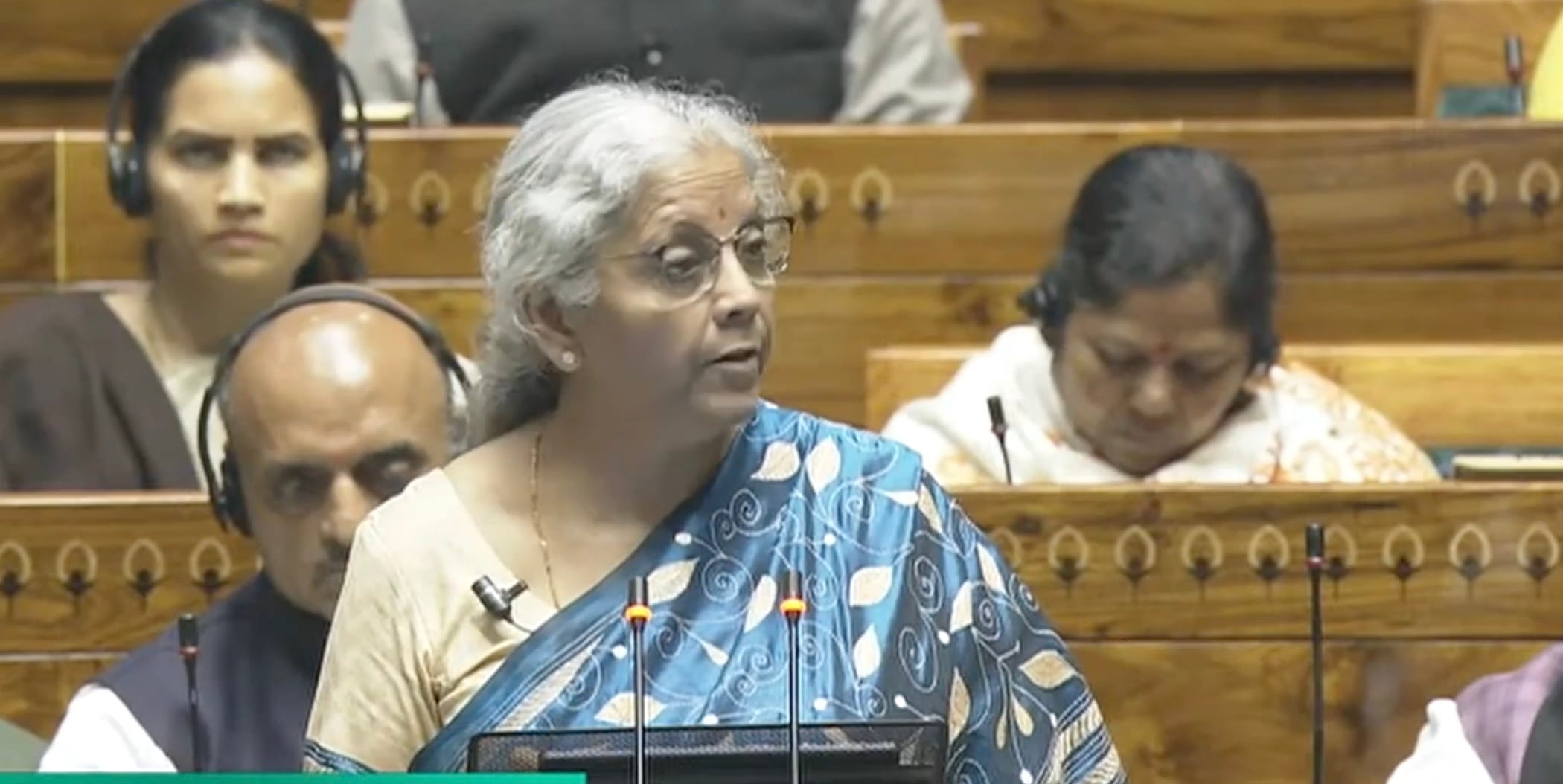
Cover photo credit: Sansad TV
View disclaimer
This is the seventh and final in a series of Thurro newsletters in the run-up to the Union Budget 2026. The underlying analysis for this piece is available in the accompanying Thurro Notebook
Unlock the power of alternative data
Do not just follow the market — stay ahead of it. Thurro helps you transform raw filings and alternative datasets into actionable insights.
Explore Thurro AltData Book a demoRelated Articles

India’s consumption story is deepening
India’s consumption base is widening, formalising, and upgrading, strengthening balance sheets and shifting demand toward higher-value categories

US bankruptcy filings rise 13% in Sep-Dec 2025
Over the past 12 quarters, filings have recorded double-digit annual growth in all but one quarter

A tale of two markets
Cash equities are increasingly delivery-led, even as derivatives premium turnover surges, revealing a bifurcated market structure beneath speculation…