

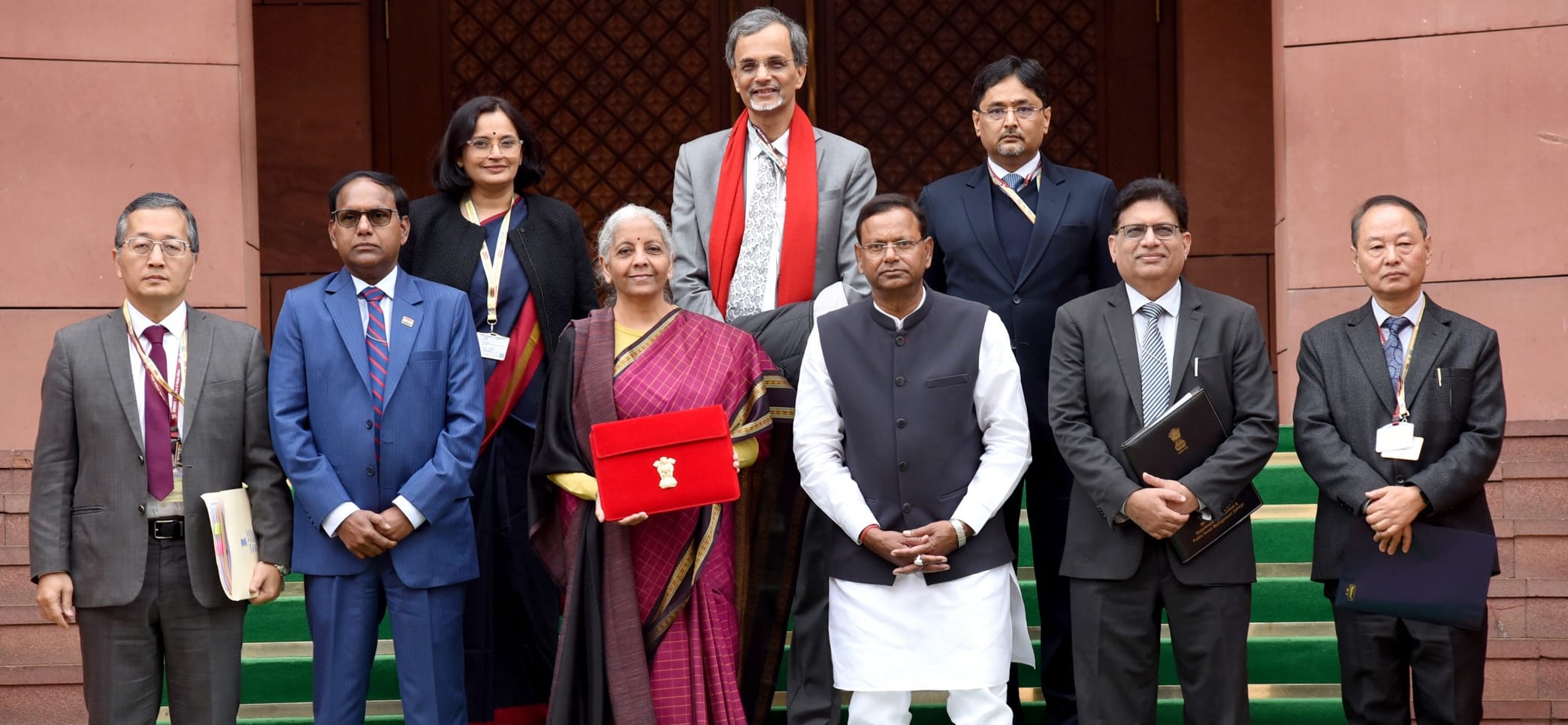

As Finance Minister Nirmala Sitharaman presented her ninth Budget in the Parliament on February 1, the overarching theme was continuity. The Union Budget 2026–27 prioritises policy stability and long-horizon infrastructure signalling over short-term stimulus, populism, or geopolitical posturing.
There is no significant tax regime reset, no new welfare architecture, no dramatic defence signalling in the speech (even as allocation is up 20%), and no overt positioning on US tariffs or the emerging trade agreements. In a global environment marked by uncertainty and volatility, the Indian government has chosen predictability over reaction. That choice defines this Budget.
Fiscal discipline is the anchor
The glide path towards medium-term debt consolidation remains the guidepost. The debt-to-GDP ratio is estimated at 55.6% in FY2027, down from 56.1% in the revised estimates for FY2026, a reduction of 50 bps. The government’s stated path is to a 50% +/- 1% anchor by FY2031. For India to reach a 49%-51% debt-to-GDP number by FY2031, it will have to shed 4.6%-6.6% of debt-to-GDP over the next four years, implying an annual reduction of 110-165 bps every year. The lack of inflation, or a slow nominal growth, is hurting this pathway. The government has budgeted a 10% nominal growth in FY2027.
Over the last four years, the absolute value of fiscal deficit has come down every year. This year, the fiscal deficit estimated to be INR 16.9 trillion is INR 1.4 trillion higher than last year.
The fiscal deficit target of 4.3% of GDP in 2026–27 is the first time in many years that the fiscal deficit slope has straight-lined compared to a gradual, steady fall since the pandemic peak. This created some fiscal headroom for the government this year.
While the gross market borrowings are budgeted at INR 17.2 trillion, net borrowings are INR 11.7 trillion. Net borrowings are broadly unchanged in nominal terms year-on-year, even as the gross borrowings have seen a reasonable uptick, in line with the uptick in fiscal deficit.
Revenue forecasts have typically been seen as conservative over the last few years. This year, direct taxes are expected to rise 12% in budget estimates of FY2027 over revised estimates of FY2026. In a GDP of nominal growth of 10%, this is an in-built expectation of significant revenue buoyancy. We note that the indirect tax collection via GST is expected to marginally decline this year given the tax cuts in September 2025. The rise in indirect tax numbers below reflects increased excise collections.
The sharp rise in gold prices and the sharp fall in INR against the hard currencies could lead to significant mark-to-market gains for the Reserve Bank of India, thereby leading to much higher accounting profits and hence dividends for the government. This could provide some buffer to government revenues, in case the direct tax buoyancy does not show up.
Public investment remains steady
Public investment continues on the same path. Capital expenditure rises by around 10%, from INR 11.1 trillion to INR 12.2 trillion, reinforcing continuity. Coupled with the grants-in-aid for capital asset creation, government’s capital expenditure rises to 4.4% of GDP, from 3.9% in FY2026. Effective capital expenditure, including grants for asset creation, remains the preferred narrative—an emphasis on the quality of spending rather than its spectacle.
The marquee infrastructure announcements—most notably the Dankuni–Surat Dedicated Freight Corridor, seven high-speed rail corridors, expanded inland waterways, and coastal shipping—should be read as long-horizon signals rather than FY2027 delivery engines. These projects, if executed well, can meaningfully alter the geography of goods movement and passenger mobility, and reduce logistics costs over time. But they do not materially change the near-term fiscal arithmetic.
In other words, the government is laying track—literally and metaphorically—without accelerating the fiscal train. However, it is execution, not announcement, which will determine whether these investments can reshape the economy.
Trust over threat in taxation
Perhaps the most consistent theme running through the Budget is the reframing of the State–citizen relationship in taxation. Across both direct and indirect taxes, the emphasis is on trust-based engagement: fewer criminal provisions, simplified compliance, automated processes, and reduced litigation. This is reflected in the decriminalisation of several technical offences, the integration of assessment and penalty proceedings, and expanded use of automated, rule-based compliance.
There is no material shift in tax philosophy, no dilution of the revenue base (no new exemptions), and no retreat from enforcement where it matters. Instead, the State appears intent on lowering friction—treating the taxpayer as a long-term partner rather than a short-term extraction point. The increase in Securities Transaction Tax on futures and options stands out precisely because it is narrow and targeted.
Read in a broader policy context, the Securities Transaction Tax (STT) increase also fits a familiar pattern in the government’s approach to, what it may be regarding as, speculative activity. Alongside regulatory interventions—including outright restrictions in online gaming and fantasy sports—the Centre has increasingly frowned upon what might be perceived as speculative activity. The objective appears less about revenue extraction and more about curbing excess churn and retail speculation, while keeping markets open and functional. The broader market is corrected between 1.5% to 2% points largely on the back of this sharp increase in STT.
Federalism, quietly managed
The government’s acceptance of a 41% vertical devolution—the share of central taxes transferred to states—broadly in line with the 16th Finance Commission’s 42% once the change in Jammu & Kashmir’s status is accounted for, reinforces the Budget’s preference for continuity. States’ resources rise in absolute terms, and there is no attempt to reopen the Centre–state fiscal compact, especially as we edge towards the Census and the delimitation exercises this year.
In aggregate, total transfers to states and Union territories in FY2027 is budgeted at INR 26.2 trillion, an increase of 12% over the revised estimates for FY2026[PS1] . However, the real test of Centre–state balance lies elsewhere: in the continued reliance on cesses and surcharges, which sit outside the divisible pool. While headline tax devolution remains stable, this mechanism allows the Centre to retain significant control over resources. Unlike the last few years where the center created fiscal headroom for states via long-term interest-free loans, this year the focus was a lot more on cities.
Macro restraint, micro signalling
Equally revealing is how the Budget balances silence on large structural questions with a proliferation of micro-level signals. Defence spending rises in absolute terms but remains broadly flat at around 1.9% of GDP, continuing a trend of relative compression. India had budgeted for a defense expenditure of INR 5 trillion in FY2026 but ended up at INR 5.7 trillion, possibly driven by the active engagement in Operation Sindoor. The FY2027 budget is INR 6 trillion, a 20% rise over the budget estimates of FY26.
Equally notable is the absence of any meaningful push on disinvestment in the speech. In the last couple of years, the government has stopped calling out “disinvestment receipts” and simply calls it “receipts” under the miscellaneous capital receipts of the Capital Receipts portion. While the government has received INR 338 billion in its revised estimates of FY 2026 (compared with the INR 470 billion budget estimates), it has budgeted INR 800 billion receipt in FY2027. The real estate investment trust (REIT) which will house the surplus real estate of public sector enterprises could create some liquidity for the government in due course.
There is no explicit reference to US tariffs or trade conflict, even as the external environment is acknowledged as fragile. The posture is consciously domestic, focused on internal stability rather than external signalling.
Yet this inward orientation coexists with quiet facilitation for global capital. Measures that ease the operating environment for large technology firms and data-centre investments point to a pragmatic attempt to keep India attractive without making a geopolitical statement.
Alongside this macro restraint, however, the Budget speech displays an unusual degree of specificity. It ranges from references to coastal biodiversity and turtle conservation, to plantation crops such as sandalwood and coconut, to niche industrial inputs like sodium antimonate used in specialised manufacturing. [AT1]
There is also an explicit proposal for a content creator academy, signalling recognition of platform-mediated forms of work as an economic category. As with earlier interventions in online gaming and other digital activities, the emphasis is on enablement and skill formation rather than regulation or labour protection.
These interventions are fiscally marginal and do not alter the Budget’s arithmetic. Yet, they are communicatively revealing: the Budget speech is increasingly used not just to allocate resources, but to signal attentiveness across states, value chains, and emerging forms of work, even as the macro framework remains deliberately stable.
Commitment over ambition
Taken together, the FY2027 Budget is not a document of new ambition. It does not attempt to reset priorities or redefine the state’s role. Instead, it is a document of commitment: to fiscal credibility, to predictable policy, and to long-horizon infrastructure planning.
This outcome is not accidental. Over the last several years, as we have noted in our AI-powered pre-Budget series, the Union Budget has steadily moved away from persuasion toward execution; from announcing intent to coordinating systems; and from addressing citizens primarily as beneficiaries to engaging them as economic actors embedded in institutions and markets. The FY2027 Budget extends that evolution. It proceeds as if the broad strategic direction—fiscal consolidation, infrastructure-led growth, and systems-based governance—is already settled and no longer requires political argument. The speech does not seek to justify its choices; it lays out their implementation. What appears as absence, in this context, reflects not uncertainty but an assumption that the underlying framework is now familiar.
In that sense, this Budget is best read as a confirmation. Employment continues to be treated as an outcome of economic systems rather than a direct policy target; federalism is managed through fiscal design; infrastructure is framed as backbone rather than stimulus; and taxation as partnership rather than extraction. The Union Budget has become less an occasion for political theatre and more a coordination document for governing a large, complex economy.
Its central message is one of control and continuity, with policy framed as disciplined execution rather than directional change.
Cover photo credit: PIB
View disclaimer
Unlock the power of alternative data
Do not just follow the market — stay ahead of it. Thurro helps you transform raw filings and alternative datasets into actionable insights.
Explore Thurro AltData Book a demoRelated Articles

India’s consumption story is deepening
India’s consumption base is widening, formalising, and upgrading, strengthening balance sheets and shifting demand toward higher-value categories

US bankruptcy filings rise 13% in Sep-Dec 2025
Over the past 12 quarters, filings have recorded double-digit annual growth in all but one quarter
A tale of two markets
Cash equities are increasingly delivery-led, even as derivatives premium turnover surges, revealing a bifurcated market structure beneath speculation…