


Narratives are malleable. Data is unforgiving.
After both Ola Electric and Ather Energy published their Q2 FY26 numbers, we decided to do a comparative study of both companies. The data shows interesting trends, especially when viewed against Ola Electric’s management commentary that the company has chosen to “consolidate at this point instead of spend on marketing and discounting unlike the market”.
Thurro’s data platform shows Ather Energy realized approximately Rs 1.37 lakh per vehicle in the September quarter, compared with Ola Electric’s Rs 1.30 lakh. Looking through a longer range, the gap widens further. For the first half of FY26 (April-September), Ather realized approximately Rs 1.38 lakh per vehicle compared with Ola Electric’s Rs 1.25 lakh, a premium of nearly 10%.
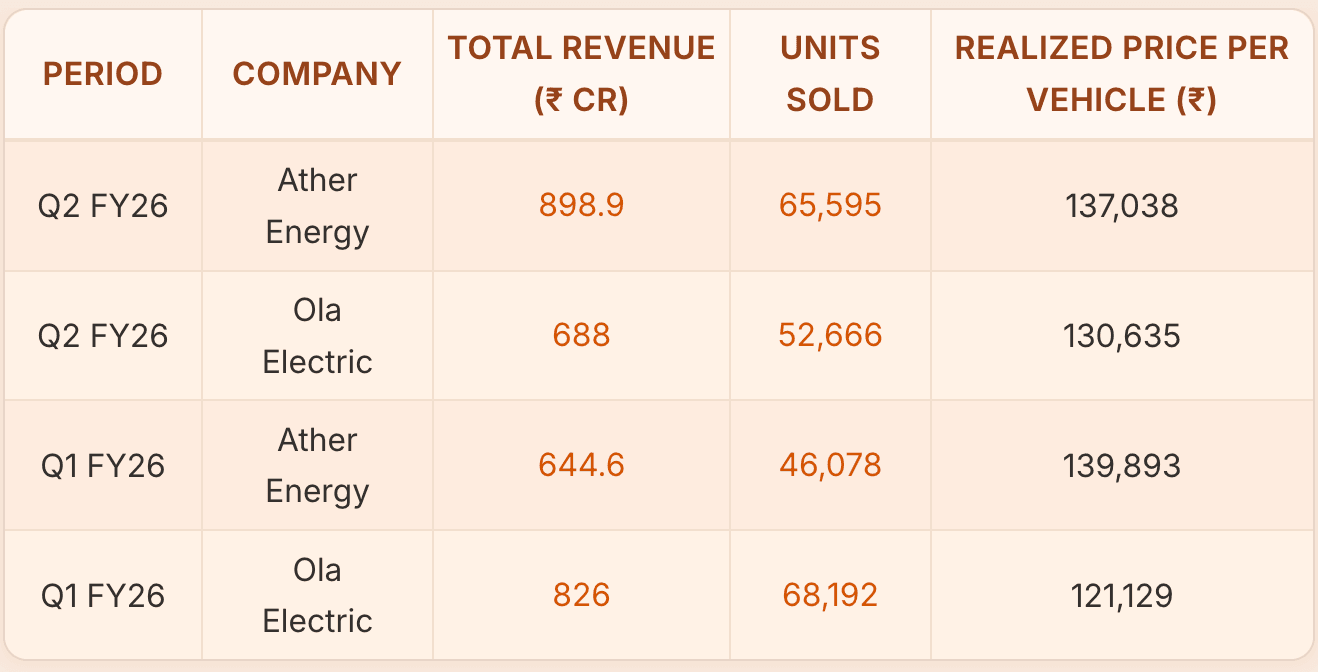
But this is still half the picture. Add the number of vehicles sold during the period, and the picture becomes more complete. Ather sold nearly 13,000 more vehicles than Ola Electric in Q2 and still earned nearly Rs 7,000 more per vehicle.
Changing leaderboard
Till about a year ago, Ola Electric was the market leader in electric two-wheelers. It was the company’s claim to fame. But then two things happened. Consumer complaints around service delays and parts availability rose sharply through FY25, even as TVS, Bajaj, and Ather expanded distribution and after-sales networks. Result? Ola Electric lost ground consistently over the last four quarters.
Thurro’s monthly registration data shows the speed of Ola’s unravelling: from 41,830 units in October 2024 to 16,036 units in October 2025. In nine of the eleven months since December 2024, Ola’s registration numbers have fallen more than 40% year-on-year. As a result, its market share has fallen from 30%+ in Q2 FY25 to 17-20% in Q2 FY26.
Ather’s fortune has moved in the exact opposite direction. After trailing its cross-city competitor for most of their lives, Ather overtook Ola Electric in terms of registrations for the first time in September, and in terms of revenue in Q2 FY26. It now has nearly one-fifth of the market, and, if the trend continues, it could result in a larger gap between the fortunes of the two Bengaluru-based companies, which have moved in opposite directions since their respective public listings.
In short, Ather is outpacing Ola on both price realization and volume growth. If you consider that the government’s production-linked incentive made up for some part of Ola Electric’s revenue, it brings down the company’s price realization even further.
This explains why , while Ather is pressing further on expansion, Ola Electric is scrambling to pivot to battery storage with Ola Shakti. When you’re losing ground in the core business, diversification starts looking like strategy.
Cover photo credit: X.com/ Ather Energy
View disclaimer
To explore the data-driven shift in the electric two-wheeler leaderboard, access this Thurro Answers Notebook, an interactive workspace detailing the pricing, registration trends, and AI-powered insights behind this analysis. You can also download the PDF below for a deeper look at the contrasting market strategies of Ather and Ola Electric.
Unlock the power of alternative data
Do not just follow the market — stay ahead of it. Thurro helps you transform raw filings and alternative datasets into actionable insights.
Explore Thurro AltData Book a demoRelated Articles

India’s consumption story is deepening
India’s consumption base is widening, formalising, and upgrading, strengthening balance sheets and shifting demand toward higher-value categories

US bankruptcy filings rise 13% in Sep-Dec 2025
Over the past 12 quarters, filings have recorded double-digit annual growth in all but one quarter

A tale of two markets
Cash equities are increasingly delivery-led, even as derivatives premium turnover surges, revealing a bifurcated market structure beneath speculation…