


A large share of India’s liquefied natural gas (LNG) imports originates in the Gulf and must transit the Strait of Hormuz, a route that has drawn renewed attention after the recent US–Iran war raised concerns about disruptions to energy shipping through the corridor.
Trade data from Thurro’s platform show that India imported USD 14.1 billion of LNG over the twelve months to August 2025, equivalent to 25.4 million tons of cargo. Qatar accounted for the largest share of supply, representing roughly 41% of India’s LNG imports, while the United Arab Emirates accounted for another 32.5%. Together, the two suppliers provided nearly three-quarters of India’s LNG imports, and cargoes from both countries must pass through the Strait of Hormuz.
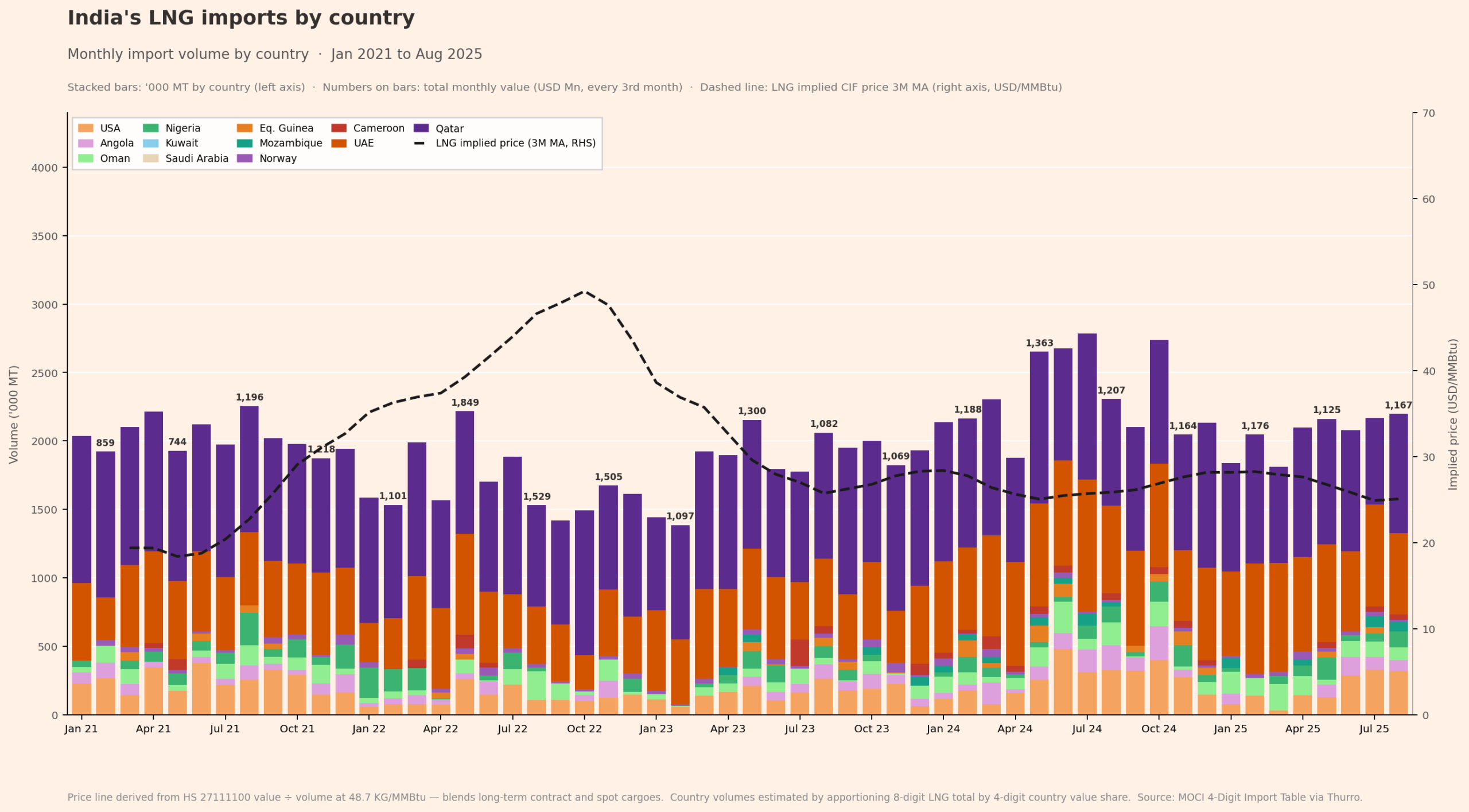
India’s LNG imports by country
Outside the Gulf, supply is more fragmented. The US accounted for roughly 9.9% of India’s LNG imports over the same period, while Oman supplied about 5.2% and countries such as Nigeria, Angola, and Mozambique contributed smaller shares. Oman’s Qalhat LNG terminal sits on the Arabian Sea side of the Arabian Peninsula and therefore largely avoids the Strait of Hormuz, but its share of India’s import mix remains modest compared with Gulf producers.
The concentration becomes clearer in physical terms. Qatar and the UAE together supplied an estimated USD 10.9 billion of India’s LNG imports during the twelve month period. A disruption to shipping through the Strait of Hormuz would, therefore, require India to replace roughly 1.7–1.8 million tons of LNG per month, with no immediate alternative route available for cargoes originating east of the chokepoint.
The Strait of Hormuz links the Persian Gulf to the Arabian Sea and handles a large share of global energy trade. While the corridor is most often discussed in the context of crude oil flows, the data show that it also sits at the centre of India’s LNG supply chain.
That exposure matters because LNG has become an increasingly important component of India’s gas system. Imported gas feeds fertiliser production, city gas distribution networks, power generation, and a range of industrial users. As domestic gas production has struggled to keep pace with demand, LNG imports have filled a growing share of the gap.
However, the supply structure is heavily concentrated in two Gulf suppliers whose export routes depend on a single maritime corridor that sits at the centre of recurring geopolitical tensions in the Gulf.
Cover photo credit: Petronet LNG Ltd
View disclaimer
This analysis draws on Thurro’s structured alternative datasets combined with machine-assisted querying tools. Integrating these data with AI-assisted analysis allows near real-time tracking of shifts in India’s crude supply chains.
Unlock the power of alternative data
Do not just follow the market — stay ahead of it. Thurro helps you transform raw filings and alternative datasets into actionable insights.
Explore Thurro AltData Book a demoRelated Articles
Nine years of net gold buying equals nine years of current account deficit — and it has doubled in value
India paid out $286bn for net gold between FY18 and FY26. Its cumulative current account deficit over the…
The UPI MDR pool is about ₹1,000 crore a month, and two-thirds of it sits where nobody can see it
Parliament has cleared the way for merchant charges on UPI. The merchant-category data says the revenue is real…
India’s commodity trade is running on price, not volume
India's trade value is still climbing — imports up about 18 percent and exports about 8 percent in…