


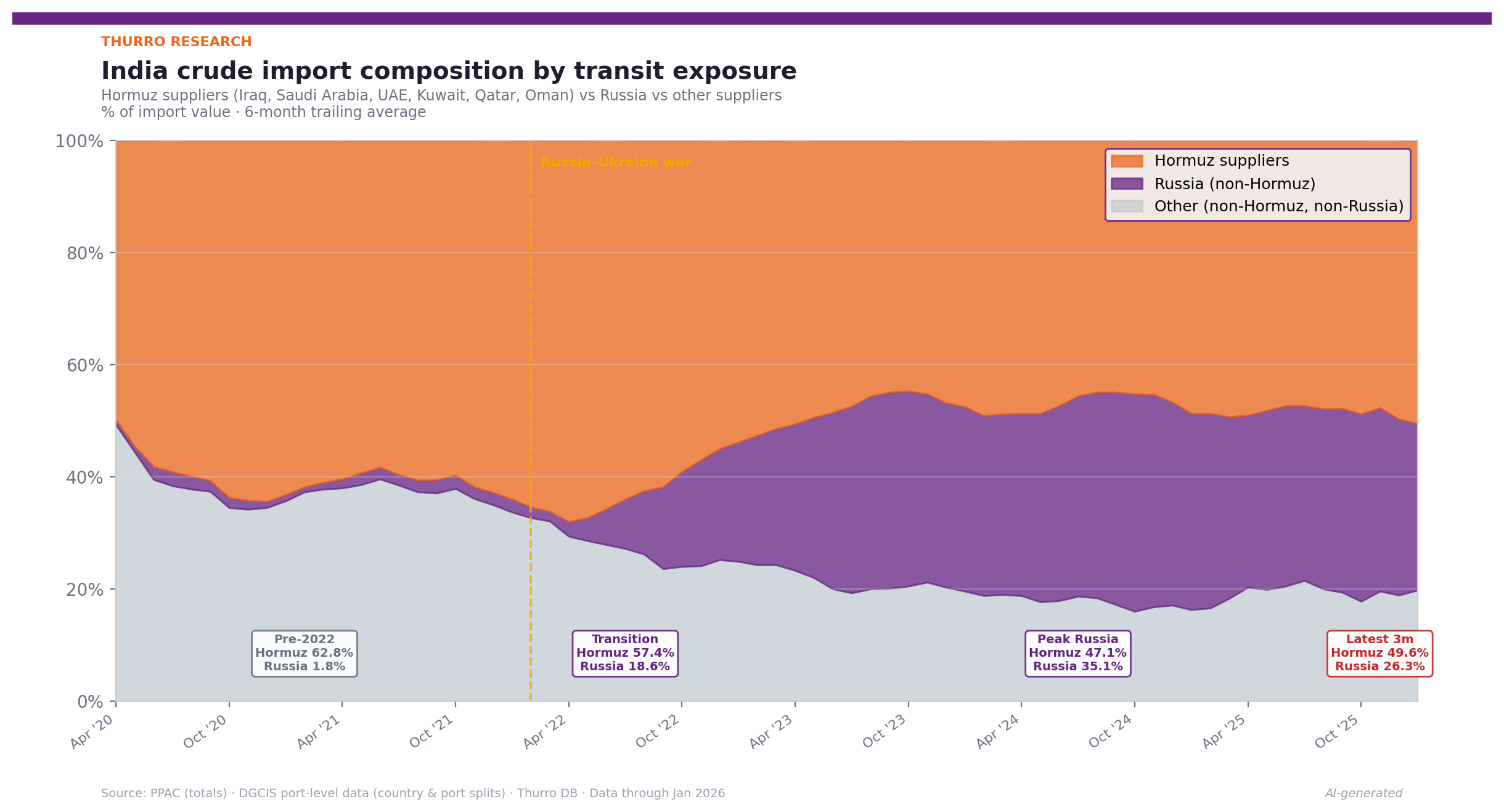
US–Iran tensions have lifted crude prices and revived concerns about supply disruptions in the Persian Gulf. For India, however, the oil shock arrives after a major shift in import geography. Trade data from Thurro’s platform show the share of India’s crude imports transiting the Strait of Hormuz has fallen from 62.8% before 2022 to 47.8% recently, largely due to the rapid rise of Russian imports.
Recent data suggest the shift may be partially reversing. Russian crude imports have softened in late-2025 as US sanctions enforcement tightened on vessels linked to the Russian shadow fleet. As a result, India’s Hormuz exposure has edged higher again, averaging around 50% in the most recent months and reaching 54.9% in January 2026.
Russia reshaped India’s crude supply chain
India’s crude sourcing has changed dramatically since 2022. Russian barrels, which accounted for 1.8% of imports before the Ukraine war, now represent 33.3% of India’s crude purchases.
The change is visible in the country’s exposure to the Strait of Hormuz. Before 2022, nearly two-thirds of India’s crude imports came from Gulf suppliers whose shipments transit the chokepoint. In recent data, that share has declined to 47.8%.
The shift has been driven primarily by west coast refining hubs, where complex export-oriented refineries have aggressively absorbed discounted Russian grades. As a result, India’s crude supply chain is less dependent on Gulf shipping routes than it was three years ago.
Diversification narrowed
The diversification is narrower than it appears. Data show that suppliers outside both Russia and the Gulf, including Nigeria, Angola, the US, Brazil, and Colombia, accounted for 35.4% of India’s imports before 2022. Their share has since fallen to 18.9%.
In other words, India reduced its exposure to Hormuz but did not replace it with a broader supplier base. Together, Russia (33%) and Gulf suppliers (48%) now account for more than four-fifths of India’s crude basket, leaving a smaller diversified tail than before 2022. The result is lower chokepoint risk but a higher concentration around a smaller set of suppliers.
Where the diversification happened
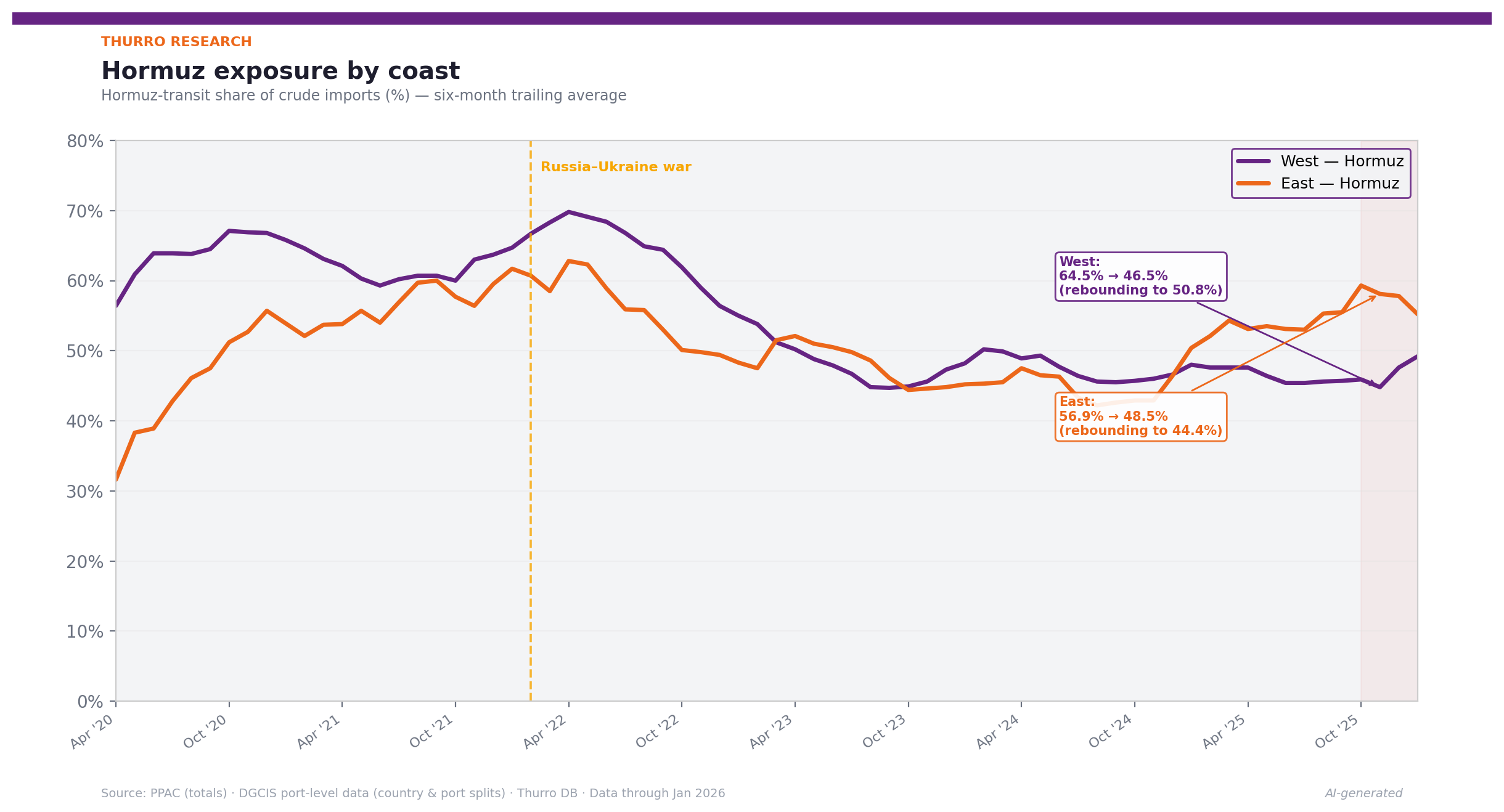
The reduction in Hormuz exposure has been uneven across India’s refining system.
Western ports experienced the largest shift. Hormuz-linked imports through western terminals fell from 64.5% before 2022 to 46.9% recently, while Russian crude rose from 2.3% to 36.4% of imports.
Eastern ports show a smaller change. Hormuz-linked imports declined from 56.9% to 48.5%, while Russian crude accounts for roughly 23% of supply.
The divergence reflects differences in refinery ownership and procurement strategies. Private west coast refiners have aggressively arbitraged Russian crude discounts, while public-sector refiners on the east coast continue to rely more heavily on long-term supply contracts with Gulf producers.
Equity market implications
These supply patterns create a clear sectoral split in Indian equities. Oil marketing companies such as Indian Oil Corporation, Bharat Petroleum, and Hindustan Petroleum remain exposed to rising crude prices because retail fuel prices often adjust with a lag.
Russian imports are also geographically concentrated: about 84% of Russian crude entering India flows through western ports, primarily serving the Gujarat refining corridor.
Second-order effects appear in sectors where crude-linked inputs are significant. Aviation—particularly InterGlobe Aviation—faces higher fuel costs, while petrochemical inputs affect paint manufacturers such as Asian Paints. Logistics companies including Delhivery may also see higher operating costs through diesel prices.
Refiners show a more nuanced pattern. Export-oriented complexes such as Reliance Industries and Nayara Energy have been among the largest buyers of Russian crude and therefore benefit from the shift in sourcing. By contrast, PSU refiners operating eastern ports remain more exposed to Middle East supply dynamics.
Macro implications
The Russia pivot reduces India’s physical supply vulnerability to a disruption in the Strait of Hormuz, but it does not shield the economy from higher global oil prices.
Crude oil is priced in an integrated global market. Even if India’s barrels originate outside the Gulf, a supply disruption in the region raises benchmark prices such as Brent and therefore increases India’s import costs. The Russian pivot therefore provides a hedge against physical supply disruption, not against price transmission.
There is, however, a partial offset. Russian Urals crude typically trades at a discount to Brent, and during previous periods of supply stress the Urals–Brent spread has widened as Russian barrels become relatively more attractive to buyers outside sanctioning jurisdictions. In such a scenario, Indian refiners purchasing Russian crude would face a smaller effective price increase than refiners dependent on benchmark-priced Middle East grades.
India’s import of Russian crude has also surfaced in trade negotiations between India and the US. Washington had imposed punitive tariffs on Indian exports while also raising concerns about New Delhi’s purchases of Russian crude, creating pressure to reduce those imports during broader trade discussions.
However, India has consistently maintained that energy sourcing decisions are guided by national interest and market conditions. The US Supreme Court’s February 2026 ruling striking down the tariff framework has since weakened that negotiating leverage, adding uncertainty to the future of such negotiations, even as India’s stance remains the same.
Speaking recently after tensions escalated in the Middle East, petroleum minister Hardeep Singh Puri said that in recent years India has ensured both availability and affordability of energy for its population by diversifying its sources. Indian energy companies now have access to supplies that are not routed through the Strait of Hormuz, which could help mitigate supply constraints.
The geopolitical sensitivity of Russian crude flows was underscored on 5 March when US Treasury Secretary Scott Bessent said Washington would issue a temporary 30-day waiver allowing Indian refiners to purchase Russian oil cargos currently stranded at sea. The move was framed as a short-term measure to keep oil flowing into global markets and alleviate pressure caused by the current situation in the Middle East.
For India, the cushion exists for now. How much of it survives, and for how long, will be determined by refinery economics as much as by diplomatic realities.
Cover photo credit: Unsplash
View disclaimer
This analysis draws on Thurro’s structured alternative datasets combined with machine-assisted querying tools. Integrating these data with AI-assisted analysis allows near real-time tracking of shifts in India’s crude supply chains.
Unlock the power of alternative data
Do not just follow the market — stay ahead of it. Thurro helps you transform raw filings and alternative datasets into actionable insights.
Explore Thurro AltData Book a demoRelated Articles
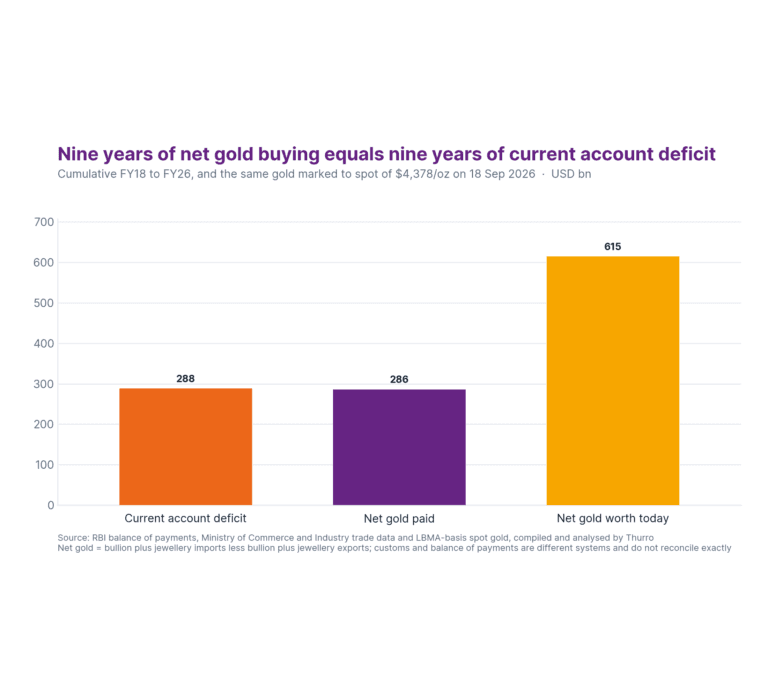
Nine years of net gold buying equals nine years of current account deficit — and it has doubled in value
India paid out $286bn for net gold between FY18 and FY26. Its cumulative current account deficit over the…
The UPI MDR pool is about ₹1,000 crore a month, and two-thirds of it sits where nobody can see it
Parliament has cleared the way for merchant charges on UPI. The merchant-category data says the revenue is real…
India’s commodity trade is running on price, not volume
India's trade value is still climbing — imports up about 18 percent and exports about 8 percent in…