

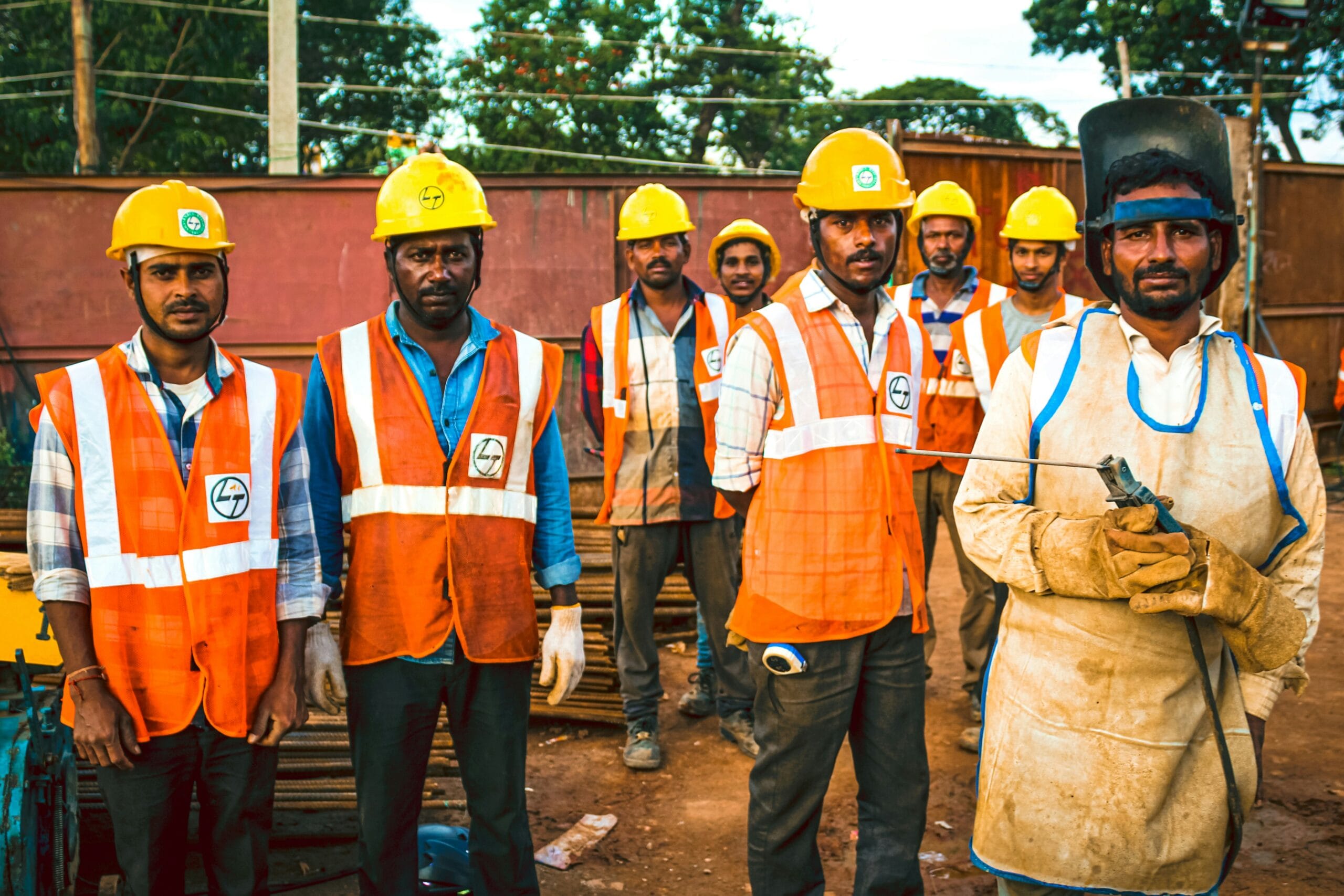

India’s demographic story is coded into a payroll spreadsheet.
Thurro’s platform shows that data from the Employees’ Provident Fund Organisation (EPFO) has quietly evolved into a live map of how Indians enter the formal economy.
EPFO data shows a net addition of 87.56 million subscribers over the last six years (April 2019 to July 2025). This includes new subscribers as well as those who exited and rejoined. New payroll additions alone stand at 65.98 million over the same period.
But that is only half the picture. The composition of these additions—by age, state, and industry—tells a far deeper story of an economy in the middle of a structural shift.
1. Youth dominate India’s formalisation pipeline
18–21 years: The first-job surge
This is the youngest stream entering EPFO—school graduates, ITI/diploma holders, and polytechnic graduates who once flowed into informal work but are now being captured early by staffing firms and organised services. This cohort:
- Is one of the most stable and high-volume cohorts in EPFO’s monthly additions.
- Posted a strong post-pandemic rebound, jumping to 269,000 in September 2020 after the April–May contraction.
- Has been growing consistently, typically adding 160,000–380,000 members every month from 2019–2025.
22–25 years: The single largest cohort
This is the biggest age group entering EPFO—college graduates, engineering graduates, and early-career jobseekers who form the backbone of India’s organised workforce. Their movement into EPFO signals job creation in services, rising staffing demand, and a steady pipeline of formal salaried roles rather than gig or informal work. This cohort:
- Has been the #1 age group in net additions since 2019.
- Reached a record peak of 503,000 in June 2025.
- Typically adds 200,000–500,000 members each month.
2. The mid-career shift is real and accelerating
26–28 years: Rising post-COVID-19
This is the “career consolidation” age: workers switching companies, roles, or sectors, and increasingly moving from informal or semi-formal employers into PF-compliant firms. The sharp rise in this cohort after the pandemic signals growing job mobility and a shift toward more organised employers. This cohort:
- Saw a dramatic jump after mid-2021, following the reopening of services and manufacturing.
- Routinely added around 200,000 members per month through 2022–2025.
- Reflects workers moving into PF-compliant organisations.
29–35 years: The biggest structural surprise
This cohort reveals the strongest shift in India’s labour market—not job creation for older workers, but the large-scale formalisation of mid-career labour. EPFO attributes this expansion to its outreach programmes and improved employer reporting, both of which are consistent with more workers being brought into the formal net. This cohort:
- Added only 70,000–130,000 members per month pre-COVID-19.
- Jumped to 180,000–380,000 per month post-pandemic.
- Hit unprecedented peaks of 440,000 (April 2025) and 467,000 (June 2025).
- Possibly reflects employers formalising long-time informal workers.
>35 years: The late but fast-growing formalisation wave
This is the oldest cohort in EPFO’s flows, and one that has grown far more rapidly than expected. Like the 29-35 year cohort, these are also people who have entered the EPFO fold as a result of its better expansion plans and improved compliance and documentation. The trend is unmistakable—older workers are formalising at scale for the first time. This cohort:
- Added only 50,000–170,000 members monthly before the pandemic.
- Regularly added 300,000+ members in most months between 2022 and 2025.
- Hit peaks above 449,000 in June 2025.
- Shows entries driven almost entirely by formalisation, not new hiring.
This is one of the most important demographic shifts in the data: India is not only formalising its youth, but also formalising its mid-career workforce at scale for the first time.
3. The pandemic created two distinct formalisation waves
EPFO’s age-wise data shows two separate labour-market shifts unfolding at different times, across different cohorts.
Wave 1: The youth return (August–December 2020)
- 18–21 and 22–25 cohorts spike after the April–May contraction (negative months).
- Driven by rehiring in retail, staffing, logistics, food delivery, BPOs, and entry-level services.
- Reflects the reopening of India’s “first-job” sectors, not structural change yet.
Wave 2: The mid-career swell (2021–2023)
- 26–28, 29–35, and >35 cohorts surge more strongly than youth.
- Linked to the restart of factories, construction, warehousing, transport, engineering units.
- Indicates compliance-led formalisation as employers regularise long-time informal workers.
4. Formal jobs cluster in a few economic hubs
Formal employment heavily concentrated in a handful of states with dense industrial and services ecosystems. Broadly, Western and Southern India drive most of the formal job absorption, with the NCR corridor adding another significant share. Over the last 12 months (August 2024-July 2025), new additions are split as follows:
Taken together, the top five labour markets account for nearly 60% of all new EPFO entries. These regions dominate because of their strong employer bases, deep supply chains, and higher compliance coverage—creating tight corridors of formal job absorption.
5. Sectoral patterns mirror the workforce entering EPFO
EPFO’s industry mix aligns closely with the age distribution seen across cohorts, showing how different sectors absorb different types of workers:
Expert Services (~50% of new additions): These include IT services, consulting, staffing agencies, and professional services. This is where graduates, diploma holders, and early-career workers begin formal employment.
Construction, engineering contractors, and infrastructure (~13%): These sectors employ a wide age range, but their formalisation patterns align strongly with the rise in mid-career and older cohorts.
Manufacturing clusters (12–14%): Textiles, engineering goods, electronics, and computer-related manufacturing pull in workers with prior informal or semi-formal experience.
What is driving the rise in EPFO numbers
A few broad forces are pushing more workers into EPFO’s net.
Employment mix is shifting: Self-employment has risen from 52.2% in 2017–18 to 58.4% in 2023–24, according to government data, while casual labour has fallen from 24.9% to 19.8%, pushing more workers through PF-compliant structures.
Compliance and payroll reporting have strengthened: EPFO’s outreach, streamlined onboarding, and tighter employer reporting have expanded coverage, bringing 77.3 million net additions into the system since tracking began in 2017.
Job mobility is rising sharply: Data shows a very high rejoiner activity—1.64 million workers rejoined in July 2025 alone. This reflects a labour market where young and mid-career workers move frequently across PF-compliant firms, inflating additions through churn, not just fresh hiring.
Staffing firms and service aggregators are absorbing youth at scale: The Expert Services category—which accounts for 50% of all new additions—includes IT services, BPOs, and staffing agencies that hire large volumes of first-time workers each year. This creates a constant conveyor belt of youth entering EPFO early.
With these drivers in mind, the shifts across age, geography, and industry begin to form a coherent picture.
What the pattern reveals
Taken together, these shifts show a labour market formalising rapidly but unevenly. Young workers enter the system early, mid-career workers are being formalised in large numbers, and most absorption is concentrated in a few states and sectors. The engines of formalisation are strong, but narrow; deep, but concentrated.
India is formalising faster than ever—but the contours of that formalisation are narrow. As the school-leaving cohort flattens and the demographic pipeline thins, the real test will be whether this engine can broaden beyond its current geographies and sectors. India’s labour market is clearly shifting. It will be interesting to see how it scales.
This narrative is based on a deeper dataset pulled from EPFO’s monthly payroll records. The full Notebook, with year-wise, age-wise, state-wise and industry-wise breakdowns, is available on Thurro Answers. Click here.
Cover photo credit: Unsplash
View disclaimer
Unlock the power of alternative data
Do not just follow the market — stay ahead of it. Thurro helps you transform raw filings and alternative datasets into actionable insights.
Explore Thurro AltData Book a demoRelated Articles
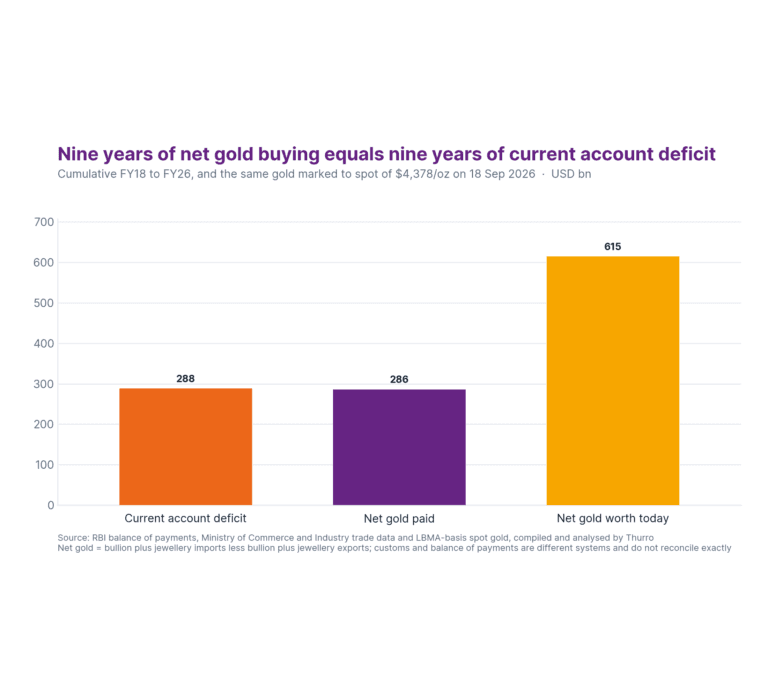
Nine years of net gold buying equals nine years of current account deficit — and it has doubled in value
India paid out $286bn for net gold between FY18 and FY26. Its cumulative current account deficit over the…
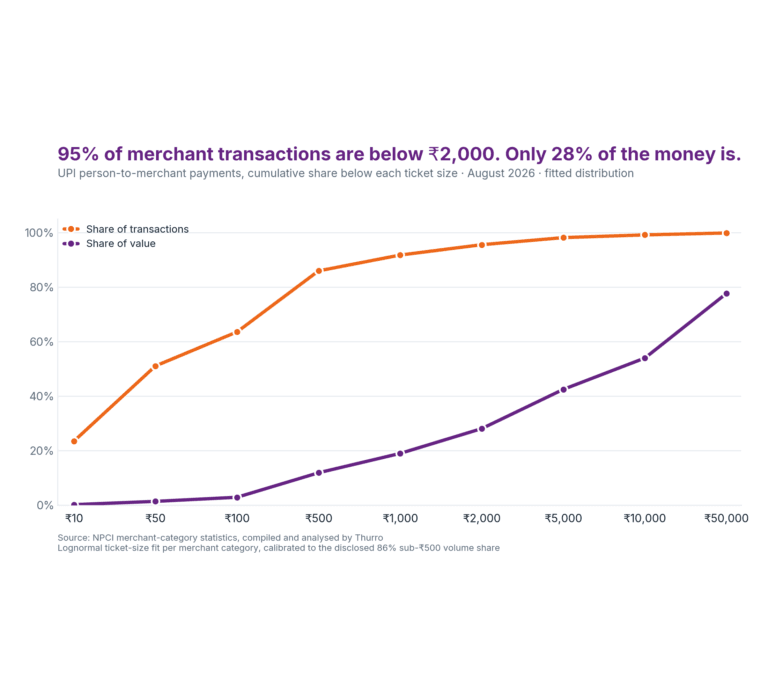
The UPI MDR pool is about ₹1,000 crore a month, and two-thirds of it sits where nobody can see it
Parliament has cleared the way for merchant charges on UPI. The merchant-category data says the revenue is real…
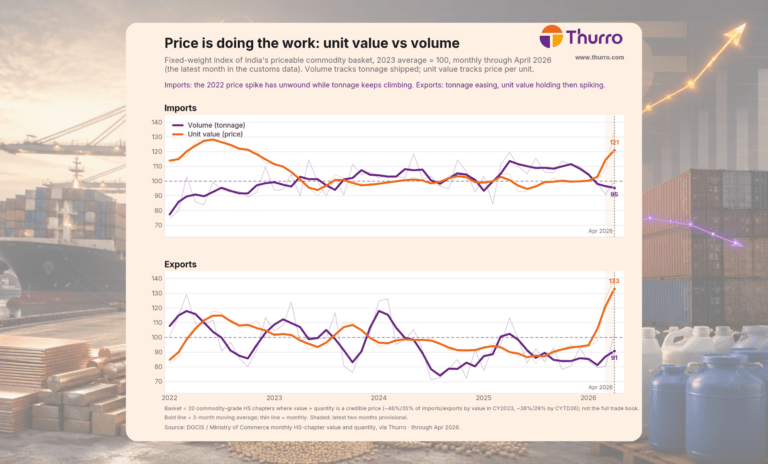
India’s commodity trade is running on price, not volume
India's trade value is still climbing — imports up about 18 percent and exports about 8 percent in…