

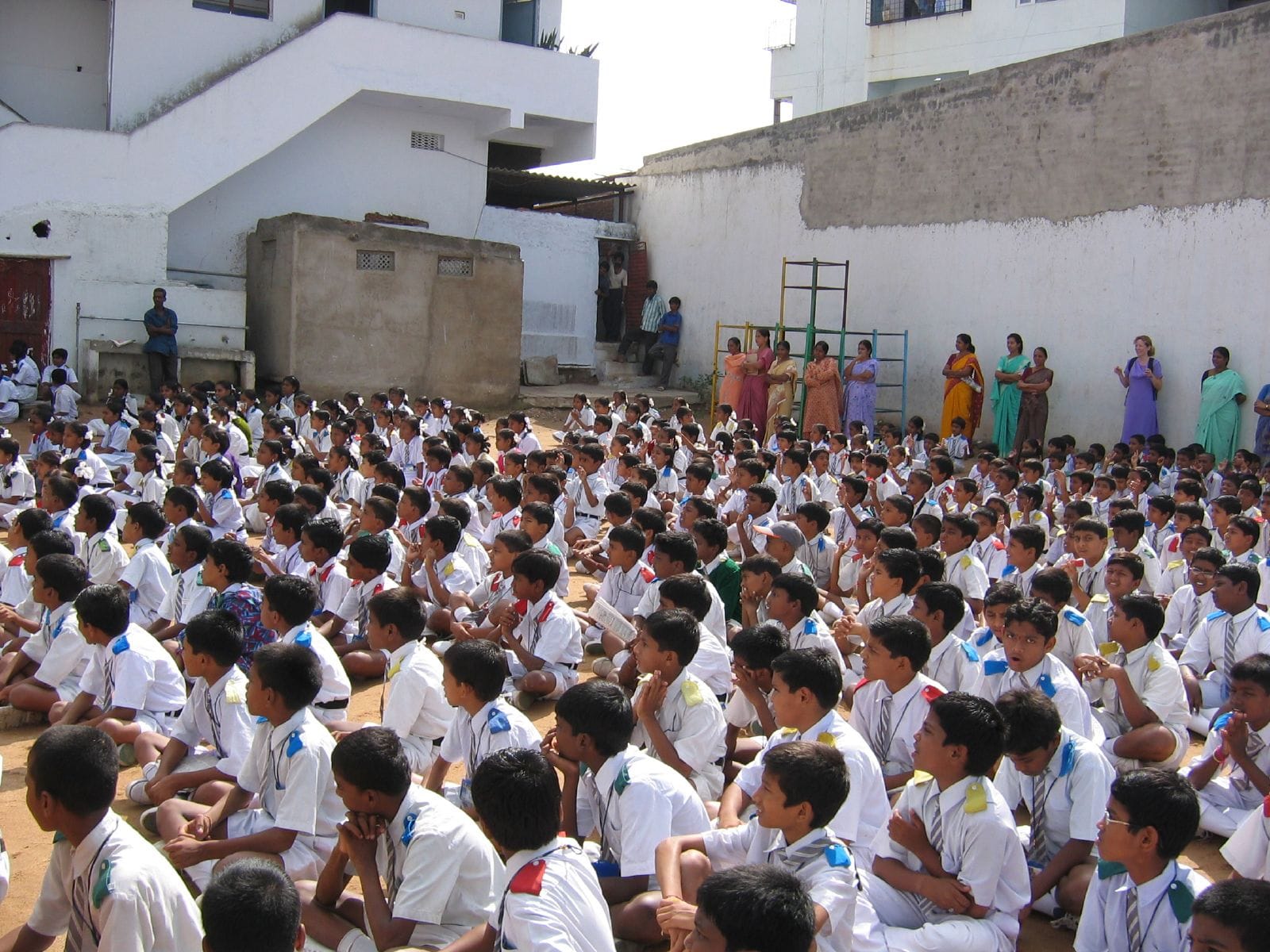

India is staring at a demographic turning point—and the first signs are appearing inside its classrooms.
For a decade, the country has repeated a single line with confidence: our demographic dividend will power the economy for years. But the latest school enrolment numbers suggest that narrative is beginning to change.
Data from Thurro’s platform shows that total enrolment (grades 1 to 12) fell 5.02% in Academic Year 2022-23, followed by declines of 1.49% and 0.45% in 2023-24 and 2024-25—a cumulative loss of 18 million students in just 36 months. Total enrolment stood at 246,932,680 in 2024-25, marking the second consecutive year below the 250-million threshold.
A further breakdown of the data by enrolment in primary, middle, and high school shows a deeper structural shift. The base of India’s schooling pyramid is thinning, while middle and high school enrolments are flattening.
The shrinking base
Primary school enrolment (grades 1–5) has been sliding every year since 2013. From 134.8 million in 2012-13 to 104.4 million in 2024-25, primary enrolment has lost nearly 30 million students. This is the steepest multi-year correction in the entire UDISE dataset.
A continuous, decade-long 2% annual contraction at the foundational level is the clearest sign of a systemic demographic shift: the number of children entering the schooling system is shrinking fast.
The flattening middle
Middle school enrolment (grades 6–8) tells a quieter but equally revealing story. From 64.9 million in 2013 to 63.7 million in 2024–25, the numbers have barely moved.
But this plateau reflects a structural lag: the smaller primary cohorts of the last decade are now flowing upward.
This also means that a larger share of children who enter primary school are now progressing to middle school. Middle-school enrolment has risen from about 48% of the primary cohort in 2013 to over 61% in 2024–25, reflecting stronger retention even as the overall system contracts.
The last bulge at the top
High school enrolment (grades 9–12) shows the opposite trend — a slow but clear rise over the last decade.
From 54.6 million in 2013 to 67.0 million at its peak in 2022, high school enrolment grew by more than 11 million in 10 years. It has softened since but still stands at 64.8 million in 2024–25, significantly higher than a decade ago.
But the slight softening after 2022 is telling. As the smaller primary and middle-school cohorts begin reaching high school in the coming years, this curve may inevitably flatten too.
The segment-wise trends reveal a structural shift: India’s school-age population has already peaked, and the system is now adjusting to smaller incoming cohorts each year. Which brings us to the next question:
Why are enrolments falling?
Thurro Analysis shows that the decline is not the result of children dropping out. In fact, retention is the strongest it has ever been, dropout rates have collapsed, gender parity has been achieved, and teacher availability has improved. The contraction is happening at the source: fewer children are entering school to begin with.
The declining fertility rate has reached the school gate. India’s total fertility rate has fallen steadily for two decades, from about 3.3 in 2000 to below 2 today. States like Kerala, Tamil Nadu, Karnataka, and Andhra Pradesh slipped below replacement fertility years ago, and the rest of the country is rapidly converging. Replacement level is 2.1 births per woman; anything lower means each generation is smaller than the one before it. That demographic shift is now showing up in the data: the fall in primary enrolment mirrors the fertility decline almost exactly, with a predictable 5–6 year lag as births convert into Class 1 admissions.
The other signals all point to the same root cause: shrinking cohorts.
Improved retention means students are not leaking out: Dropout rates have fallen sharply across all levels. This means the decline in enrolment is not happening inside the system, but before children enter it.
Gender parity has been achieved across the system: Historically, gender exclusion capped enrolment levels, especially in secondary school. That friction is gone.
Data from Thurro’s platform shows that girls’ share in high-school enrolment has risen from 46.89% in 2012–13 to 49.25% in 2024–25, while boys’ share has declined from 53.11% to 50.75%. With boys and girls entering at equal rates, the fall cannot be blamed on social access gaps. If participation is rising but totals are shrinking, the cohorts themselves must be smaller.
Migration and urbanisation are reshaping enrolments: Massive interstate migration is changing state-level numbers. Enrolment in Bihar, for example, fell from 27.47 million to 21.35 million within two years; Assam shows similar drops. Migration does not reduce the national child population, but it redistributes children across states , making some states look like they are declining faster. It reveals—and intensifies—the demographic contraction.
Post-pandemic disruptions still ripple through admissions: COVID-19 weakened the link between age and school admission:
— School enrolment was delayed by 1–2 years for millions of children
— Many older children re-entered irregularly
— A number of students shifted to informal or hyperlocal learning
These are temporary ripples, but they sit on top of the demographic decline and make the fall in early-grade enrolment sharper than fertility alone would suggest.
Improved data accuracy has also played a small role. Stricter verification and the removal of duplicate or unverifiable enrolments, especially in states that historically carried inflated records, may have made the recent decline appear sharper. This doesn’t drive the long-term fall, but it does make the underlying demographic contraction more visible.
The bottom line
The thinning base of the schooling pyramid is the first clear visual of India’s demographic turn. Smaller birth cohorts today mean a tighter labour force tomorrow, with growth eventually shifting from population-led to productivity-led. The high-school bulge is the last large cohort; everything below it is shrinking, signalling that India’s demographic dividend is entering its final years.
View disclaimer
This narrative is based on a sharp enrolment drop spotted on Thurro AltData and analysed using years of UDISE data. The full Notebook, containing the raw output and root cause analysis, is available on Thurro Answers. Click here or download the PDF version below to read offline.
Unlock the power of alternative data
Do not just follow the market — stay ahead of it. Thurro helps you transform raw filings and alternative datasets into actionable insights.
Explore Thurro AltData Book a demoRelated Articles
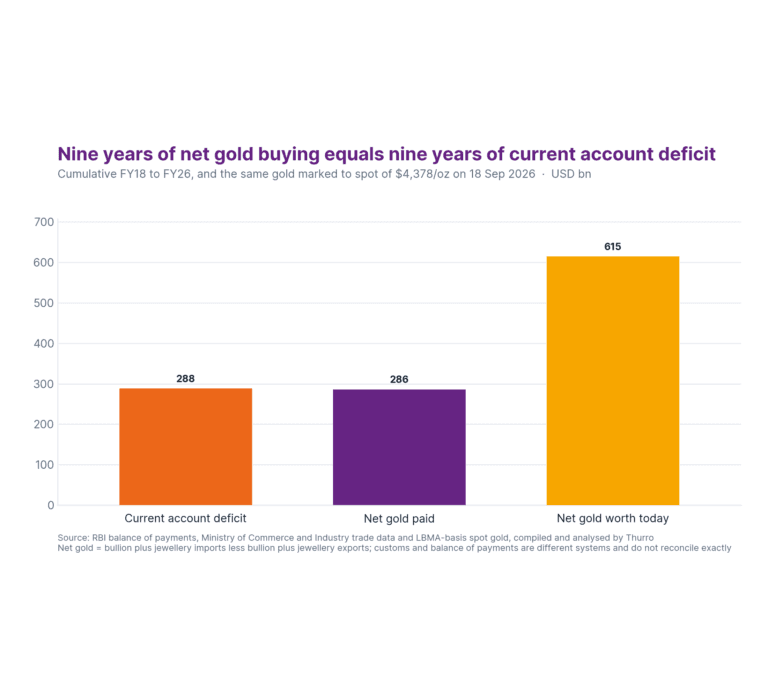
Nine years of net gold buying equals nine years of current account deficit — and it has doubled in value
India paid out $286bn for net gold between FY18 and FY26. Its cumulative current account deficit over the…
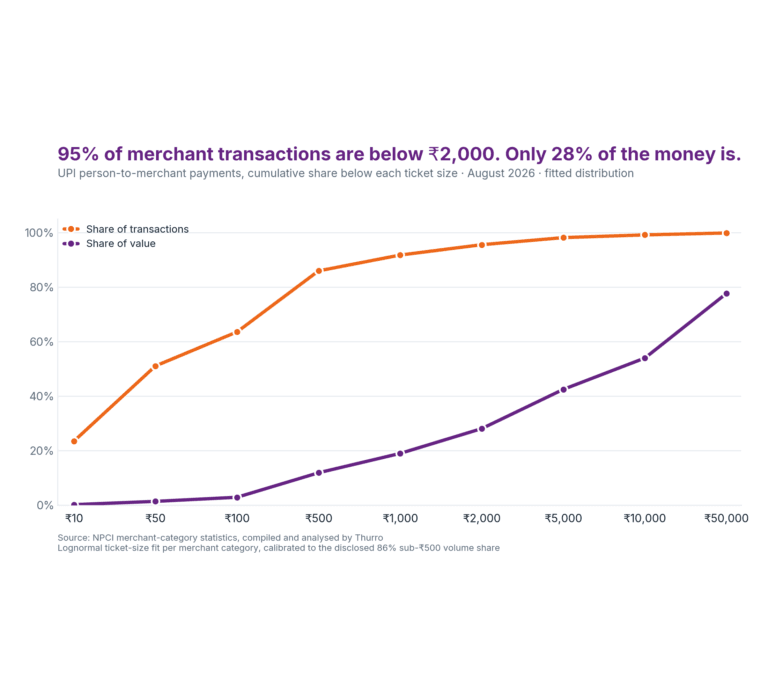
The UPI MDR pool is about ₹1,000 crore a month, and two-thirds of it sits where nobody can see it
Parliament has cleared the way for merchant charges on UPI. The merchant-category data says the revenue is real…
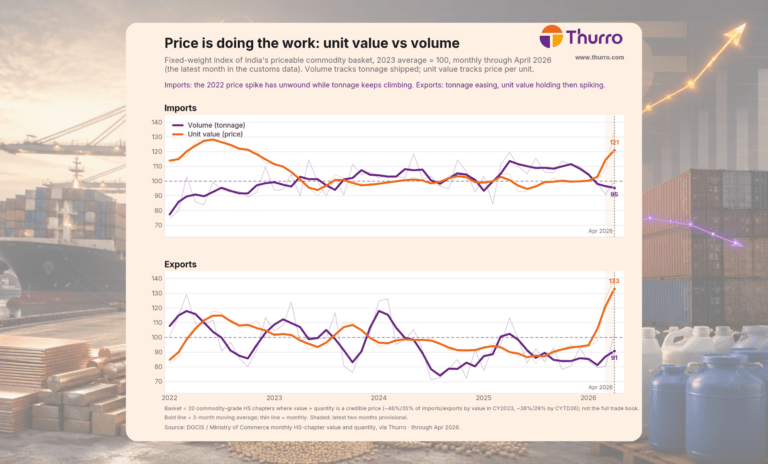
India’s commodity trade is running on price, not volume
India's trade value is still climbing — imports up about 18 percent and exports about 8 percent in…